Pearson Edexcel · GCSE · History
Course version: 1HI0 · Version from Sept 2016
Key topic 4: Life in Nazi Germany, 1933–39 - 3 Employment and living…
Full specification wording
Option 31: Key topic 4: Life in Nazi Germany, 1933–39 - 3 Employment and living standards: Changes in the standard of living, especially of German workers. The Labour Front, Strength Through Joy, Beauty of Labour.
The Nazi regime significantly altered the standard of living for German workers, balancing job security with the loss of freedoms.
Checked against the Pearson Edexcel 1HI0 specification (opens in a new tab) on .
- Point 2 of 2
- 3 key terms
Study notes
From the checked teaching notes for this specification point.
The idea
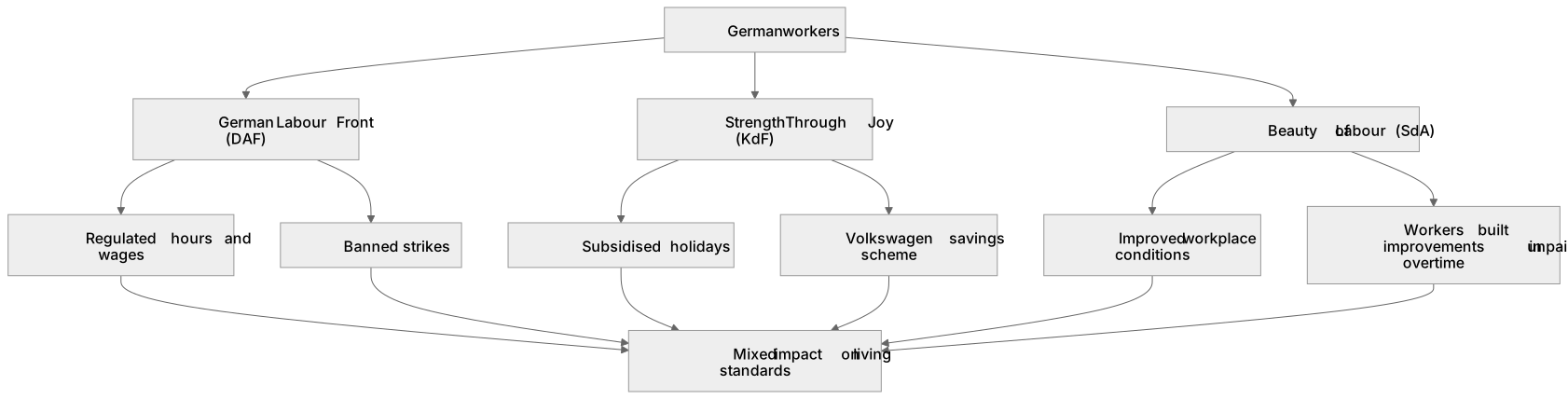
The Nazi regime significantly altered the standard of living for German workers, balancing job security with the loss of freedoms. Trade unions were replaced by the German Labour Front (DAF), which regulated hours and wages but banned strikes. To maintain morale and control leisure, the Strength Through Joy (KdF) movement offered subsidised holidays and the Volkswagen savings scheme. The Beauty of Labour (SdA) campaigned to improve workplace conditions, such as installing canteens, though workers often built these themselves during unpaid overtime. While employment rose, real wages stagnated and working hours increased, leading to a mixed impact on living standards.
What earns the marks
- Assess the role of the German Labour Front (DAF) in controlling workers and replacing independent trade unions.
- Explain how Strength Through Joy (KdF) aimed to improve worker morale and control leisure time through state-sponsored activities.
- Describe the initiatives of the Beauty of Labour (SdA) to improve working environments and the hidden costs to workers.
- Evaluate the overall changes in the standard of living, contrasting increased employment with longer hours and stagnant real wages.
Common mistakes and how to put them right
Stating that the standard of living improved for all workers under the Nazis.
Put it right: Note that while unemployment fell, workers lost their rights, worked longer hours, and the cost of living often outstripped wage increases.
Assuming the Volkswagen scheme successfully delivered cars to workers.
Put it right: Clarify that no worker received a Volkswagen before the war began, as production shifted to military vehicles.
Confusing the DAF with a traditional trade union.
Put it right: Explain that the DAF was a state-controlled organisation designed to ensure industrial peace and control the workforce, not to advocate for workers' rights.
Exam tips
- Use the KdF and SdA as specific examples of how the Nazi state attempted to win the loyalty of the working class.
- When discussing living standards, distinguish between the psychological benefits of employment and the material reality of wages and working hours.
- Be prepared to argue both sides of the debate regarding whether German workers were better or worse off under Nazi rule.
Try the lesson
The start of the Option 31: Key topic 4: Life in Nazi Germany, 1933–39 - 3 Employment and living standards: Changes in the standard of living, especially of German workers. The Labour Front, Strength Through Joy, Beauty of Labour. lesson, made from checked teaching notes for this specification point.
Have a go first
What was the main purpose of the Nazi 'Strength Through Joy' (KdF) organisation?
Listen
The Nazi regime significantly altered the standard of living for German workers, balancing job security with the loss of freedoms. Trade unions were replaced by the German Labour Front (DAF), which regulated hours and wages but banned strikes. To maintain morale and control leisure, the Strength Through Joy (KdF) movement offered subsidised holidays and the Volkswagen savings scheme. The Beauty of Labour (SdA) campaigned to improve workplace conditions, such as installing canteens, though workers often built these themselves during unpaid overtime. While employment rose, real wages stagnated and working hours increased, leading to a mixed impact on living standards. A strong answer earns marks for these points. Assess the role of the German Labour Front (DAF) in controlling workers and replacing independent trade unions. Explain how Strength Through Joy (KdF) aimed to improve worker morale and control leisure time through state-sponsored activities. Describe the initiatives of the Beauty of Labour (SdA) to improve working environments and the hidden costs to workers. Evaluate the overall changes in the standard of living, contrasting increased employment with longer hours and stagnant real wages. A common slip: Stating that the standard of living improved for all workers under the Nazis. Instead, Note that while unemployment fell, workers lost their rights, worked longer hours, and the cost of living often outstripped wage increases. Exam tip: Use the KdF and SdA as specific examples of how the Nazi state attempted to win the loyalty of the working class.
See it
Key words
Say what each word means before you turn the card.
German Labour Front (DAF)
Try answering aloud or in your head before turning the card.
Strength Through Joy (KdF)
Try answering aloud or in your head before turning the card.
Beauty of Labour (SdA)
Try answering aloud or in your head before turning the card.
See every definition
- German Labour Front (DAF)
- A state-controlled organisation that replaced independent trade unions, regulated hours and wages, and banned strikes to ensure industrial peace.
- Strength Through Joy (KdF)
- A movement that offered subsidised holidays and the Volkswagen savings scheme to maintain morale and control leisure.
- Beauty of Labour (SdA)
- A campaign to improve workplace conditions, such as installing canteens, though workers often built these themselves during unpaid overtime.
Label the diagram
Some boxes have lost their names. Pick the right name for each number.
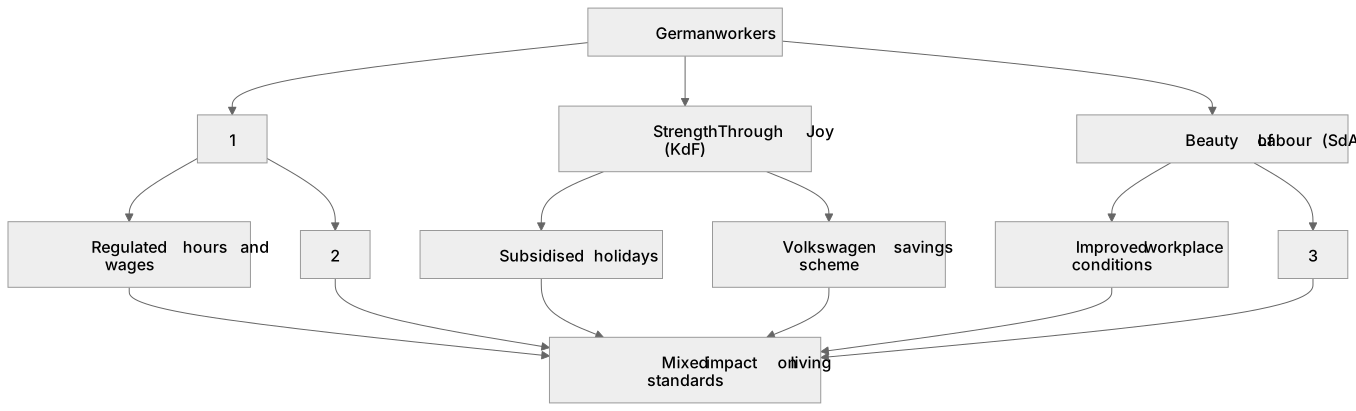
1Box 1
2Box 2
3Box 3
There is more to this lesson
The full lesson goes on to check your understanding and help you earn the marks. Create a free account to carry on, with your progress saved.
A week of Premium from your first lesson · Then the free plan continues · No card, no charge
Test your understanding of Option 31: Key topic 4: Life in Nazi Germany, 1933–39 - 3 Employment and living standards: Changes in the standard of living, especially of German workers. The Labour Front, Strength Through Joy, Beauty of Labour.
Active recall beats re-reading. Take an instant quiz now to test what you’ve learned and lock it into long-term memory.
A week of Premium from your first lesson · Then the free plan continues · No card, no charge