Pearson Edexcel · GCSE · History
Course version: 1HI0 · Version from Sept 2016
Key topic 4: Life in Nazi Germany, 1933–39 - 4 The persecution of…
Full specification wording
Option 31: Key topic 4: Life in Nazi Germany, 1933–39 - 4 The persecution of minorities: The persecution of Jewish people, including the boycott of Jewish shops and businesses (1933), the Nuremberg Laws and 'Kristallnacht'.
The persecution of Jewish people in Nazi Germany escalated rapidly between 1933 and 1939.
Checked against the Pearson Edexcel 1HI0 specification (opens in a new tab) on .
- Point 2 of 2
- 4 key terms
Study notes
From the checked teaching notes for this specification point.
The idea
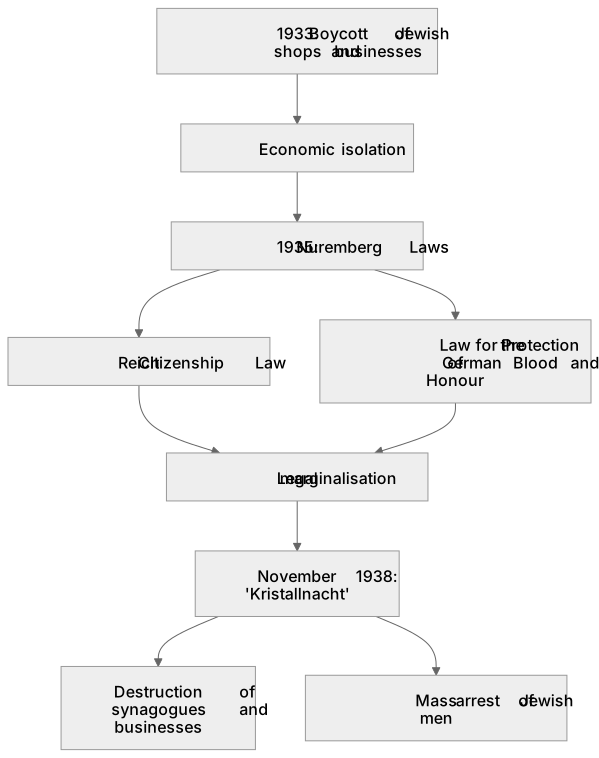
The persecution of Jewish people in Nazi Germany escalated rapidly between 1933 and 1939. It began with economic isolation, notably the SA-led boycott of Jewish shops and businesses in April 1933, aiming to segregate Jewish people from the economy. In 1935, the Nuremberg Laws institutionalised anti-Semitism; the Reich Citizenship Law stripped Jewish people of citizenship, while the Law for the Protection of German Blood and Honour banned intermarriage. The persecution turned violently physical during 'Kristallnacht' in November 1938, a state-sponsored pogrom resulting in the destruction of synagogues, businesses, and the mass arrest of Jewish men.
What earns the marks
- Describe the events and aims of the 1933 boycott of Jewish shops and businesses.
- Explain the significance of the Nuremberg Laws (1935) in legally defining and marginalising Jewish people.
- Detail the events of 'Kristallnacht' (1938), including the destruction of property and the escalation of physical violence.
- Analyse the progression of anti-Semitic policies from economic boycotts to legal disenfranchisement and state-sponsored violence.
Common mistakes and how to put them right
Treating the persecution of Jewish people as a single, sudden event.
Put it right: Emphasise the gradual escalation of persecution, starting with economic boycotts, moving to legal restrictions, and culminating in physical violence.
Stating that the Nuremberg Laws only banned intermarriage.
Put it right: Ensure you also mention the Reich Citizenship Law, which removed the political and civil rights of Jewish people.
Describing 'Kristallnacht' as a spontaneous uprising by the German public.
Put it right: Clarify that the violence was orchestrated by the Nazi leadership, specifically the SA and SS, using the assassination of Ernst vom Rath as a pretext.
Exam tips
- Use a chronological approach to demonstrate how the severity of anti-Semitic policies increased over time.
- Be precise with dates and the specific names of legislation, such as the two distinct parts of the Nuremberg Laws.
- When discussing 'Kristallnacht', highlight its significance as a turning point towards overt, state-directed violence against Jewish people.
Try the lesson
The start of the Option 31: Key topic 4: Life in Nazi Germany, 1933–39 - 4 The persecution of minorities: The persecution of Jewish people, including the boycott of Jewish shops and businesses (1933), the Nuremberg Laws and 'Kristallnacht'. lesson, made from checked teaching notes for this specification point.
Have a go first
What action did the Nazi government take against Jewish people in April 1933?
Listen
The persecution of Jewish people in Nazi Germany escalated rapidly between 1933 and 1939. It began with economic isolation, notably the SA-led boycott of Jewish shops and businesses in April 1933, aiming to segregate Jewish people from the economy. In 1935, the Nuremberg Laws institutionalised anti-Semitism; the Reich Citizenship Law stripped Jewish people of citizenship, while the Law for the Protection of German Blood and Honour banned intermarriage. The persecution turned violently physical during 'Kristallnacht' in November 1938, a state-sponsored pogrom resulting in the destruction of synagogues, businesses, and the mass arrest of Jewish men. A strong answer earns marks for these points. Describe the events and aims of the 1933 boycott of Jewish shops and businesses. Explain the significance of the Nuremberg Laws (1935) in legally defining and marginalising Jewish people. Detail the events of 'Kristallnacht' (1938), including the destruction of property and the escalation of physical violence. Analyse the progression of anti-Semitic policies from economic boycotts to legal disenfranchisement and state-sponsored violence. A common slip: Treating the persecution of Jewish people as a single, sudden event. Instead, Emphasise the gradual escalation of persecution, starting with economic boycotts, moving to legal restrictions, and culminating in physical violence. Exam tip: Use a chronological approach to demonstrate how the severity of anti-Semitic policies increased over time.
See it
Watch it explained
What is the one idea the video explains? Say it in a sentence.
Read the described scene instead
Between 1933 and 1939, the persecution of Jewish people in Nazi Germany escalated rapidly. It was not one sudden event. It began with economic isolation, moved to legal discrimination, and then to state-sponsored violence. In April 1933, the SA led a boycott of Jewish shops and businesses. The aim was economic isolation: to segregate Jewish people from German economic life. This was an early, organised act of persecution. It was not yet the legal discrimination of the Nuremberg Laws. In 1935, the Nuremberg Laws institutionalised anti-Semitism. The Reich Citizenship Law stripped Jewish people of citizenship. The Law for the Protection of German Blood and Honour banned intermarriage. Together, these laws legally defined and marginalised Jewish people. Persecution turned violently physical during Kristallnacht in November 1938. This was a state-sponsored pogrom, orchestrated by the Nazi leadership and carried out by the SA and SS. The assassination of Ernst vom Rath was used as a pretext. Synagogues and businesses were destroyed, and Jewish men were mass-arrested. A common mistake is to treat this persecution as a single, sudden event. Instead, trace the escalation: the 1933 boycott, the 1935 Nuremberg Laws, and Kristallnacht in 1938. Another mistake is to say the Nuremberg Laws only banned intermarriage. They also included the Reich Citizenship Law. And Kristallnacht was not a spontaneous public uprising; it was orchestrated by the Nazi leadership. So the persecution of Jewish people escalated between 1933 and 1939. It began with the 1933 boycott and economic isolation, moved to the 1935 Nuremberg Laws and legal discrimination, and became overt state-sponsored violence in Kristallnacht in 1938. This chronology shows increasing severity.
Key words
Say what each word means before you turn the card.
Anti-Semitism
Try answering aloud or in your head before turning the card.
Escalation of persecution
Try answering aloud or in your head before turning the card.
State-sponsored violence
Try answering aloud or in your head before turning the card.
Legal discrimination
Try answering aloud or in your head before turning the card.
See every definition
- Anti-Semitism
- Hostility towards Jewish people, which the Nuremberg Laws institutionalised in 1935.
- Escalation of persecution
- The gradual increase in severity of persecution, starting with economic boycotts, moving to legal restrictions, and culminating in physical violence.
- State-sponsored violence
- Violence orchestrated by the Nazi leadership, as during 'Kristallnacht', a state-sponsored pogrom.
- Legal discrimination
- The marginalising of Jewish people through legislation such as the Nuremberg Laws, which stripped them of citizenship and banned intermarriage.
Label the diagram
Some boxes have lost their names. Pick the right name for each number.
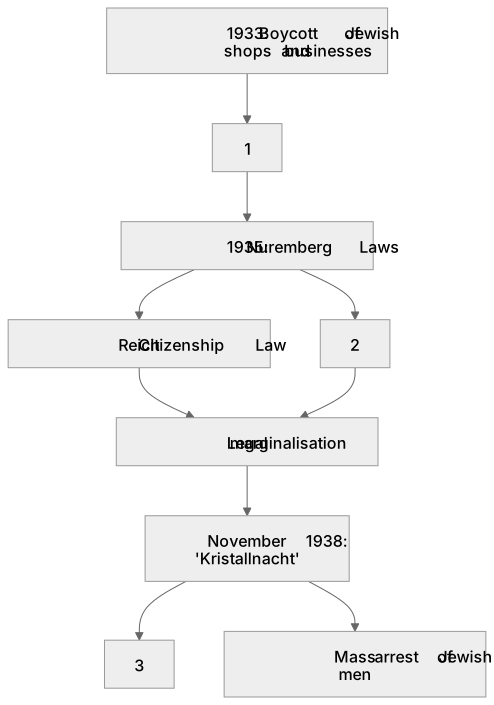
1Box 1
2Box 2
3Box 3
There is more to this lesson
The full lesson goes on to check your understanding and help you earn the marks. Create a free account to carry on, with your progress saved.
A week of Premium from your first lesson · Then the free plan continues · No card, no charge
Test your understanding of Option 31: Key topic 4: Life in Nazi Germany, 1933–39 - 4 The persecution of minorities: The persecution of Jewish people, including the boycott of Jewish shops and businesses (1933), the Nuremberg Laws and 'Kristallnacht'.
Active recall beats re-reading. Take an instant quiz now to test what you’ve learned and lock it into long-term memory.
A week of Premium from your first lesson · Then the free plan continues · No card, no charge