Pearson Edexcel · GCSE · History
Course version: 1HI0 · Version from Sept 2016
Key topic 1: Establishing communist rule, 1945–59 - 2 Communist rule: The…
Full specification wording
Option 32: Key topic 1: Establishing communist rule, 1945–59 - 2 Communist rule: The ideology and role of Mao. Reasons for Mao’s dominant position.
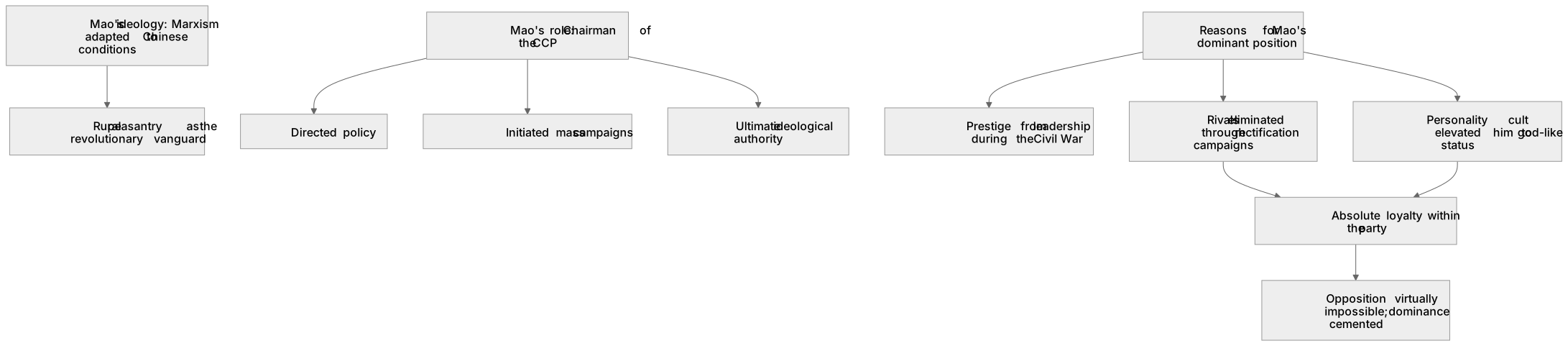
Mao’s ideology adapted Marxism to Chinese conditions by identifying the rural peasantry, rather than the urban proletariat, as the revolutionary vanguard.
Checked against the Pearson Edexcel 1HI0 specification (opens in a new tab) on .
- Point 1 of 2
- 3 key terms
Study notes
From the checked teaching notes for this specification point.
The idea
Mao’s ideology adapted Marxism to Chinese conditions by identifying the rural peasantry, rather than the urban proletariat, as the revolutionary vanguard. His role was central; as Chairman of the CCP, he directed policy, initiated mass campaigns, and served as the ultimate ideological authority. Mao’s dominant position was secured through several key factors. His successful leadership during the Civil War granted him immense prestige. He ruthlessly eliminated rivals through rectification campaigns, ensuring absolute loyalty within the party. Furthermore, the cultivation of a pervasive personality cult elevated him to a god-like status, making any opposition to his rule virtually impossible and cementing his absolute dominance over the nation.
What earns the marks
- Define Mao Zedong Thought, specifically the adaptation of Marxism to focus on the peasantry.
- Describe Mao's roles as Chairman of the Party and Head of State in directing national policy.
- Explain how Mao's historical successes established his unassailable prestige.
- Analyse the use of rectification campaigns and the personality cult to eliminate rivals and enforce dominance.
Common mistakes and how to put them right
Confusing Maoism with orthodox Soviet Marxism.
Put it right: Emphasise that Mao adapted Marxism to rely on the rural peasantry rather than the urban working class.
Stating Mao ruled entirely alone.
Put it right: Acknowledge that while dominant, Mao operated through the CCP structure and initially worked with other senior leaders.
Ignoring the role of terror.
Put it right: Include the use of purges and rectification campaigns as key methods for maintaining his dominant position.
Exam tips
- Clearly distinguish between Mao's 'ideology' (his ideas) and his 'role' (his practical actions in government).
- Use the concept of the 'personality cult' to explain why Mao faced so little opposition from within the party.
- Connect Mao's historical legacy from the Civil War to his political power in the 1950s.
Try the lesson
The start of the Option 32: Key topic 1: Establishing communist rule, 1945–59 - 2 Communist rule: The ideology and role of Mao. Reasons for Mao’s dominant position. lesson, made from checked teaching notes for this specification point.
Have a go first
Which of the following was a core feature of Mao Zedong's political ideology (Mao Zedong Thought)?
Listen
Mao’s ideology adapted Marxism to Chinese conditions by identifying the rural peasantry, rather than the urban proletariat, as the revolutionary vanguard. His role was central; as Chairman of the CCP, he directed policy, initiated mass campaigns, and served as the ultimate ideological authority. Mao’s dominant position was secured through several key factors. His successful leadership during the Civil War granted him immense prestige. He ruthlessly eliminated rivals through rectification campaigns, ensuring absolute loyalty within the party. Furthermore, the cultivation of a pervasive personality cult elevated him to a god-like status, making any opposition to his rule virtually impossible and cementing his absolute dominance over the nation. A strong answer earns marks for these points. Define Mao Zedong Thought, specifically the adaptation of Marxism to focus on the peasantry. Describe Mao's roles as Chairman of the Party and Head of State in directing national policy. Explain how Mao's historical successes established his unassailable prestige. Analyse the use of rectification campaigns and the personality cult to eliminate rivals and enforce dominance. A common slip: Confusing Maoism with orthodox Soviet Marxism. Instead, Emphasise that Mao adapted Marxism to rely on the rural peasantry rather than the urban working class. Exam tip: Clearly distinguish between Mao's 'ideology' (his ideas) and his 'role' (his practical actions in government).
See it
Key words
Say what each word means before you turn the card.
Ideology
Try answering aloud or in your head before turning the card.
Cult of personality
Try answering aloud or in your head before turning the card.
Political power
Try answering aloud or in your head before turning the card.
See every definition
- Ideology
- Mao’s ideas adapted Marxism to Chinese conditions by identifying the rural peasantry, rather than the urban proletariat, as the revolutionary vanguard.
- Cult of personality
- A pervasive personality cult elevated Mao to a god-like status, making any opposition to his rule virtually impossible.
- Political power
- Mao’s dominant position was secured through his prestige from the Civil War, the elimination of rivals through rectification campaigns, and the personality cult.
Label the diagram
Some boxes have lost their names. Pick the right name for each number.
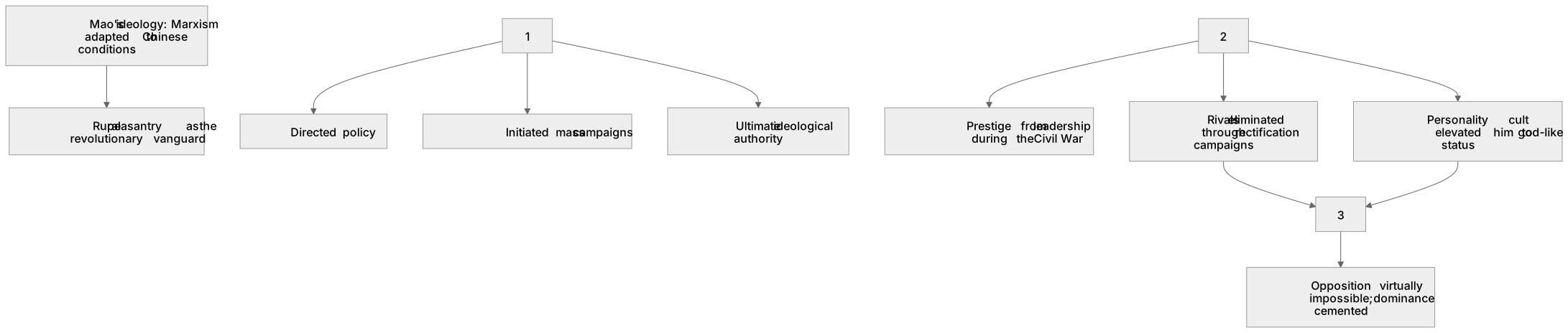
1Box 1
2Box 2
3Box 3
There is more to this lesson
The full lesson goes on to check your understanding and help you earn the marks. Create a free account to carry on, with your progress saved.
A week of Premium from your first lesson · Then the free plan continues · No card, no charge
Test your understanding of Option 32: Key topic 1: Establishing communist rule, 1945–59 - 2 Communist rule: The ideology and role of Mao. Reasons for Mao’s dominant position.
Active recall beats re-reading. Take an instant quiz now to test what you’ve learned and lock it into long-term memory.
A week of Premium from your first lesson · Then the free plan continues · No card, no charge