Pearson Edexcel · GCSE · History
Course version: 1HI0 · Version from Sept 2016
Key topic 2: Economic policy, 1949–65 - 2 Industry and the Five-Year Plan,…
Full specification wording
Option 32: Key topic 2: Economic policy, 1949–65 - 2 Industry and the Five-Year Plan, 1953–57: Success and failures of the first Five-Year Plan.
The first Five-Year Plan (1953–57) achieved significant successes in heavy industry, with coal and steel production exceeding their ambitious targets.
Checked against the Pearson Edexcel 1HI0 specification (opens in a new tab) on .
- Point 2 of 2
- 3 key terms
Study notes
From the checked teaching notes for this specification point.
The idea
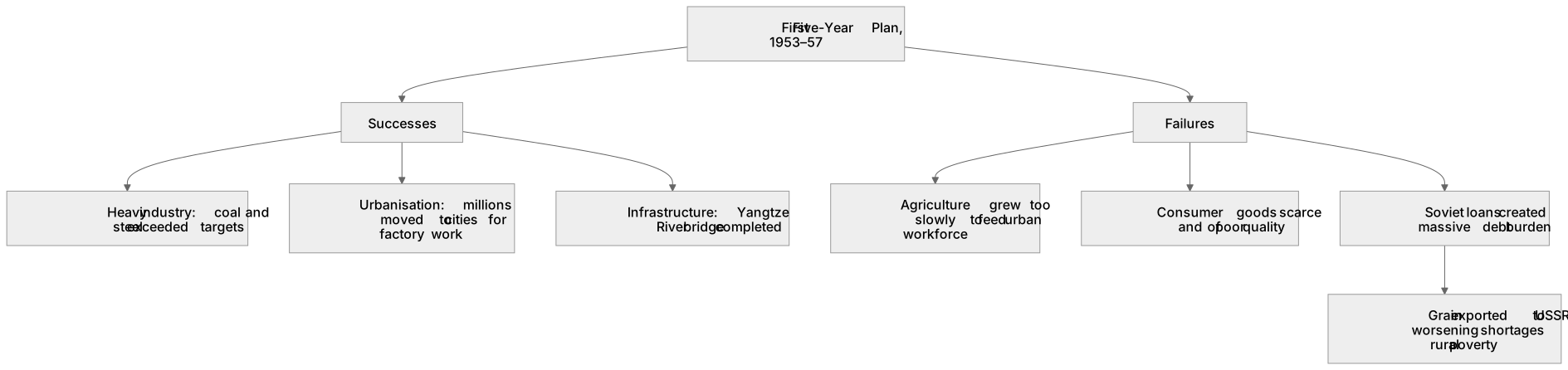
The first Five-Year Plan (1953–57) achieved significant successes in heavy industry, with coal and steel production exceeding their ambitious targets. Urbanisation accelerated as millions moved to cities for factory work, and major infrastructure projects, like the bridge across the Yangtze River, were completed. However, the plan had notable failures. Agricultural output grew too slowly to feed the expanding urban workforce, leading to food shortages. The focus on heavy industry meant consumer goods were scarce and of poor quality. Furthermore, the reliance on Soviet loans created a massive debt burden, forcing China to export desperately needed grain to the USSR, exacerbating domestic shortages and rural poverty.
What earns the marks
- Detail the successes in heavy industry, noting that production of coal, steel, and iron often exceeded official targets.
- Describe the successful completion of major infrastructure and engineering projects, such as the Yangtze River bridge.
- Explain the failure in agriculture, where output failed to keep pace with the rapidly growing urban population.
- Analyse the negative impact on living standards due to the lack of consumer goods and the heavy burden of repaying Soviet loans.
Common mistakes and how to put them right
Claiming the plan was a complete failure.
Put it right: Acknowledge the genuine and significant successes in heavy industrial output and infrastructure.
Stating that agricultural production fell during this period.
Put it right: Agricultural output did increase, but not fast enough to meet the demands of the growing urban workforce.
Ignoring the human cost.
Put it right: Mention the strict discipline, poor living conditions for workers, and the extraction of resources from the peasantry.
Exam tips
- Use a balanced approach when evaluating the plan, ensuring you discuss both clear successes and significant failures.
- Link the failures in agriculture directly to the focus on heavy industry and the need to repay Soviet loans.
- Memorise a couple of specific production successes (e.g., steel or coal) to use as concrete evidence in your answers.
Try the lesson
The start of the Option 32: Key topic 2: Economic policy, 1949–65 - 2 Industry and the Five-Year Plan, 1953–57: Success and failures of the first Five-Year Plan. lesson, made from checked teaching notes for this specification point.
Have a go first
Which of the following was a major success of China's First Five-Year Plan (1953–1957)?
Listen
The first Five-Year Plan (1953–57) achieved significant successes in heavy industry, with coal and steel production exceeding their ambitious targets. Urbanisation accelerated as millions moved to cities for factory work, and major infrastructure projects, like the bridge across the Yangtze River, were completed. However, the plan had notable failures. Agricultural output grew too slowly to feed the expanding urban workforce, leading to food shortages. The focus on heavy industry meant consumer goods were scarce and of poor quality. Furthermore, the reliance on Soviet loans created a massive debt burden, forcing China to export desperately needed grain to the USSR, exacerbating domestic shortages and rural poverty. A strong answer earns marks for these points. Detail the successes in heavy industry, noting that production of coal, steel, and iron often exceeded official targets. Describe the successful completion of major infrastructure and engineering projects, such as the Yangtze River bridge. Explain the failure in agriculture, where output failed to keep pace with the rapidly growing urban population. Analyse the negative impact on living standards due to the lack of consumer goods and the heavy burden of repaying Soviet loans. A common slip: Claiming the plan was a complete failure. Instead, acknowledge the genuine and significant successes in heavy industrial output and infrastructure. Exam tip: Use a balanced approach when evaluating the plan, ensuring you discuss both clear successes and significant failures.
See it
Key words
Say what each word means before you turn the card.
Urbanisation
Try answering aloud or in your head before turning the card.
Agricultural challenges
Try answering aloud or in your head before turning the card.
Living standards
Try answering aloud or in your head before turning the card.
See every definition
- Urbanisation
- The acceleration of movement to cities as millions moved there for factory work during the first Five-Year Plan.
- Agricultural challenges
- Output grew too slowly to feed the expanding urban workforce, leading to food shortages, and reliance on Soviet loans forced the export of desperately needed grain.
- Living standards
- Consumer goods were scarce and of poor quality, and the burden of repaying Soviet loans exacerbated domestic shortages and rural poverty.
Label the diagram
Some boxes have lost their names. Pick the right name for each number.
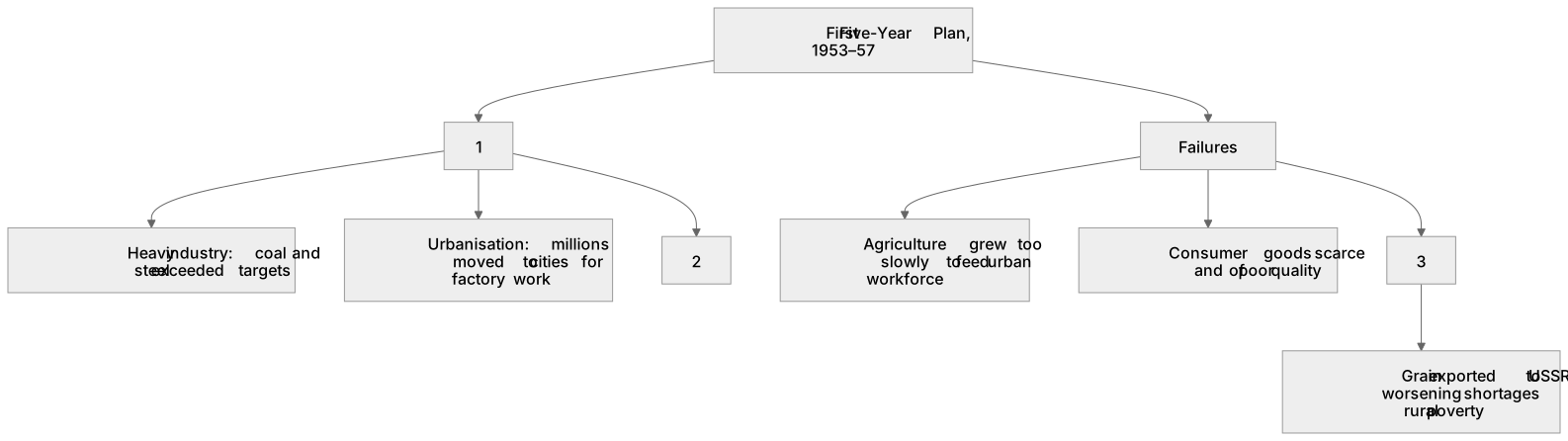
1Box 1
2Box 2
3Box 3
There is more to this lesson
The full lesson goes on to check your understanding and help you earn the marks. Create a free account to carry on, with your progress saved.
A week of Premium from your first lesson · Then the free plan continues · No card, no charge
Test your understanding of Option 32: Key topic 2: Economic policy, 1949–65 - 2 Industry and the Five-Year Plan, 1953–57: Success and failures of the first Five-Year Plan.
Active recall beats re-reading. Take an instant quiz now to test what you’ve learned and lock it into long-term memory.
A week of Premium from your first lesson · Then the free plan continues · No card, no charge