Pearson Edexcel · GCSE · History
Course version: 1HI0 · Version from Sept 2016
Key topic 3: The Cultural Revolution and its aftermath, 1966–76 - 1…
Full specification wording
Option 32: Key topic 3: The Cultural Revolution and its aftermath, 1966–76 - 1 Reasons for the Cultural Revolution: The power struggle: Mao, Liu Shaoqi and Deng Xiaoping.
Following the disastrous Great Leap Forward, Mao Zedong stepped back from day-to-day government, allowing Liu Shaoqi and Deng Xiaoping to restore the economy through pragmatic policies.
Checked against the Pearson Edexcel 1HI0 specification (opens in a new tab) on .
- Point 1 of 2
- 4 key terms
Study notes
From the checked teaching notes for this specification point.
The idea
Following the disastrous Great Leap Forward, Mao Zedong stepped back from day-to-day government, allowing Liu Shaoqi and Deng Xiaoping to restore the economy through pragmatic policies. This created a profound power struggle. Mao believed their pragmatic approach, which included restoring private plots and markets, was leading China down a capitalist road and undermining his communist vision. Liu and Deng gained significant popularity and control over the Chinese Communist Party (CCP) apparatus, threatening Mao's absolute authority. Mao launched the Cultural Revolution primarily to eliminate these rivals, reassert his dominance over the party, and destroy the pragmatic faction, famously labelling Liu as the 'number one capitalist roader'.
What earns the marks
- Explain how the failure of the Great Leap Forward weakened Mao's position and elevated Liu Shaoqi and Deng Xiaoping.
- Describe the pragmatic economic policies introduced by Liu and Deng, such as allowing private farming plots.
- Analyse Mao's ideological fear that Liu and Deng were creating a new privileged class and abandoning true communism.
- Evaluate how Mao used the Cultural Revolution as a political tool to purge Liu and Deng from the CCP leadership.
Common mistakes and how to put them right
Stating that Mao was completely removed from power before 1966.
Put it right: Mao remained Party Chairman but stepped back from daily administration.
Confusing the roles of Liu and Deng.
Put it right: Liu was Head of State (President) and Deng was CCP General Secretary, both working together on economic recovery.
Claiming Liu and Deng wanted to overthrow communism.
Put it right: They were committed communists who believed pragmatic economic reforms were necessary for survival.
Exam tips
- Use the phrase 'capitalist roaders' when discussing Mao's accusations against Liu and Deng.
- Link the power struggle directly to the ideological differences between Mao's mass mobilisation and Liu/Deng's pragmatism.
- When explaining the causes of the Cultural Revolution, ensure you balance ideological motives with Mao's personal desire to regain absolute power.
Try the lesson
The start of the Option 32: Key topic 3: The Cultural Revolution and its aftermath, 1966–76 - 1 Reasons for the Cultural Revolution: The power struggle: Mao, Liu Shaoqi and Deng Xiaoping. lesson, made from checked teaching notes for this specification point.
Have a go first
Which of the following best describes the main reason for the power struggle between Mao Zedong and leaders like Liu Shaoqi and Deng Xiaoping in the early 1960s?
Listen
Following the disastrous Great Leap Forward, Mao Zedong stepped back from day-to-day government, allowing Liu Shaoqi and Deng Xiaoping to restore the economy through pragmatic policies. This created a profound power struggle. Mao believed their pragmatic approach, which included restoring private plots and markets, was leading China down a capitalist road and undermining his communist vision. Liu and Deng gained significant popularity and control over the Chinese Communist Party (CCP) apparatus, threatening Mao's absolute authority. Mao launched the Cultural Revolution primarily to eliminate these rivals, reassert his dominance over the party, and destroy the pragmatic faction, famously labelling Liu as the 'number one capitalist roader'. A strong answer earns marks for these points. Explain how the failure of the Great Leap Forward weakened Mao's position and elevated Liu Shaoqi and Deng Xiaoping. Describe the pragmatic economic policies introduced by Liu and Deng, such as allowing private farming plots. Analyse Mao's ideological fear that Liu and Deng were creating a new privileged class and abandoning true communism. Evaluate how Mao used the Cultural Revolution as a political tool to purge Liu and Deng from the CCP leadership. A common slip: Stating that Mao was completely removed from power before 1966. Instead, Mao remained Party Chairman but stepped back from daily administration. Exam tip: Use the phrase 'capitalist roaders' when discussing Mao's accusations against Liu and Deng.
See it
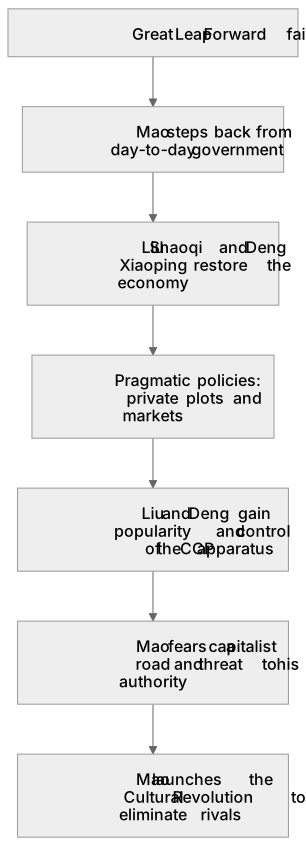
Put it in order
Put these steps in the order they happen.
- 1. Mao launches the Cultural Revolution to eliminate rivals
- 2. Mao fears a capitalist road and threat to his authority
- 3. Liu Shaoqi and Deng Xiaoping restore the economy
- 4. Liu and Deng gain popularity and control of the CCP apparatus
- 5. Great Leap Forward fails
- 6. Mao steps back from day-to-day government
- 7. Pragmatic policies: private plots and markets
Key words
Say what each word means before you turn the card.
Power struggle
Try answering aloud or in your head before turning the card.
Pragmatic policies
Try answering aloud or in your head before turning the card.
Capitalist roaders
Try answering aloud or in your head before turning the card.
Pragmatic faction
Try answering aloud or in your head before turning the card.
See every definition
- Power struggle
- A profound contest in which Liu Shaoqi and Deng Xiaoping gained popularity and control over the CCP apparatus, threatening Mao's absolute authority.
- Pragmatic policies
- Measures used by Liu and Deng to restore the economy, including restoring private plots and markets.
- Capitalist roaders
- Mao's label for Liu and Deng, reflecting his belief that their pragmatic approach was leading China down a capitalist road.
- Pragmatic faction
- The group around Liu and Deng that Mao sought to destroy through the Cultural Revolution.
Label the diagram
Some boxes have lost their names. Pick the right name for each number.
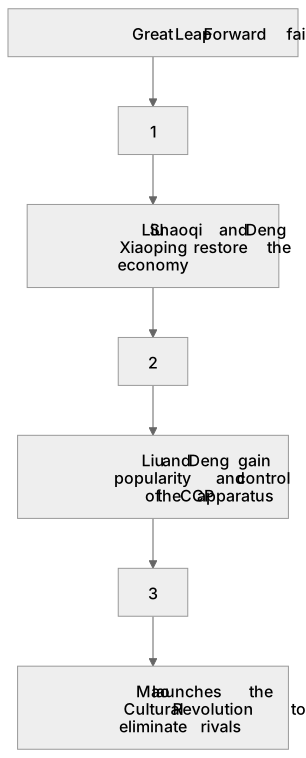
1Box 1
2Box 2
3Box 3
There is more to this lesson
The full lesson goes on to check your understanding and help you earn the marks. Create a free account to carry on, with your progress saved.
A week of Premium from your first lesson · Then the free plan continues · No card, no charge
Test your understanding of Option 32: Key topic 3: The Cultural Revolution and its aftermath, 1966–76 - 1 Reasons for the Cultural Revolution: The power struggle: Mao, Liu Shaoqi and Deng Xiaoping.
Active recall beats re-reading. Take an instant quiz now to test what you’ve learned and lock it into long-term memory.
A week of Premium from your first lesson · Then the free plan continues · No card, no charge