Pearson Edexcel · GCSE · History
Course version: 1HI0 · Version from Sept 2016
Key topic 4: Life in Mao’s China, 1949–76 - 1 Communist control: Thought…
Full specification wording
Option 32: Key topic 4: Life in Mao’s China, 1949–76 - 1 Communist control: Thought control and the development of the ‘Reform Through Labour’ system.
The CCP enforced ideological conformity through intense thought control, requiring citizens to study Maoist theory and participate in 'struggle sessions' to confess ideological errors.
Checked against the Pearson Edexcel 1HI0 specification (opens in a new tab) on .
- Point 2 of 2
- 4 key terms
Study notes
From the checked teaching notes for this specification point.
The idea
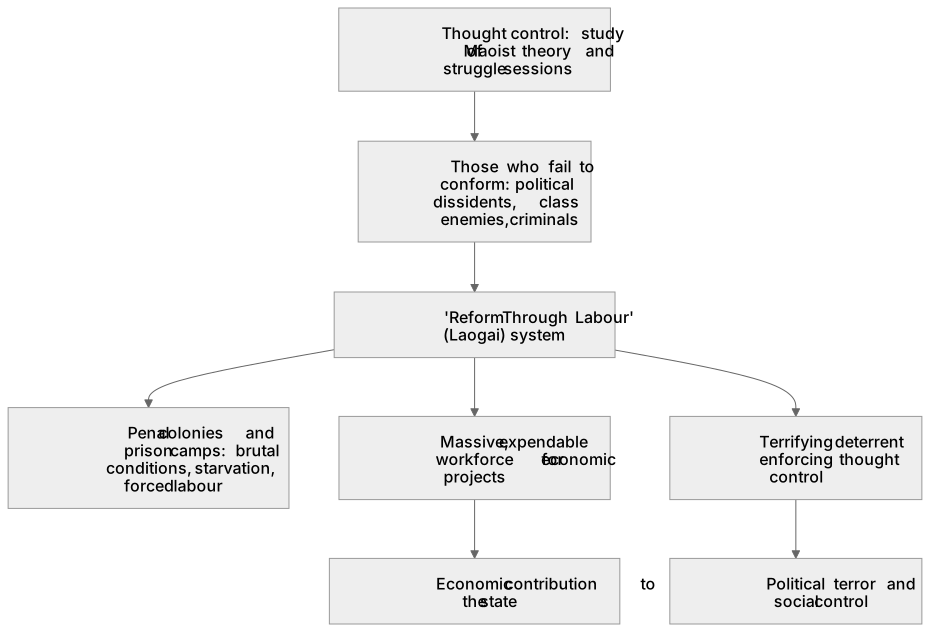
The CCP enforced ideological conformity through intense thought control, requiring citizens to study Maoist theory and participate in 'struggle sessions' to confess ideological errors. To deal with political dissidents, class enemies, and criminals, the state developed the 'Reform Through Labour' (Laogai) system. This vast network of penal colonies and prison camps subjected inmates to brutal conditions, starvation, and forced labour in mines, farms, and factories. The Laogai system served a dual purpose: it provided the state with a massive, expendable workforce for economic projects and acted as a terrifying deterrent, enforcing thought control by removing and punishing those who failed to conform to the strict dictates of Party ideology.
What earns the marks
- Explain the methods of thought control, including study groups, self-criticism, and struggle sessions.
- Describe the origins and expansion of the 'Reform Through Labour' (Laogai) system.
- Detail the conditions within the Laogai camps, including forced labour, indoctrination, and high mortality rates.
- Analyse the economic contribution of the Laogai system to the Chinese state.
- Evaluate the role of the Laogai system as an instrument of political terror and social control.
Common mistakes and how to put them right
Confusing 'Reform Through Labour' (Laogai) with 'Re-education Through Labour' (Laojiao).
Put it right: Laogai was the formal prison system for convicted criminals and political prisoners.
Viewing thought control merely as propaganda.
Put it right: It involved active, coercive participation in self-criticism and mutual surveillance.
Assuming the Laogai system was only for political prisoners.
Put it right: It also housed common criminals and those deemed socially undesirable.
Exam tips
- Connect thought control mechanisms, like struggle sessions, to the broader atmosphere of fear and conformity.
- Emphasise the dual function of the Laogai system: economic exploitation and political repression.
- Use specific examples of who might be sent to the Laogai, such as landlords, rightists, or counter-revolutionaries, to add depth to your answer.
Try the lesson
The start of the Option 32: Key topic 4: Life in Mao’s China, 1949–76 - 1 Communist control: Thought control and the development of the ‘Reform Through Labour’ system. lesson, made from checked teaching notes for this specification point.
Have a go first
What was the Chinese term for the extensive network of 'Reform Through Labour' prison camps established under Mao Zedong?
Listen
The CCP enforced ideological conformity through intense thought control, requiring citizens to study Maoist theory and participate in 'struggle sessions' to confess ideological errors. To deal with political dissidents, class enemies, and criminals, the state developed the 'Reform Through Labour' (Laogai) system. This vast network of penal colonies and prison camps subjected inmates to brutal conditions, starvation, and forced labour in mines, farms, and factories. The Laogai system served a dual purpose: it provided the state with a massive, expendable workforce for economic projects and acted as a terrifying deterrent, enforcing thought control by removing and punishing those who failed to conform to the strict dictates of Party ideology. A strong answer earns marks for these points. Explain the methods of thought control, including study groups, self-criticism, and struggle sessions. Describe the origins and expansion of the 'Reform Through Labour' (Laogai) system. Detail the conditions within the Laogai camps, including forced labour, indoctrination, and high mortality rates. Analyse the economic contribution of the Laogai system to the Chinese state. Exam tip: Connect thought control mechanisms, like struggle sessions, to the broader atmosphere of fear and conformity.
See it
Key words
Say what each word means before you turn the card.
Thought control
Try answering aloud or in your head before turning the card.
Struggle sessions
Try answering aloud or in your head before turning the card.
Reform Through Labour
Try answering aloud or in your head before turning the card.
Laogai
Try answering aloud or in your head before turning the card.
See every definition
- Thought control
- Enforcing ideological conformity through intense measures, requiring citizens to study Maoist theory and participate in struggle sessions to confess ideological errors.
- Struggle sessions
- Sessions in which citizens participated to confess ideological errors as part of the CCP's thought control.
- Reform Through Labour
- A system developed by the state to deal with political dissidents, class enemies and criminals, consisting of a vast network of penal colonies and prison camps.
- Laogai
- A system of penal colonies and prison camps where inmates were subjected to brutal conditions, starvation and forced labour in mines, farms and factories.
Label the diagram
Some boxes have lost their names. Pick the right name for each number.
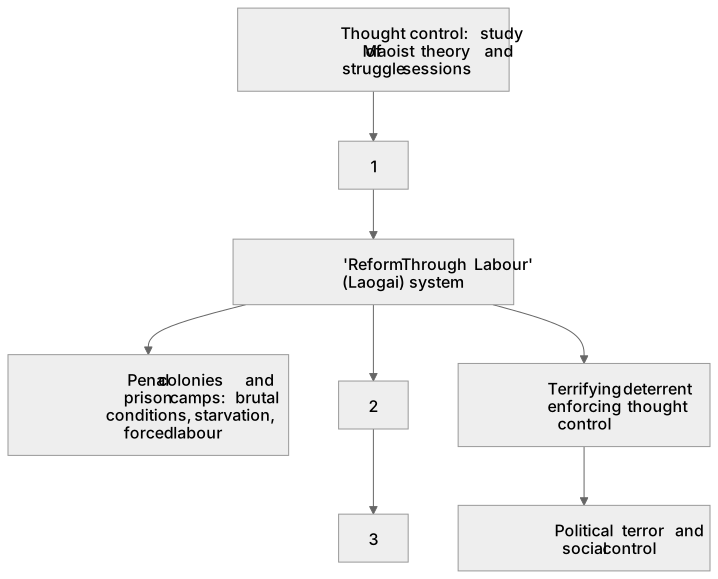
1Box 1
2Box 2
3Box 3
There is more to this lesson
The full lesson goes on to check your understanding and help you earn the marks. Create a free account to carry on, with your progress saved.
A week of Premium from your first lesson · Then the free plan continues · No card, no charge
Test your understanding of Option 32: Key topic 4: Life in Mao’s China, 1949–76 - 1 Communist control: Thought control and the development of the ‘Reform Through Labour’ system.
Active recall beats re-reading. Take an instant quiz now to test what you’ve learned and lock it into long-term memory.
A week of Premium from your first lesson · Then the free plan continues · No card, no charge