Pearson Edexcel · GCSE · History
Course version: 1HI0 · Version from Sept 2016
Key topic 4: Life in Mao’s China, 1949–76 - 2 Family life and the role of…
Full specification wording
Option 32: Key topic 4: Life in Mao’s China, 1949–76 - 2 Family life and the role of women: Reasons for changes in the status of women under Mao. The significance of foot binding and the Marriage Law (1950).
Mao Zedong famously declared that "women hold up half the sky", reflecting the ideological drive to improve women's status to mobilise them for the workforce and socialist construction.
Checked against the Pearson Edexcel 1HI0 specification (opens in a new tab) on .
- Point 2 of 2
Study notes
From the checked teaching notes for this specification point.
The idea
Mao Zedong famously declared that "women hold up half the sky", reflecting the ideological drive to improve women's status to mobilise them for the workforce and socialist construction. Before 1949, women suffered severe patriarchal oppression, symbolised by the painful practice of foot binding, which crippled women to make them dependent and subservient. The CCP banned foot binding, liberating women physically. The 1950 Marriage Law was a landmark reform, outlawing arranged marriages, concubinage, and the payment of dowries, while granting women the right to divorce and own property. This fundamentally challenged traditional family structures, though implementation varied, especially in rural areas where patriarchal attitudes persisted.
What earns the marks
- Explain the ideological and economic reasons for changing women's status, such as the need for female labour in agriculture and industry.
- Describe the physical and social impact of foot binding and explain why its abolition was significant for women's liberation.
- Identify the key terms of the 1950 Marriage Law, including the banning of arranged marriages, dowries, and concubinage.
- Evaluate the impact of the Marriage Law, noting the increase in divorces and the resistance faced in traditional rural communities.
Common mistakes and how to put them right
Claiming the Marriage Law achieved total equality immediately.
Put it right: Emphasise that traditional patriarchal attitudes remained strong, particularly in rural areas.
Confusing the timeline of foot binding.
Put it right: Note that while earlier reformers opposed it, the CCP strictly enforced its eradication after 1949.
Stating that women only gained social rights.
Put it right: Highlight that women also gained economic rights, such as property ownership and equal pay in theory, though not always in practice.
Exam tips
- Use the phrase "women hold up half the sky" to illustrate Mao's ideological stance on gender equality.
- When discussing the Marriage Law, provide specific examples of what it banned (e.g., concubinage) and what it permitted (e.g., divorce).
- Contrast the urban and rural experiences of women to show a nuanced understanding of the reforms' limitations.
Try the lesson
The start of the Option 32: Key topic 4: Life in Mao’s China, 1949–76 - 2 Family life and the role of women: Reasons for changes in the status of women under Mao. The significance of foot binding and the Marriage Law (1950). lesson, made from checked teaching notes for this specification point.
Have a go first
What was a key provision of the 1950 Marriage Law in Mao's China?
Listen
Mao Zedong famously declared that "women hold up half the sky", reflecting the ideological drive to improve women's status to mobilise them for the workforce and socialist construction. Before 1949, women suffered severe patriarchal oppression, symbolised by the painful practice of foot binding, which crippled women to make them dependent and subservient. The CCP banned foot binding, liberating women physically. The 1950 Marriage Law was a landmark reform, outlawing arranged marriages, concubinage, and the payment of dowries, while granting women the right to divorce and own property. This fundamentally challenged traditional family structures, though implementation varied, especially in rural areas where patriarchal attitudes persisted. A strong answer earns marks for these points. Explain the ideological and economic reasons for changing women's status, such as the need for female labour in agriculture and industry. Describe the physical and social impact of foot binding and explain why its abolition was significant for women's liberation. Identify the key terms of the 1950 Marriage Law, including the banning of arranged marriages, dowries, and concubinage. Evaluate the impact of the Marriage Law, noting the increase in divorces and the resistance faced in traditional rural communities. A common slip: Claiming the Marriage Law achieved total equality immediately. Instead, emphasise that traditional patriarchal attitudes remained strong, particularly in rural areas. Exam tip: Use the phrase "women hold up half the sky" to illustrate Mao's ideological stance on gender equality.
See it
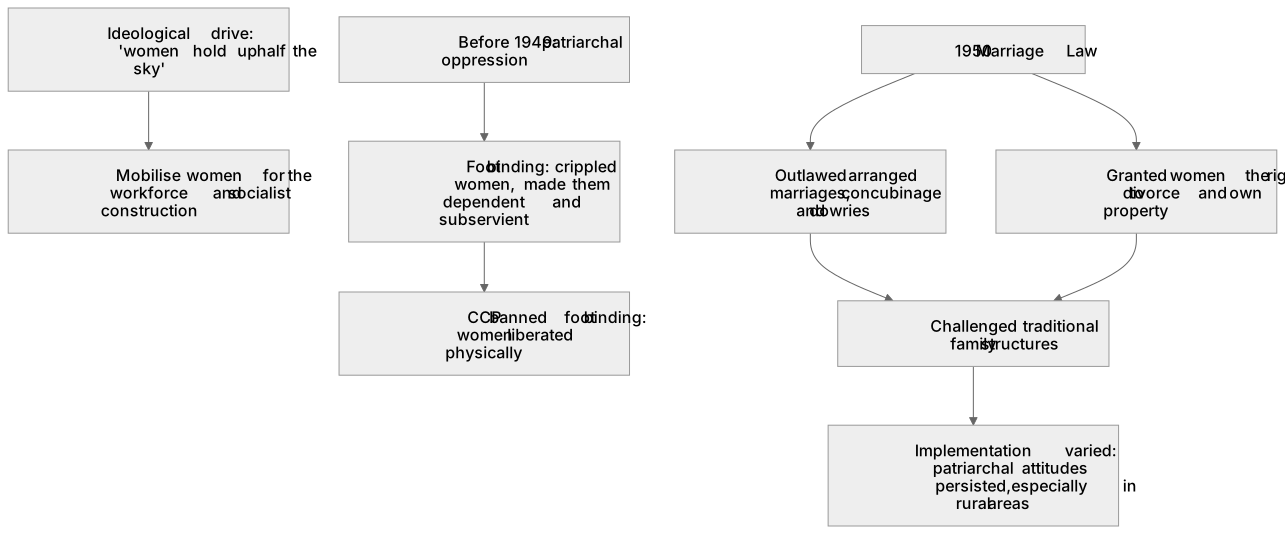
Label the diagram
Some boxes have lost their names. Pick the right name for each number.
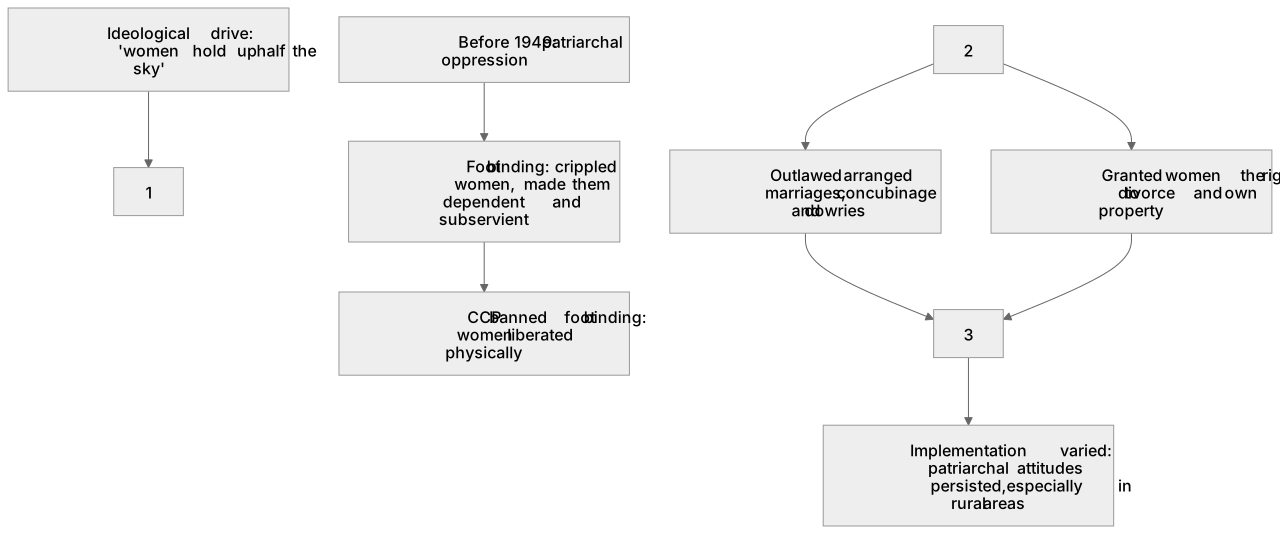
1Box 1
2Box 2
3Box 3
There is more to this lesson
The full lesson goes on to check your understanding and help you earn the marks. Create a free account to carry on, with your progress saved.
A week of Premium from your first lesson · Then the free plan continues · No card, no charge
Test your understanding of Option 32: Key topic 4: Life in Mao’s China, 1949–76 - 2 Family life and the role of women: Reasons for changes in the status of women under Mao. The significance of foot binding and the Marriage Law (1950).
Active recall beats re-reading. Take an instant quiz now to test what you’ve learned and lock it into long-term memory.
A week of Premium from your first lesson · Then the free plan continues · No card, no charge