Pearson Edexcel · GCSE · History
Course version: 1HI0 · Version from Sept 2016
Key topic 1: The development of the civil rights movement, 1954–60 - 3 The…
Full specification wording
Option 33: Key topic 1: The development of the civil rights movement, 1954–60 - 3 The Montgomery Bus Boycott and its impact, 1955–60: Causes and events of the Montgomery Bus Boycott. The significance of Rosa Parks.
The Montgomery Bus Boycott was caused by the deeply humiliating segregation on city buses, where black passengers were forced to sit at the back and yield seats to white people.
Checked against the Pearson Edexcel 1HI0 specification (opens in a new tab) on .
- Point 1 of 3
- 4 key terms
Study notes
From the checked teaching notes for this specification point.
The idea
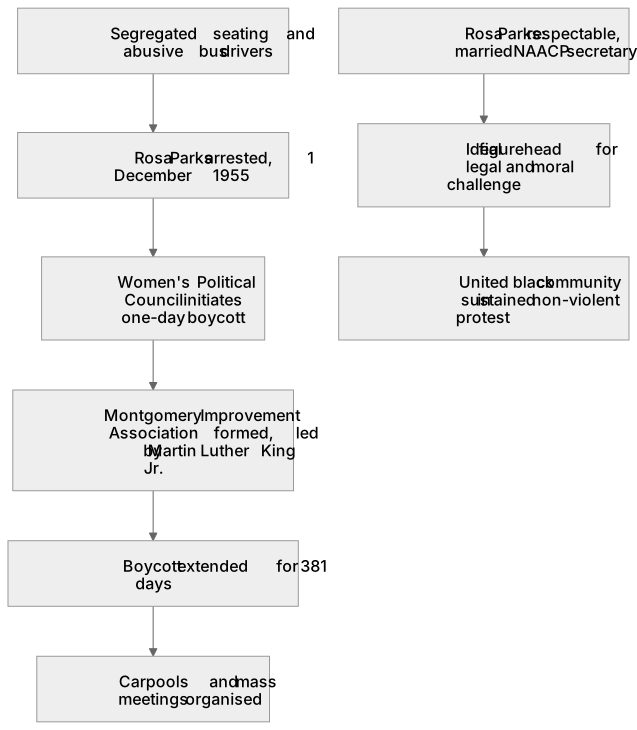
The Montgomery Bus Boycott was caused by the deeply humiliating segregation on city buses, where black passengers were forced to sit at the back and yield seats to white people. The catalyst event was the arrest of Rosa Parks on 1 December 1955 for refusing to give up her seat. The Women's Political Council initiated a one-day boycott, which the newly formed Montgomery Improvement Association, led by Martin Luther King Jr., extended for 381 days. Events included the organisation of complex carpools and mass meetings. The significance of Rosa Parks was paramount: as a respectable, married NAACP secretary, she was the perfect, unimpeachable figurehead for a legal and moral challenge, unlike previous candidates like Claudette Colvin, uniting the black community in sustained non-violent protest.
What earns the marks
- Explain the long-standing grievances over segregated seating and abusive bus drivers as underlying causes of the boycott.
- Describe the specific events of 1 December 1955, including Rosa Parks's refusal to surrender her seat and her subsequent arrest.
- Detail the rapid organisation of the boycott by the Women's Political Council and the Montgomery Improvement Association.
- Analyse why Rosa Parks's background and character made her the ideal figurehead for the NAACP's legal challenge.
Common mistakes and how to put them right
Claiming Rosa Parks refused to give up her seat simply because her feet were tired.
Put it right: Explain that her refusal was a deliberate act of defiance against the segregated system, rooted in her NAACP activism.
Stating that Rosa Parks was the first person to be arrested for refusing to give up a bus seat.
Put it right: Mention that others, like Claudette Colvin, had been arrested previously, but Parks was chosen as the test case.
Ignoring the role of the Women's Political Council (WPC).
Put it right: Acknowledge that the WPC, led by Jo Ann Robinson, printed the initial leaflets that launched the boycott.
Exam tips
- Emphasise that the boycott was a planned, strategic campaign rather than a spontaneous reaction.
- Mention the formation of the Montgomery Improvement Association (MIA) and its role in sustaining the boycott.
- When discussing Rosa Parks's significance, focus on her respectability and her connections to the NAACP.
Try the lesson
The start of the Option 33: Key topic 1: The development of the civil rights movement, 1954–60 - 3 The Montgomery Bus Boycott and its impact, 1955–60: Causes and events of the Montgomery Bus Boycott. The significance of Rosa Parks. lesson, made from checked teaching notes for this specification point.
Have a go first
What specific event triggered the start of the Montgomery Bus Boycott in December 1955?
Listen
The Montgomery Bus Boycott was caused by the deeply humiliating segregation on city buses, where black passengers were forced to sit at the back and yield seats to white people. The catalyst event was the arrest of Rosa Parks on 1 December 1955 for refusing to give up her seat. The Women's Political Council initiated a one-day boycott, which the newly formed Montgomery Improvement Association, led by Martin Luther King Jr., extended for 381 days. Events included the organisation of complex carpools and mass meetings. The significance of Rosa Parks was paramount: as a respectable, married NAACP secretary, she was the perfect, unimpeachable figurehead for a legal and moral challenge, unlike previous candidates like Claudette Colvin, uniting the black community in sustained non-violent protest. A strong answer earns marks for these points. Explain the long-standing grievances over segregated seating and abusive bus drivers as underlying causes of the boycott. Describe the specific events of 1 December 1955, including Rosa Parks's refusal to surrender her seat and her subsequent arrest. Detail the rapid organisation of the boycott by the Women's Political Council and the Montgomery Improvement Association. Analyse why Rosa Parks's background and character made her the ideal figurehead for the NAACP's legal challenge. A common slip: Claiming Rosa Parks refused to give up her seat simply because her feet were tired. Instead, Explain that her refusal was a deliberate act of defiance against the segregated system, rooted in her NAACP activism. Exam tip: Emphasise that the boycott was a planned, strategic campaign rather than a spontaneous reaction.
See it
Key words
Say what each word means before you turn the card.
Segregation
Try answering aloud or in your head before turning the card.
Non-violent protest
Try answering aloud or in your head before turning the card.
Montgomery Improvement Association
Try answering aloud or in your head before turning the card.
Women's Political Council
Try answering aloud or in your head before turning the card.
See every definition
- Segregation
- The deeply humiliating system on city buses where black passengers were forced to sit at the back and yield seats to white people.
- Non-violent protest
- A sustained form of protest in which the black community was united during the boycott.
- Montgomery Improvement Association
- A newly formed organisation, led by Martin Luther King Jr., which extended the one-day boycott for 381 days.
- Women's Political Council
- The organisation that initiated a one-day boycott of the city buses.
Label the diagram
Some boxes have lost their names. Pick the right name for each number.
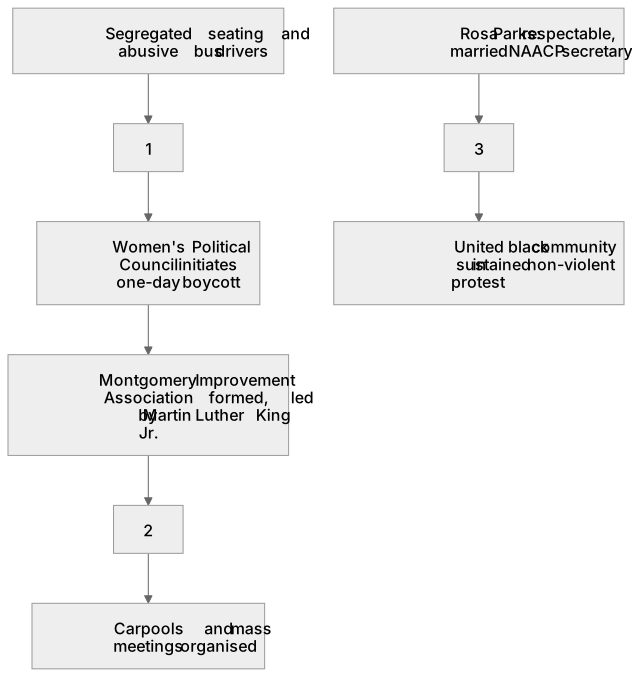
1Box 1
2Box 2
3Box 3
There is more to this lesson
The full lesson goes on to check your understanding and help you earn the marks. Create a free account to carry on, with your progress saved.
A week of Premium from your first lesson · Then the free plan continues · No card, no charge
Test your understanding of Option 33: Key topic 1: The development of the civil rights movement, 1954–60 - 3 The Montgomery Bus Boycott and its impact, 1955–60: Causes and events of the Montgomery Bus Boycott. The significance of Rosa Parks.
Active recall beats re-reading. Take an instant quiz now to test what you’ve learned and lock it into long-term memory.
A week of Premium from your first lesson · Then the free plan continues · No card, no charge