Pearson Edexcel · GCSE · History
Course version: 1HI0 · Version from Sept 2016
Key topic 1: The development of the civil rights movement, 1954–60 - 3 The…
Full specification wording
Option 33: Key topic 1: The development of the civil rights movement, 1954–60 - 3 The Montgomery Bus Boycott and its impact, 1955–60: The significance of the leadership of Martin Luther King. The setting up of the SCLC.
Martin Luther King Jr. emerged as a highly significant leader during the Montgomery Bus Boycott.
Checked against the Pearson Edexcel 1HI0 specification (opens in a new tab) on .
- Point 3 of 3
- 4 key terms
Study notes
From the checked teaching notes for this specification point.
The idea
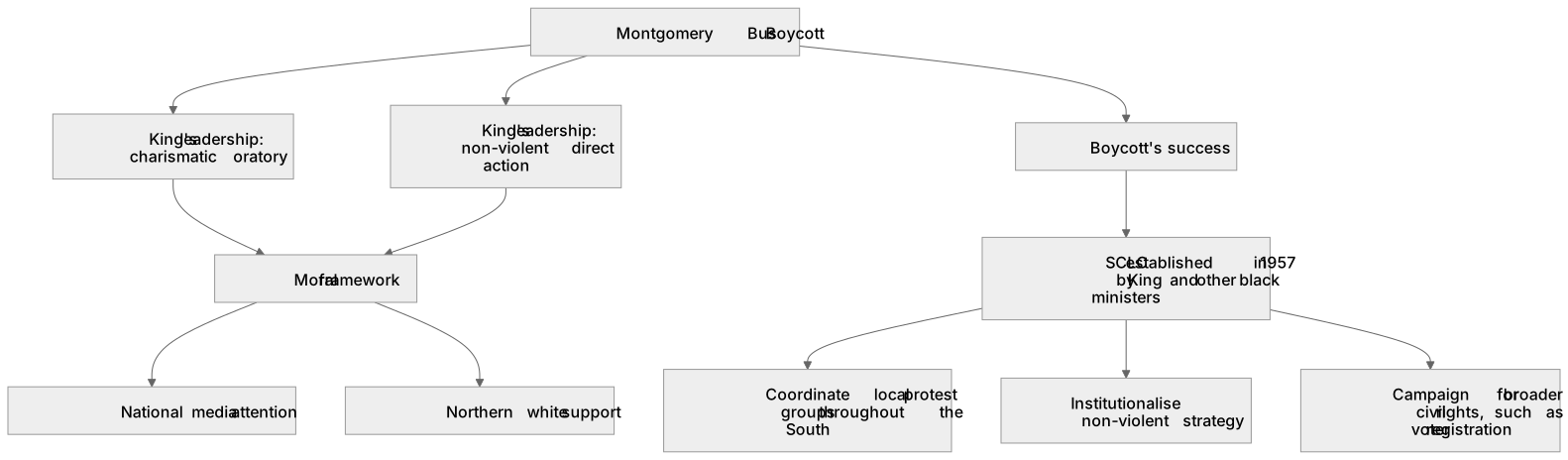
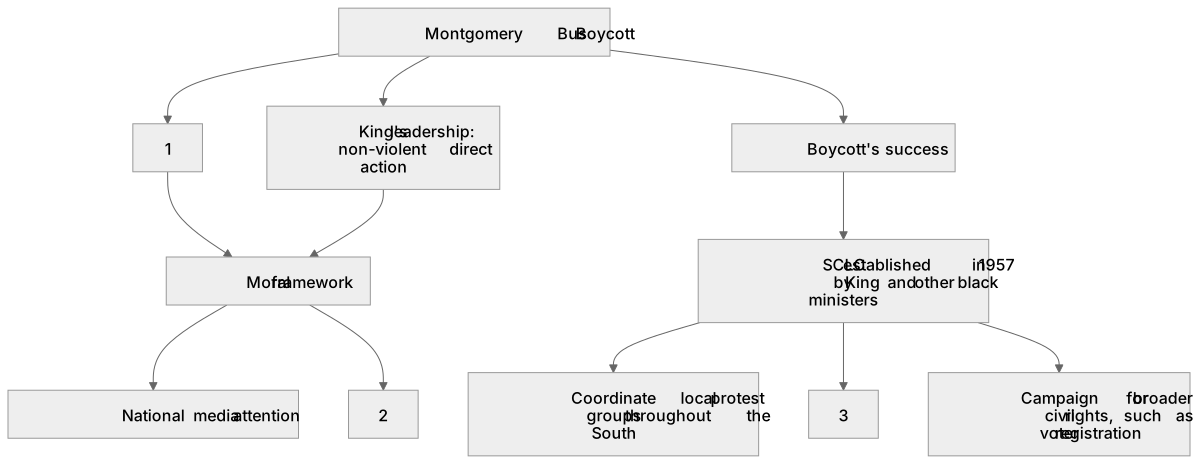
Martin Luther King Jr. emerged as a highly significant leader during the Montgomery Bus Boycott. His charismatic oratory and steadfast commitment to non-violent direct action were crucial in sustaining the boycott. King's leadership provided a moral framework that attracted national media attention and northern white support. Following the boycott's success, King and other black ministers established the Southern Christian Leadership Conference (SCLC) in 1957. The SCLC aimed to coordinate local protest groups throughout the South, institutionalising the non-violent strategy and providing a structured organisation to campaign for broader civil rights, such as voter registration, beyond Montgomery.
What earns the marks
- Identify King's role as the president of the Montgomery Improvement Association (MIA).
- Explain how King's philosophy of non-violent direct action gave the movement moral superiority.
- Describe the formation of the SCLC in 1957 by King and other civil rights activists.
- Evaluate the SCLC's role in coordinating civil rights campaigns across the South.
Common mistakes and how to put them right
Claiming King started the Montgomery Bus Boycott.
Put it right by stating Rosa Parks' arrest triggered it and King was chosen to lead the MIA.
Confusing the SCLC with the NAACP.
Put it right by noting the NAACP focused on legal challenges while the SCLC focused on non-violent direct action.
Stating the SCLC was formed before the boycott.
Put it right by specifying it was established in 1957 as a result of the boycott's success.
Exam tips
- When discussing King's significance, focus on his ability to mobilise mass participation and attract media attention.
- Link the creation of the SCLC directly to the success of the Montgomery Bus Boycott.
- Use the SCLC as an example of how the civil rights movement became more organised and coordinated after 1956.
Try the lesson
The start of the Option 33: Key topic 1: The development of the civil rights movement, 1954–60 - 3 The Montgomery Bus Boycott and its impact, 1955–60: The significance of the leadership of Martin Luther King. The setting up of the SCLC. lesson, made from checked teaching notes for this specification point.
Have a go first
Which organisation was established in 1957 by Martin Luther King Jr. and other black ministers to coordinate civil rights protests in the South?
Listen
Martin Luther King Jr. emerged as a highly significant leader during the Montgomery Bus Boycott. His charismatic oratory and steadfast commitment to non-violent direct action were crucial in sustaining the boycott. King's leadership provided a moral framework that attracted national media attention and northern white support. Following the boycott's success, King and other black ministers established the Southern Christian Leadership Conference (SCLC) in 1957. The SCLC aimed to coordinate local protest groups throughout the South, institutionalising the non-violent strategy and providing a structured organisation to campaign for broader civil rights, such as voter registration, beyond Montgomery. A strong answer earns marks for these points. Identify King's role as the president of the Montgomery Improvement Association (MIA). Explain how King's philosophy of non-violent direct action gave the movement moral superiority. Describe the formation of the SCLC in 1957 by King and other civil rights activists. Evaluate the SCLC's role in coordinating civil rights campaigns across the South. A common slip: Claiming King started the Montgomery Bus Boycott. Instead, stating Rosa Parks' arrest triggered it and King was chosen to lead the MIA. Exam tip: When discussing King's significance, focus on his ability to mobilise mass participation and attract media attention.
See it
Key words
Say what each word means before you turn the card.
Leadership
Try answering aloud or in your head before turning the card.
Non-violent direct action
Try answering aloud or in your head before turning the card.
Organisation
Try answering aloud or in your head before turning the card.
Mass mobilisation
Try answering aloud or in your head before turning the card.
See every definition
- Leadership
- Martin Luther King Jr. emerged as a highly significant leader during the Montgomery Bus Boycott, providing a moral framework that attracted national media attention and northern white support.
- Non-violent direct action
- A steadfast commitment to this was crucial in sustaining the boycott, and the SCLC institutionalised the non-violent strategy.
- Organisation
- The SCLC provided a structured organisation to campaign for broader civil rights, such as voter registration, beyond Montgomery.
- Mass mobilisation
- King's significance lay in his ability to mobilise mass participation and attract media attention.
Label the diagram
Some boxes have lost their names. Pick the right name for each number.
1Box 1
2Box 2
3Box 3
There is more to this lesson
The full lesson goes on to check your understanding and help you earn the marks. Create a free account to carry on, with your progress saved.
A week of Premium from your first lesson · Then the free plan continues · No card, no charge
Test your understanding of Option 33: Key topic 1: The development of the civil rights movement, 1954–60 - 3 The Montgomery Bus Boycott and its impact, 1955–60: The significance of the leadership of Martin Luther King. The setting up of the SCLC.
Active recall beats re-reading. Take an instant quiz now to test what you’ve learned and lock it into long-term memory.
A week of Premium from your first lesson · Then the free plan continues · No card, no charge