Pearson Edexcel · GCSE · History
Course version: 1HI0 · Version from Sept 2016
Key topic 1: The development of the civil rights movement, 1954–60 - 4…
Full specification wording
Option 33: Key topic 1: The development of the civil rights movement, 1954–60 - 4 Opposition to the civil rights movement: Opposition to desegregation in the South, including the ‘Dixiecrats’ and the setting up of White Citizens’ Councils.
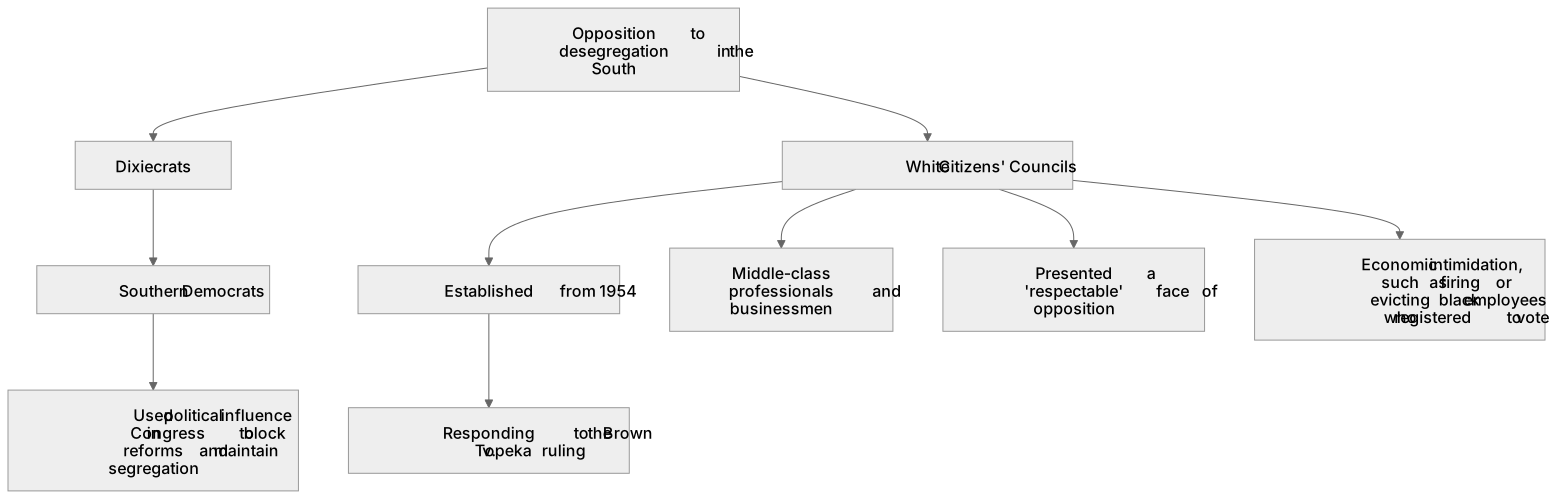
Opposition to desegregation in the South was highly organised at political and community levels.
- Point 2 of 2
- 4 key terms
Study notes
From the checked teaching notes for this specification point.
The idea
Opposition to desegregation in the South was highly organised at political and community levels. The 'Dixiecrats' were Southern Democrats who vehemently opposed civil rights legislation, using their political influence in Congress to block reforms and maintain segregation. At the grassroots level, White Citizens' Councils were established from 1954, primarily responding to the Brown v. Topeka ruling. Unlike the KKK, these councils presented a 'respectable' face of opposition, comprising middle-class professionals and businessmen. They utilised economic intimidation, such as firing black employees who registered to vote or evicting them, to suppress civil rights activism and resist the desegregation of schools and public facilities.
What earns the marks
- Identify the 'Dixiecrats' as Southern politicians who actively opposed civil rights legislation in Congress.
- Explain the origins of the White Citizens' Councils in response to the 1954 Brown v. Board of Education decision.
- Describe the methods used by White Citizens' Councils, focusing on economic pressure and intimidation rather than overt physical violence.
- Evaluate the effectiveness of these groups in delaying the implementation of desegregation in the South.
Common mistakes and how to put them right
Confusing White Citizens' Councils with the KKK.
Put it right by explaining that the Councils used economic and political pressure and were seen as 'respectable', whereas the KKK relied on terrorism and violence.
Assuming the Dixiecrats were a separate political party in the 1950s.
Put it right by noting that while they formed a breakaway party in 1948, during the 1950s they operated as a powerful conservative bloc within the Democratic Party.
Believing opposition only came from uneducated individuals.
Put it right by highlighting that White Citizens' Councils were largely made up of middle-class professionals, business owners, and politicians.
Exam tips
- Contrast the methods of the White Citizens' Councils (economic intimidation) with those of the KKK (physical violence) to show a nuanced understanding of opposition.
- Use the Dixiecrats to demonstrate how political opposition at the state and federal levels hindered civil rights progress.
- Link the formation of the White Citizens' Councils directly to the backlash against the Brown v. Topeka ruling.
Try the lesson
The start of the Option 33: Key topic 1: The development of the civil rights movement, 1954–60 - 4 Opposition to the civil rights movement: Opposition to desegregation in the South, including the ‘Dixiecrats’ and the setting up of White Citizens’ Councils. lesson, made from checked teaching notes for this specification point.
Have a go first
What was the primary purpose of the White Citizens' Councils established in the South during the 1950s?
Listen
Opposition to desegregation in the South was highly organised at political and community levels. The 'Dixiecrats' were Southern Democrats who vehemently opposed civil rights legislation, using their political influence in Congress to block reforms and maintain segregation. At the grassroots level, White Citizens' Councils were established from 1954, primarily responding to the Brown v. Topeka ruling. Unlike the KKK, these councils presented a 'respectable' face of opposition, comprising middle-class professionals and businessmen. They utilised economic intimidation, such as firing black employees who registered to vote or evicting them, to suppress civil rights activism and resist the desegregation of schools and public facilities. A strong answer earns marks for these points. Identify the 'Dixiecrats' as Southern politicians who actively opposed civil rights legislation in Congress. Explain the origins of the White Citizens' Councils in response to the 1954 Brown v. Board of Education decision. Describe the methods used by White Citizens' Councils, focusing on economic pressure and intimidation rather than overt physical violence. Evaluate the effectiveness of these groups in delaying the implementation of desegregation in the South. A common slip: Confusing White Citizens' Councils with the KKK. Instead, explaining that the Councils used economic and political pressure and were seen as 'respectable', whereas the KKK relied on terrorism and violence. Exam tip: Contrast the methods of the White Citizens' Councils (economic intimidation) with those of the KKK (physical violence) to show a nuanced understanding of opposition.
See it
Key words
Say what each word means before you turn the card.
Political opposition
Try answering aloud or in your head before turning the card.
Economic intimidation
Try answering aloud or in your head before turning the card.
Segregation
Try answering aloud or in your head before turning the card.
Grassroots resistance
Try answering aloud or in your head before turning the card.
See every definition
- Political opposition
- Southern Democrats known as the 'Dixiecrats' used their political influence in Congress to block reforms and maintain segregation.
- Economic intimidation
- A method used by White Citizens' Councils, such as firing black employees who registered to vote or evicting them, to suppress civil rights activism.
- Segregation
- The system that opposition groups sought to maintain and that White Citizens' Councils resisted desegregation of in schools and public facilities.
- Grassroots resistance
- Opposition organised at community level, where White Citizens' Councils were established from 1954, primarily responding to the Brown v. Topeka ruling.
Label the diagram
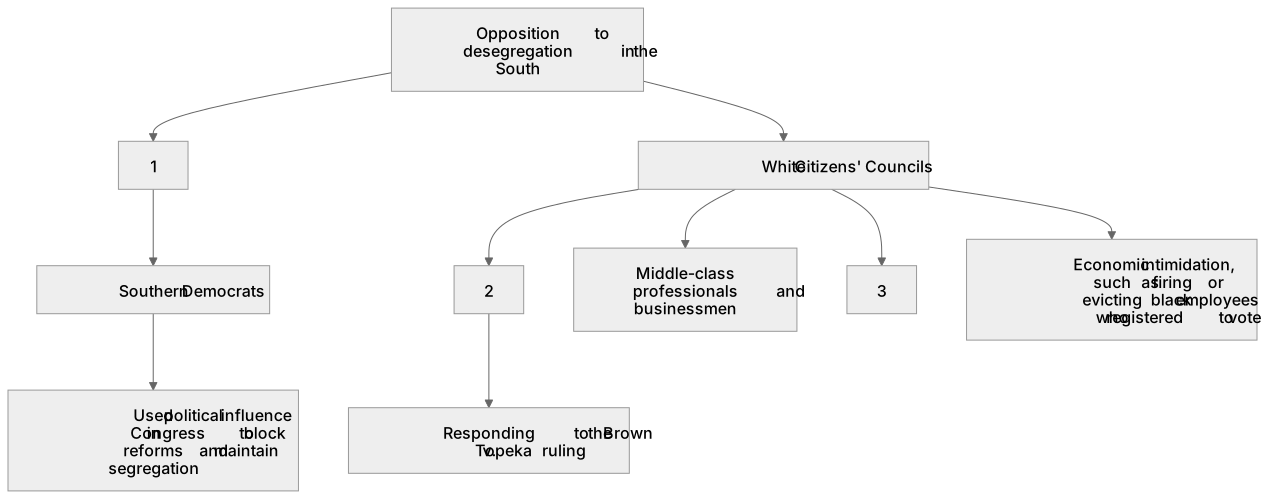
Some boxes have lost their names. Pick the right name for each number.
1Box 1
2Box 2
3Box 3
There is more to this lesson
The full lesson goes on to check your understanding and help you earn the marks. Create a free account to carry on, with your progress saved.
A week of Premium from your first lesson · Then the free plan continues · No card, no charge
Test your understanding of Option 33: Key topic 1: The development of the civil rights movement, 1954–60 - 4 Opposition to the civil rights movement: Opposition to desegregation in the South, including the ‘Dixiecrats’ and the setting up of White Citizens’ Councils.
Active recall beats re-reading. Take an instant quiz now to test what you’ve learned and lock it into long-term memory.
A week of Premium from your first lesson · Then the free plan continues · No card, no charge