Pearson Edexcel · GCSE · History
Course version: 1HI0 · Version from Sept 2016
Key topic 2: Protest, progress and radicalism, 1960–75 - 1 Developments,…
Full specification wording
Option 33: Key topic 2: Protest, progress and radicalism, 1960–75 - 1 Developments, 1960–62 ● The significance of Greensboro and the sit-in movement.: The James Meredith case (1962).
The James Meredith case of 1962 highlights the intense struggle to desegregate higher education in the US South.
Checked against the Pearson Edexcel 1HI0 specification (opens in a new tab) on .
- Point 2 of 2
- 4 key terms
Study notes
From the checked teaching notes for this specification point.
The idea
The James Meredith case of 1962 highlights the intense struggle to desegregate higher education in the US South. Meredith, an African American veteran, applied to the segregated University of Mississippi. Despite a Supreme Court ruling supporting his admission, state governor Ross Barnett physically blocked his entry. President John F. Kennedy intervened, sending federal marshals to escort Meredith. This sparked a violent riot by white segregationists, resulting in two deaths. Kennedy then deployed federal troops to restore order and ensure Meredith's enrolment. The case demonstrated that federal power could and would be used to enforce civil rights rulings against defiant state authorities, marking a significant victory for the civil rights movement.
What earns the marks
- Identify James Meredith as the first African American student to enrol at the University of Mississippi.
- Explain the resistance from state authorities, specifically Governor Ross Barnett.
- Describe the intervention of President Kennedy using federal marshals and troops.
- Analyse the significance of the case in demonstrating federal willingness to enforce desegregation laws over state opposition.
Common mistakes and how to put them right
Confusing James Meredith with other civil rights figures like James Farmer.
Put it right by associating Meredith specifically with the University of Mississippi (Ole Miss).
Stating that the university desegregated peacefully.
Put it right by detailing the violent riots that resulted in two deaths and required federal troops.
Claiming Eisenhower was president during this event.
Put it right by identifying John F. Kennedy as the president who sent federal forces for Meredith.
Exam tips
- Use the James Meredith case as a prime example of the tension between state and federal government regarding civil rights.
- Highlight the role of the media in broadcasting the riots, which pressured the federal government to act decisively.
- Link this event to earlier educational desegregation efforts, such as Little Rock, to show a pattern of federal intervention.
Try the lesson
The start of the Option 33: Key topic 2: Protest, progress and radicalism, 1960–75 - 1 Developments, 1960–62 ● The significance of Greensboro and the sit-in movement.: The James Meredith case (1962). lesson, made from checked teaching notes for this specification point.
Have a go first
What was the primary objective of James Meredith's legal and direct action in 1962?
Listen
The James Meredith case of 1962 highlights the intense struggle to desegregate higher education in the US South. Meredith, an African American veteran, applied to the segregated University of Mississippi. Despite a Supreme Court ruling supporting his admission, state governor Ross Barnett physically blocked his entry. President John F. Kennedy intervened, sending federal marshals to escort Meredith. This sparked a violent riot by white segregationists, resulting in two deaths. Kennedy then deployed federal troops to restore order and ensure Meredith's enrolment. The case demonstrated that federal power could and would be used to enforce civil rights rulings against defiant state authorities, marking a significant victory for the civil rights movement. A strong answer earns marks for these points. Identify James Meredith as the first African American student to enrol at the University of Mississippi. Explain the resistance from state authorities, specifically Governor Ross Barnett. Describe the intervention of President Kennedy using federal marshals and troops. Analyse the significance of the case in demonstrating federal willingness to enforce desegregation laws over state opposition. A common slip: Confusing James Meredith with other civil rights figures like James Farmer. Instead, associating Meredith specifically with the University of Mississippi (Ole Miss). Exam tip: Use the James Meredith case as a prime example of the tension between state and federal government regarding civil rights.
See it
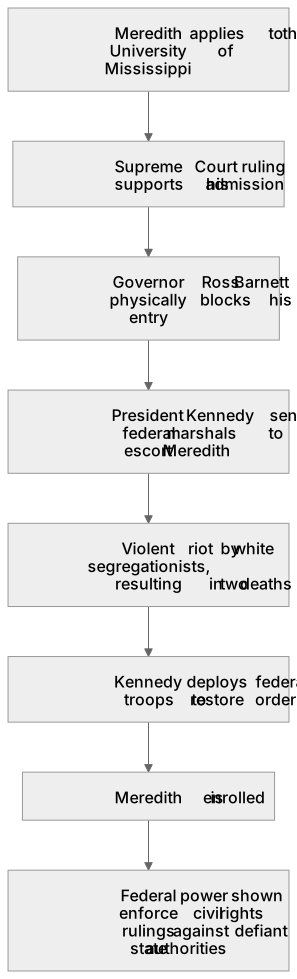
Put it in order
Put these steps in the order they happen.
- 1. Violent riot by white segregationists, resulting in two deaths
- 2. Federal power shown to enforce civil rights rulings against defiant state authorities
- 3. Kennedy deploys federal troops to restore order
- 4. Meredith applies to the University of Mississippi
- 5. Supreme Court ruling supports his admission
- 6. Meredith is enrolled
- 7. Governor Ross Barnett physically blocks his entry
- 8. President Kennedy sends federal marshals to escort Meredith
Key words
Say what each word means before you turn the card.
Federal vs State power
Try answering aloud or in your head before turning the card.
Educational desegregation
Try answering aloud or in your head before turning the card.
Presidential intervention
Try answering aloud or in your head before turning the card.
Violent resistance to civil rights
Try answering aloud or in your head before turning the card.
See every definition
- Federal vs State power
- The tension between state and federal government regarding civil rights, shown when federal power was used to enforce civil rights rulings against defiant state authorities.
- Educational desegregation
- The struggle to desegregate higher education in the US South, which the James Meredith case of 1962 highlights.
- Presidential intervention
- President John F. Kennedy intervened by sending federal marshals to escort Meredith and then deploying federal troops to restore order.
- Violent resistance to civil rights
- A violent riot by white segregationists resulted in two deaths and required federal troops to restore order.
Label the diagram
Some boxes have lost their names. Pick the right name for each number.
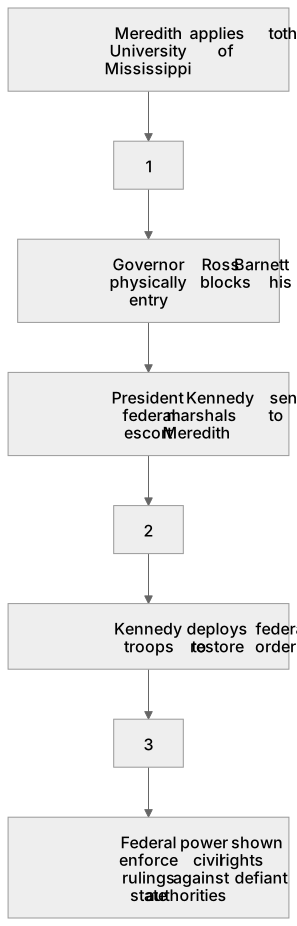
1Box 1
2Box 2
3Box 3
There is more to this lesson
The full lesson goes on to check your understanding and help you earn the marks. Create a free account to carry on, with your progress saved.
A week of Premium from your first lesson · Then the free plan continues · No card, no charge
Test your understanding of Option 33: Key topic 2: Protest, progress and radicalism, 1960–75 - 1 Developments, 1960–62 ● The significance of Greensboro and the sit-in movement.: The James Meredith case (1962).
Active recall beats re-reading. Take an instant quiz now to test what you’ve learned and lock it into long-term memory.
A week of Premium from your first lesson · Then the free plan continues · No card, no charge