Pearson Edexcel · GCSE · History
Course version: 1HI0 · Version from Sept 2016
Key topic 2: Protest, progress and radicalism, 1960–75 - 2 Peaceful…
Full specification wording
Option 33: Key topic 2: Protest, progress and radicalism, 1960–75 - 2 Peaceful protests and their impact, 1963–65: King and the peace marches of 1963 in Birmingham and Washington.
In 1963, Martin Luther King Jr. led pivotal peace marches in Birmingham and Washington, D.C., significantly advancing the civil rights cause.
Checked against the Pearson Edexcel 1HI0 specification (opens in a new tab) on .
- Point 1 of 3
- 4 key terms
Study notes
From the checked teaching notes for this specification point.
The idea
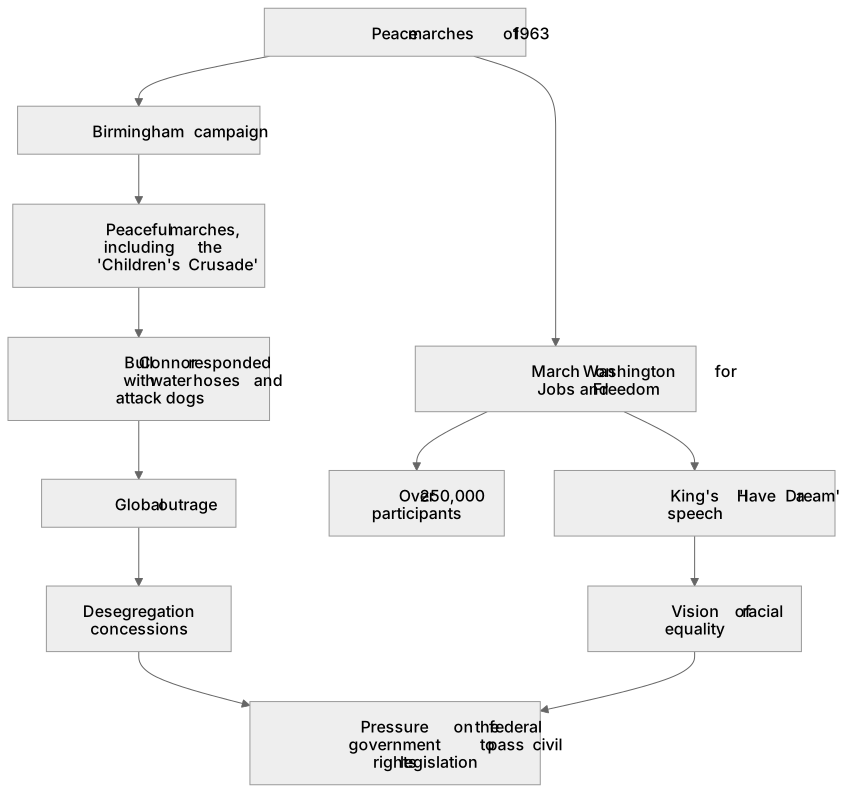
In 1963, Martin Luther King Jr. led pivotal peace marches in Birmingham and Washington, D.C., significantly advancing the civil rights cause. The Birmingham campaign targeted a heavily segregated city, using peaceful marches, including the 'Children's Crusade'. Police Chief Bull Connor responded with water hoses and attack dogs, generating global outrage and forcing desegregation concessions. Later that year, the March on Washington for Jobs and Freedom drew over 250,000 participants. Here, King delivered his iconic 'I Have a Dream' speech, which articulated a powerful vision of racial equality. These marches demonstrated the effectiveness of non-violent direct action, increased white support for civil rights, and placed immense pressure on the federal government to pass comprehensive civil rights legislation.
What earns the marks
- Detail the events of the Birmingham campaign, including the use of children in protests and Bull Connor's violent response.
- Explain the significance of the media coverage in Birmingham in shifting public opinion and forcing federal action.
- Describe the scale and purpose of the 1963 March on Washington, noting the diverse crowd of over 250,000 people.
- Analyse the impact of King's 'I Have a Dream' speech in articulating the goals of the civil rights movement to a national audience.
Common mistakes and how to put them right
Confusing the events of Birmingham with Selma.
Put it right by associating Birmingham with Bull Connor, water hoses, and 1963, and Selma with voting rights and 1965.
Assuming the March on Washington was solely organised by King.
Put it right by acknowledging it was a collaborative effort by the 'Big Six' civil rights leaders, including A. Philip Randolph.
Stating that the marches immediately resulted in the Civil Rights Act.
Put it right by explaining they built crucial pressure, but the Act was passed the following year in 1964.
Exam tips
- Contrast the peaceful tactics of the protesters with the violent reactions of authorities to explain why public sympathy shifted.
- Use specific details, such as the 'Children's Crusade' in Birmingham, to strengthen your narrative of the events.
- Discuss the March on Washington as a turning point in gaining mainstream white support for civil rights legislation.
Try the lesson
The start of the Option 33: Key topic 2: Protest, progress and radicalism, 1960–75 - 2 Peaceful protests and their impact, 1963–65: King and the peace marches of 1963 in Birmingham and Washington. lesson, made from checked teaching notes for this specification point.
Have a go first
What was a key feature of the civil rights campaign led by Martin Luther King Jr. in Birmingham in 1963?
Listen
In 1963, Martin Luther King Jr. led pivotal peace marches in Birmingham and Washington, D.C., significantly advancing the civil rights cause. The Birmingham campaign targeted a heavily segregated city, using peaceful marches, including the 'Children's Crusade'. Police Chief Bull Connor responded with water hoses and attack dogs, generating global outrage and forcing desegregation concessions. Later that year, the March on Washington for Jobs and Freedom drew over 250,000 participants. Here, King delivered his iconic 'I Have a Dream' speech, which articulated a powerful vision of racial equality. These marches demonstrated the effectiveness of non-violent direct action, increased white support for civil rights, and placed immense pressure on the federal government to pass comprehensive civil rights legislation. A strong answer earns marks for these points. Detail the events of the Birmingham campaign, including the use of children in protests and Bull Connor's violent response. Explain the significance of the media coverage in Birmingham in shifting public opinion and forcing federal action. Describe the scale and purpose of the 1963 March on Washington, noting the diverse crowd of over 250,000 people. Analyse the impact of King's 'I Have a Dream' speech in articulating the goals of the civil rights movement to a national audience. A common slip: Confusing the events of Birmingham with Selma. Instead, associating Birmingham with Bull Connor, water hoses, and 1963, and Selma with voting rights and 1965. Exam tip: Contrast the peaceful tactics of the protesters with the violent reactions of authorities to explain why public sympathy shifted.
See it
Key words
Say what each word means before you turn the card.
Non-violent direct action
Try answering aloud or in your head before turning the card.
Media influence and public opinion
Try answering aloud or in your head before turning the card.
Leadership of Martin Luther King Jr.
Try answering aloud or in your head before turning the card.
Legislative pressure
Try answering aloud or in your head before turning the card.
See every definition
- Non-violent direct action
- Peaceful marches, such as those in Birmingham and Washington, which demonstrated the effectiveness of this approach for the civil rights cause.
- Media influence and public opinion
- Coverage of Bull Connor's water hoses and attack dogs in Birmingham generated global outrage and increased white support for civil rights.
- Leadership of Martin Luther King Jr.
- He led pivotal peace marches in Birmingham and Washington, D.C., and delivered the iconic 'I Have a Dream' speech articulating a vision of racial equality.
- Legislative pressure
- The marches placed immense pressure on the federal government to pass comprehensive civil rights legislation.
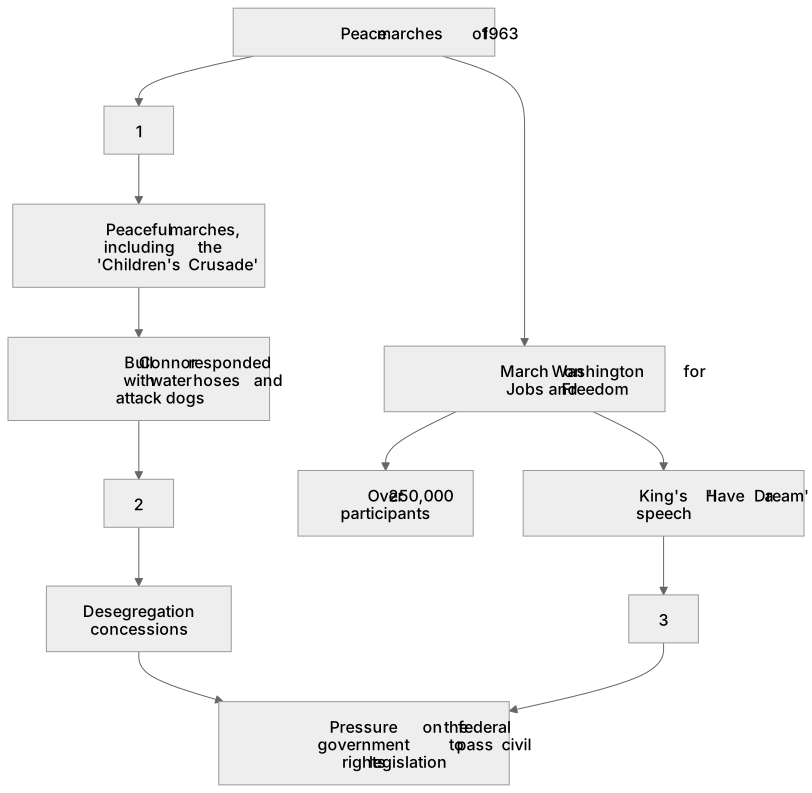
Label the diagram
Some boxes have lost their names. Pick the right name for each number.
1Box 1
2Box 2
3Box 3
There is more to this lesson
The full lesson goes on to check your understanding and help you earn the marks. Create a free account to carry on, with your progress saved.
A week of Premium from your first lesson · Then the free plan continues · No card, no charge
Test your understanding of Option 33: Key topic 2: Protest, progress and radicalism, 1960–75 - 2 Peaceful protests and their impact, 1963–65: King and the peace marches of 1963 in Birmingham and Washington.
Active recall beats re-reading. Take an instant quiz now to test what you’ve learned and lock it into long-term memory.
A week of Premium from your first lesson · Then the free plan continues · No card, no charge