Pearson Edexcel · GCSE · History
Course version: 1HI0 · Version from Sept 2016
Key topic 2: Protest, progress and radicalism, 1960–75 - 2 Peaceful…
Full specification wording
Option 33: Key topic 2: Protest, progress and radicalism, 1960–75 - 2 Peaceful protests and their impact, 1963–65: The impact of peaceful protest and the roles of Presidents Kennedy and Johnson in the passage of the Civil Rights Act (1964). Selma and the Voting Rights Act (1965).
Peaceful protests, such as Birmingham and the March on Washington, created immense public pressure that compelled federal action on civil rights.
Checked against the Pearson Edexcel 1HI0 specification (opens in a new tab) on .
- Point 3 of 3
- 4 key terms
Study notes
From the checked teaching notes for this specification point.
The idea
Peaceful protests, such as Birmingham and the March on Washington, created immense public pressure that compelled federal action on civil rights. President Kennedy initiated the Civil Rights Act in 1963, responding to this pressure, but was assassinated before its passage. President Johnson masterfully used his political skills and Kennedy's legacy to push the Civil Rights Act of 1964 through Congress, legally ending segregation. However, voting discrimination persisted. In 1965, the Selma to Montgomery marches highlighted this issue, culminating in 'Bloody Sunday' where peaceful marchers were brutally attacked by state troopers. The televised violence outraged the nation, prompting Johnson to introduce and sign the Voting Rights Act of 1965, which banned literacy tests and provided federal oversight of elections, transforming Southern politics.
What earns the marks
- Explain how peaceful protests generated media coverage that shifted public opinion and pressured politicians.
- Differentiate the roles of Kennedy (initiating the bill) and Johnson (securing its passage) regarding the 1964 Civil Rights Act.
- Describe the events of the Selma campaign, particularly the violence of 'Bloody Sunday' and its impact on national consciousness.
- Detail the provisions of the 1965 Voting Rights Act, such as the abolition of literacy tests and the introduction of federal examiners.
Common mistakes and how to put them right
Attributing the passage of the Civil Rights Act solely to Kennedy.
Put it right by emphasising Johnson's crucial legislative manoeuvring to overcome the Southern filibuster.
Confusing the Civil Rights Act (1964) with the Voting Rights Act (1965).
Put it right by noting the 1964 Act ended segregation, while the 1965 Act specifically protected voting rights.
Stating that Selma was about desegregating transport.
Put it right by identifying Selma as a campaign specifically focused on voter registration.
Exam tips
- When discussing the Civil Rights Act, explicitly link the legislative success to the groundwork laid by grassroots peaceful protests.
- Use 'Bloody Sunday' as a key example of how televised violence against peaceful protesters forced presidential and congressional action.
- Be prepared to compare the significance of the 1964 Civil Rights Act with the 1965 Voting Rights Act in achieving equality.
Try the lesson
The start of the Option 33: Key topic 2: Protest, progress and radicalism, 1960–75 - 2 Peaceful protests and their impact, 1963–65: The impact of peaceful protest and the roles of Presidents Kennedy and Johnson in the passage of the Civil Rights Act (1964). Selma and the Voting Rights Act (1965). lesson, made from checked teaching notes for this specification point.
Have a go first
Which significant change was introduced by the Civil Rights Act of 1964?
Listen
Peaceful protests, such as Birmingham and the March on Washington, created immense public pressure that compelled federal action on civil rights. President Kennedy initiated the Civil Rights Act in 1963, responding to this pressure, but was assassinated before its passage. President Johnson masterfully used his political skills and Kennedy's legacy to push the Civil Rights Act of 1964 through Congress, legally ending segregation. However, voting discrimination persisted. In 1965, the Selma to Montgomery marches highlighted this issue, culminating in 'Bloody Sunday' where peaceful marchers were brutally attacked by state troopers. The televised violence outraged the nation, prompting Johnson to introduce and sign the Voting Rights Act of 1965, which banned literacy tests and provided federal oversight of elections, transforming Southern politics. A strong answer earns marks for these points. Explain how peaceful protests generated media coverage that shifted public opinion and pressured politicians. Differentiate the roles of Kennedy (initiating the bill) and Johnson (securing its passage) regarding the 1964 Civil Rights Act. Describe the events of the Selma campaign, particularly the violence of 'Bloody Sunday' and its impact on national consciousness. Detail the provisions of the 1965 Voting Rights Act, such as the abolition of literacy tests and the introduction of federal examiners. A common slip: Attributing the passage of the Civil Rights Act solely to Kennedy. Instead, emphasising Johnson's crucial legislative manoeuvring to overcome the Southern filibuster. Exam tip: When discussing the Civil Rights Act, explicitly link the legislative success to the groundwork laid by grassroots peaceful protests.
See it
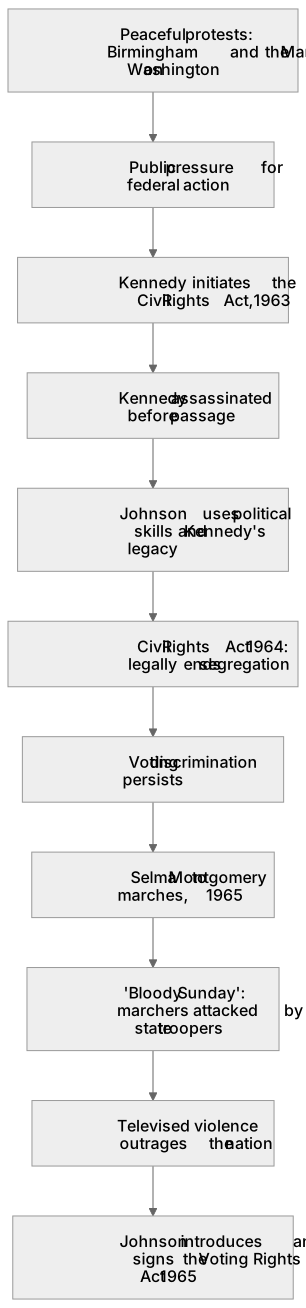
Put the events in order
Put these events in the order they happened, earliest first.
- 1. Kennedy initiated the Civil Rights Act
- 2. Selma to Montgomery marches took place
- 3. Johnson secured passage of the Civil Rights Act
Key words
Say what each word means before you turn the card.
Presidential leadership and legislation
Try answering aloud or in your head before turning the card.
The legislative impact of protest
Try answering aloud or in your head before turning the card.
Voting rights and political empowerment
Try answering aloud or in your head before turning the card.
The role of the media in civil rights
Try answering aloud or in your head before turning the card.
See every definition
- Presidential leadership and legislation
- Kennedy initiated the Civil Rights Act in 1963, while Johnson used his political skills and Kennedy's legacy to push it through Congress.
- The legislative impact of protest
- Peaceful protests created immense public pressure that compelled federal action on civil rights.
- Voting rights and political empowerment
- The Voting Rights Act of 1965 banned literacy tests and provided federal oversight of elections, transforming Southern politics.
- The role of the media in civil rights
- Televised violence against peaceful marchers outraged the nation, prompting Johnson to introduce and sign the Voting Rights Act of 1965.
Label the diagram
Some boxes have lost their names. Pick the right name for each number.
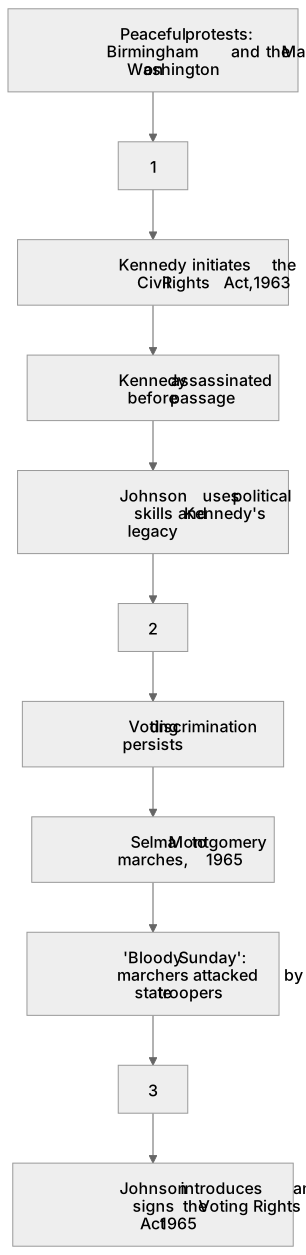
1Box 1
2Box 2
3Box 3
There is more to this lesson
The full lesson goes on to check your understanding and help you earn the marks. Create a free account to carry on, with your progress saved.
A week of Premium from your first lesson · Then the free plan continues · No card, no charge
Test your understanding of Option 33: Key topic 2: Protest, progress and radicalism, 1960–75 - 2 Peaceful protests and their impact, 1963–65: The impact of peaceful protest and the roles of Presidents Kennedy and Johnson in the passage of the Civil Rights Act (1964). Selma and the Voting Rights Act (1965).
Active recall beats re-reading. Take an instant quiz now to test what you’ve learned and lock it into long-term memory.
A week of Premium from your first lesson · Then the free plan continues · No card, no charge