Pearson Edexcel · GCSE · History
Course version: 1HI0 · Version from Sept 2016
Key topic 2: Protest, progress and radicalism, 1960–75 - 3 Malcolm X and…
Full specification wording
Option 33: Key topic 2: Protest, progress and radicalism, 1960–75 - 3 Malcolm X and Black Power, 1963–70: Reasons for the emergence of Black Power. The significance of Stokely Carmichael and the 1968 Mexico Olympics.
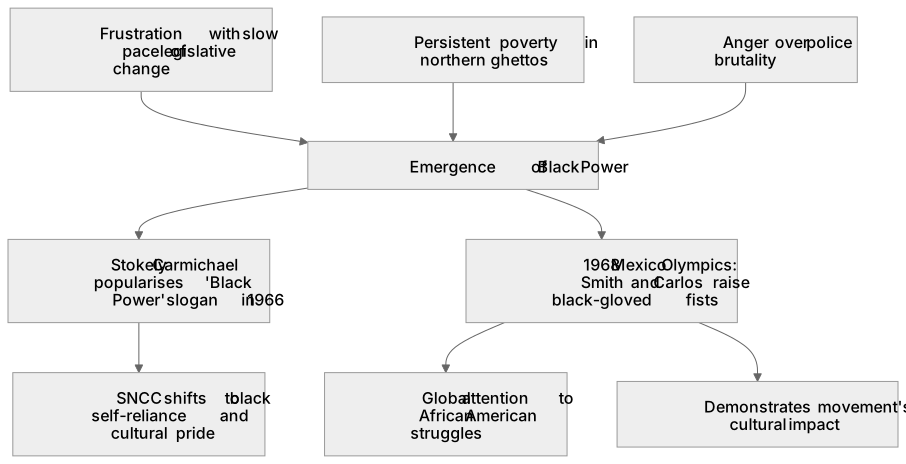
The Black Power movement emerged due to growing frustration with the slow pace of legislative change, persistent poverty in northern ghettos, and anger over police brutality, which non-violent…
Checked against the Pearson Edexcel 1HI0 specification (opens in a new tab) on .
- Point 2 of 3
- 4 key terms
Study notes
From the checked teaching notes for this specification point.
The idea
The Black Power movement emerged due to growing frustration with the slow pace of legislative change, persistent poverty in northern ghettos, and anger over police brutality, which non-violent campaigns failed to resolve. Stokely Carmichael was highly significant; as leader of SNCC, he popularised the slogan 'Black Power' in 1966, shifting the group away from interracial non-violence towards black self-reliance and cultural pride. The 1968 Mexico Olympics provided a massive global platform for this ideology when athletes Tommie Smith and John Carlos raised black-gloved fists during the medal ceremony, bringing international attention to African American struggles and demonstrating the movement's cultural impact.
What earns the marks
- Explain that Black Power emerged from disillusionment with the limitations of non-violent protests in addressing economic inequality and de facto segregation.
- Detail Stokely Carmichael's role in radicalising SNCC and popularising the 'Black Power' slogan during the 1966 March Against Fear.
- Describe the Black Power salute by Tommie Smith and John Carlos at the 1968 Mexico Olympics as a highly visible protest against racial discrimination.
- Analyse the significance of the Olympic protest in bringing global awareness to the American civil rights struggle and inspiring black pride.
Common mistakes and how to put them right
Assuming Black Power was solely about violence.
Put it right by emphasising its focus on black pride, economic self-sufficiency, and political empowerment.
Stating Martin Luther King supported Black Power.
Put it right by noting King rejected the slogan, fearing it would alienate white supporters and provoke violence.
Confusing the 1968 Olympic protest with the Black Panthers.
Put it right by identifying Smith and Carlos as athletes demonstrating solidarity with the broader Black Power movement, not acting as official Panther representatives.
Exam tips
- Link the emergence of Black Power to the failure of the Civil Rights Acts to solve economic and social issues in northern cities.
- Use Stokely Carmichael's 1966 speech as a turning point marking the fracture of the unified, non-violent civil rights coalition.
- Discuss the 1968 Olympics to demonstrate how civil rights protests evolved to utilise international media platforms.
Try the lesson
The start of the Option 33: Key topic 2: Protest, progress and radicalism, 1960–75 - 3 Malcolm X and Black Power, 1963–70: Reasons for the emergence of Black Power. The significance of Stokely Carmichael and the 1968 Mexico Olympics. lesson, made from checked teaching notes for this specification point.
Have a go first
Which of the following was a key reason for the emergence of the Black Power movement in the mid-1960s?
Listen
The Black Power movement emerged due to growing frustration with the slow pace of legislative change, persistent poverty in northern ghettos, and anger over police brutality, which non-violent campaigns failed to resolve. Stokely Carmichael was highly significant; as leader of SNCC, he popularised the slogan 'Black Power' in 1966, shifting the group away from interracial non-violence towards black self-reliance and cultural pride. The 1968 Mexico Olympics provided a massive global platform for this ideology when athletes Tommie Smith and John Carlos raised black-gloved fists during the medal ceremony, bringing international attention to African American struggles and demonstrating the movement's cultural impact. A strong answer earns marks for these points. Explain that Black Power emerged from disillusionment with the limitations of non-violent protests in addressing economic inequality and de facto segregation. Detail Stokely Carmichael's role in radicalising SNCC and popularising the 'Black Power' slogan during the 1966 March Against Fear. Describe the Black Power salute by Tommie Smith and John Carlos at the 1968 Mexico Olympics as a highly visible protest against racial discrimination. Analyse the significance of the Olympic protest in bringing global awareness to the American civil rights struggle and inspiring black pride. A common slip: Assuming Black Power was solely about violence. Instead, emphasising its focus on black pride, economic self-sufficiency, and political empowerment. Exam tip: Link the emergence of Black Power to the failure of the Civil Rights Acts to solve economic and social issues in northern cities.
See it
Key words
Say what each word means before you turn the card.
Black Power
Try answering aloud or in your head before turning the card.
Stokely Carmichael
Try answering aloud or in your head before turning the card.
Black Pride
Try answering aloud or in your head before turning the card.
Media and Protest
Try answering aloud or in your head before turning the card.
See every definition
- Black Power
- A movement that emerged from frustration with the slow pace of legislative change, persistent poverty in northern ghettos and anger over police brutality, focusing on black pride, economic self-sufficiency and political empowerment.
- Stokely Carmichael
- As leader of SNCC, he popularised the slogan 'Black Power' in 1966, shifting the group away from interracial non-violence towards black self-reliance and cultural pride.
- Black Pride
- A focus of the Black Power movement, alongside economic self-sufficiency and political empowerment, rather than being solely about violence.
- Media and Protest
- The use of a massive global platform, as at the 1968 Mexico Olympics, to bring international attention to African American struggles and demonstrate the movement's cultural impact.
Label the diagram
Some boxes have lost their names. Pick the right name for each number.
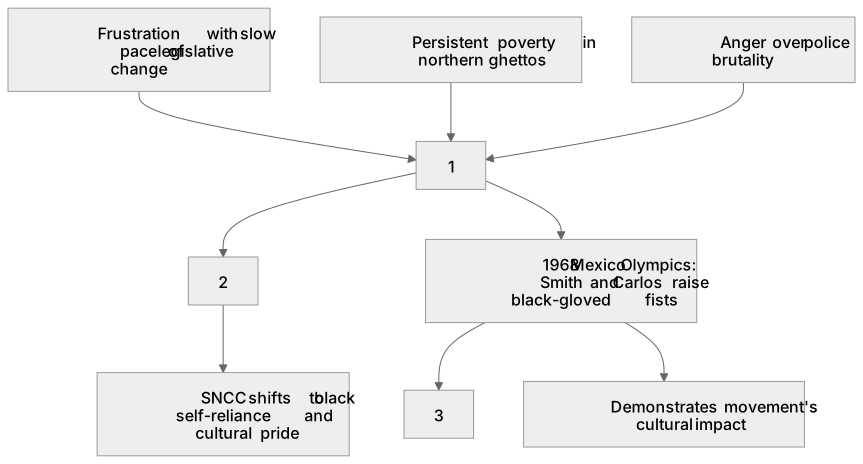
1Box 1
2Box 2
3Box 3
There is more to this lesson
The full lesson goes on to check your understanding and help you earn the marks. Create a free account to carry on, with your progress saved.
A week of Premium from your first lesson · Then the free plan continues · No card, no charge
Test your understanding of Option 33: Key topic 2: Protest, progress and radicalism, 1960–75 - 3 Malcolm X and Black Power, 1963–70: Reasons for the emergence of Black Power. The significance of Stokely Carmichael and the 1968 Mexico Olympics.
Active recall beats re-reading. Take an instant quiz now to test what you’ve learned and lock it into long-term memory.
A week of Premium from your first lesson · Then the free plan continues · No card, no charge