Pearson Edexcel · GCSE · History
Course version: 1HI0 · Version from Sept 2016
Key topic 3: US involvement in the Vietnam War, 1954–75 - 1 Reasons for US…
Full specification wording
Option 33: Key topic 3: US involvement in the Vietnam War, 1954–75 - 1 Reasons for US involvement in the conflict in Vietnam, 1954–63: Reasons for greater US involvement under Eisenhower, including the domino theory and weaknesses of the Diem government.
US involvement in Vietnam escalated under President Eisenhower primarily due to Cold War anxieties.
Checked against the Pearson Edexcel 1HI0 specification (opens in a new tab) on .
- Point 1 of 2
Study notes
From the checked teaching notes for this specification point.
The idea
US involvement in Vietnam escalated under President Eisenhower primarily due to Cold War anxieties. The cornerstone of his policy was the 'domino theory', which posited that if South Vietnam fell to communism, neighbouring Southeast Asian countries would follow. To prevent this, Eisenhower provided substantial financial and military backing to Ngo Dinh Diem’s newly formed Republic of Vietnam. However, Diem’s government was fundamentally weak, characterised by corruption, nepotism, and severe persecution of the Buddhist majority. These weaknesses alienated the South Vietnamese peasantry and fuelled support for the Vietcong. Consequently, the US was forced to increase its involvement, sending military advisors and economic aid to prop up an increasingly fragile regime against communist insurgency.
What earns the marks
- Explain the concept of the domino theory and how it drove Eisenhower's foreign policy in Southeast Asia.
- Describe the financial and advisory support Eisenhower provided to South Vietnam after the French defeat at Dien Bien Phu.
- Identify the weaknesses of Diem's government, including corruption, nepotism, and anti-Buddhist policies.
- Analyse how the unpopularity of Diem's regime necessitated greater US involvement to prevent a communist takeover.
Common mistakes and how to put them right
Confusing Eisenhower's involvement with later presidents.
Put it right: Eisenhower sent financial aid and advisors, not combat troops.
Assuming Diem was a popular democratic leader.
Put it right: Diem was an autocratic leader whose oppressive policies alienated the majority of his population.
Misunderstanding the domino theory.
Put it right: It was a geopolitical theory about the sequential spread of communism, not a military strategy.
Exam tips
- Clearly link the domino theory to the broader context of the Cold War and the policy of containment.
- Use specific examples of Diem's weaknesses, such as his favouritism towards Catholics in a majority Buddhist country, to explain the rise of the Vietcong.
- Emphasise that Eisenhower's involvement laid the groundwork for the subsequent escalation by Kennedy and Johnson.
Try the lesson
The start of the Option 33: Key topic 3: US involvement in the Vietnam War, 1954–75 - 1 Reasons for US involvement in the conflict in Vietnam, 1954–63: Reasons for greater US involvement under Eisenhower, including the domino theory and weaknesses of the Diem government. lesson, made from checked teaching notes for this specification point.
Have a go first
What was the 'domino theory', which President Eisenhower used to justify greater US involvement in Vietnam?
Listen
US involvement in Vietnam escalated under President Eisenhower primarily due to Cold War anxieties. The cornerstone of his policy was the 'domino theory', which posited that if South Vietnam fell to communism, neighbouring Southeast Asian countries would follow. To prevent this, Eisenhower provided substantial financial and military backing to Ngo Dinh Diem’s newly formed Republic of Vietnam. However, Diem’s government was fundamentally weak, characterised by corruption, nepotism, and severe persecution of the Buddhist majority. These weaknesses alienated the South Vietnamese peasantry and fuelled support for the Vietcong. Consequently, the US was forced to increase its involvement, sending military advisors and economic aid to prop up an increasingly fragile regime against communist insurgency. A strong answer earns marks for these points. Explain the concept of the domino theory and how it drove Eisenhower's foreign policy in Southeast Asia. Describe the financial and advisory support Eisenhower provided to South Vietnam after the French defeat at Dien Bien Phu. Identify the weaknesses of Diem's government, including corruption, nepotism, and anti-Buddhist policies. Analyse how the unpopularity of Diem's regime necessitated greater US involvement to prevent a communist takeover. A common slip: Confusing Eisenhower's involvement with later presidents. Instead, Eisenhower sent financial aid and advisors, not combat troops. Exam tip: Clearly link the domino theory to the broader context of the Cold War and the policy of containment.
See it
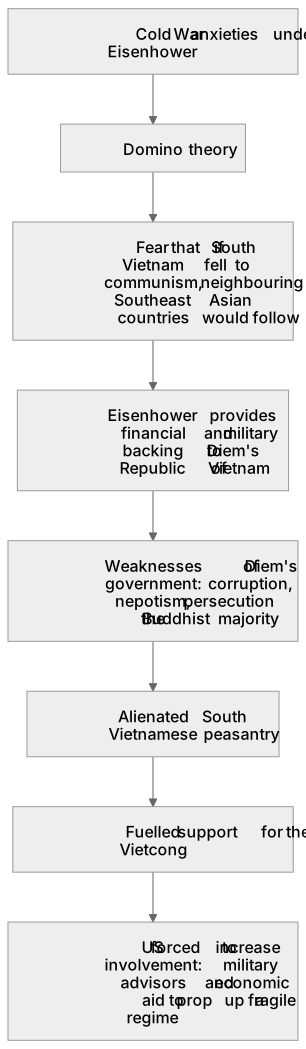
Put it in order
Put these steps in the order they happen.
- 1. Weaknesses of Diem's government: corruption, nepotism, persecution of the Buddhist majority
- 2. US forced to increase involvement: military advisors and economic aid to prop up a fragile regime
- 3. Alienated South Vietnamese peasantry
- 4. Cold War anxieties under Eisenhower
- 5. Domino theory
- 6. Fuelled support for the Vietcong
- 7. Fear that if South Vietnam fell to communism, neighbouring Southeast Asian countries would follow
- 8. Eisenhower provides financial and military backing to Diem's Republic of Vietnam
Label the diagram
Some boxes have lost their names. Pick the right name for each number.
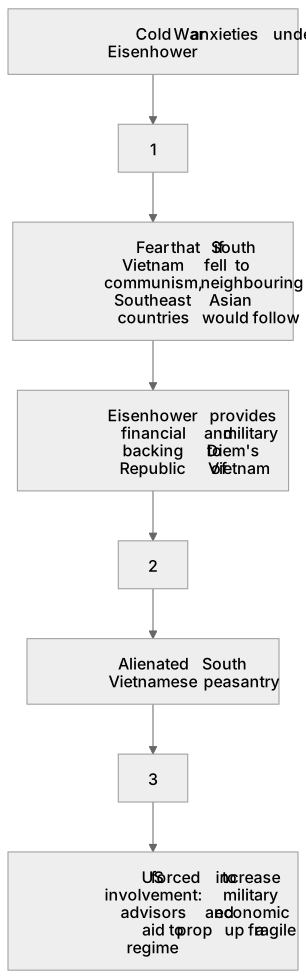
1Box 1
2Box 2
3Box 3
There is more to this lesson
The full lesson goes on to check your understanding and help you earn the marks. Create a free account to carry on, with your progress saved.
A week of Premium from your first lesson · Then the free plan continues · No card, no charge
Test your understanding of Option 33: Key topic 3: US involvement in the Vietnam War, 1954–75 - 1 Reasons for US involvement in the conflict in Vietnam, 1954–63: Reasons for greater US involvement under Eisenhower, including the domino theory and weaknesses of the Diem government.
Active recall beats re-reading. Take an instant quiz now to test what you’ve learned and lock it into long-term memory.
A week of Premium from your first lesson · Then the free plan continues · No card, no charge