Pearson Edexcel · GCSE · History
Course version: 1HI0 · Version from Sept 2016
Key topic 3: US involvement in the Vietnam War, 1954–75 - 3 The nature of…
Full specification wording
Option 33: Key topic 3: US involvement in the Vietnam War, 1954–75 - 3 The nature of the conflict in Vietnam, 1964–68: The guerrilla tactics used by the Vietcong.
The Vietcong employed asymmetric guerrilla tactics to counter the superior firepower and technology of the US military.
Checked against the Pearson Edexcel 1HI0 specification (opens in a new tab) on .
- Point 1 of 3
- 2 key terms
Study notes
From the checked teaching notes for this specification point.
The idea
The Vietcong employed asymmetric guerrilla tactics to counter the superior firepower and technology of the US military. Lacking heavy weaponry, they relied on the element of surprise, mobility, and deep knowledge of the local terrain. Key methods included 'hit-and-run' ambushes, where fighters would attack US patrols and quickly melt back into the jungle or civilian population. They constructed extensive underground tunnel networks, such as those at Cu Chi, providing safe havens, supply routes, and hospitals. Furthermore, the Vietcong extensively used booby traps, like punji stakes and tripwire explosives, which inflicted severe psychological and physical damage on US troops while requiring minimal resources to deploy.
What earns the marks
- Describe the use of 'hit-and-run' ambush tactics to minimise casualties against superior US firepower.
- Explain the strategic importance of tunnel networks (e.g., Cu Chi) for hiding, communication, and medical care.
- Identify specific booby traps used, such as punji stakes and repurposed unexploded US ordnance.
- Discuss the psychological impact of these tactics on the morale of US soldiers.
- Explain how blending in with the local peasant population provided camouflage and logistical support.
Common mistakes and how to put them right
Describing Vietcong tactics as traditional, pitched battles.
Put it right: Emphasise that they actively avoided large-scale, open battles where US airpower and artillery would dominate.
Assuming the Vietcong were poorly organised because they used guerrilla tactics.
Put it right: Highlight that their tactics were highly coordinated, disciplined, and supported by the Ho Chi Minh Trail.
Stating that booby traps caused the majority of US deaths.
Put it right: Clarify that while booby traps caused significant casualties, their primary effect was psychological, creating constant fear.
Exam tips
- Use specific examples of tactics, such as 'punji stakes' or 'Cu Chi tunnels', to add precise detail to your answers.
- Always link the tactic to its intended effect, such as how blending in with civilians made US 'Search and Destroy' missions extremely difficult.
- Contrast Vietcong methods with US conventional warfare to highlight the asymmetric nature of the conflict.
Try the lesson
The start of the Option 33: Key topic 3: US involvement in the Vietnam War, 1954–75 - 3 The nature of the conflict in Vietnam, 1964–68: The guerrilla tactics used by the Vietcong. lesson, made from checked teaching notes for this specification point.
Have a go first
Which of the following was a key guerrilla tactic used by the Vietcong during the Vietnam War?
Listen
The Vietcong employed asymmetric guerrilla tactics to counter the superior firepower and technology of the US military. Lacking heavy weaponry, they relied on the element of surprise, mobility, and deep knowledge of the local terrain. Key methods included 'hit-and-run' ambushes, where fighters would attack US patrols and quickly melt back into the jungle or civilian population. They constructed extensive underground tunnel networks, such as those at Cu Chi, providing safe havens, supply routes, and hospitals. Furthermore, the Vietcong extensively used booby traps, like punji stakes and tripwire explosives, which inflicted severe psychological and physical damage on US troops while requiring minimal resources to deploy. A strong answer earns marks for these points. Describe the use of 'hit-and-run' ambush tactics to minimise casualties against superior US firepower. Explain the strategic importance of tunnel networks (e.g., Cu Chi) for hiding, communication, and medical care. Identify specific booby traps used, such as punji stakes and repurposed unexploded US ordnance. Discuss the psychological impact of these tactics on the morale of US soldiers. A common slip: Describing Vietcong tactics as traditional, pitched battles. Instead, Emphasise that they actively avoided large-scale, open battles where US airpower and artillery would dominate. Exam tip: Use specific examples of tactics, such as 'punji stakes' or 'Cu Chi tunnels', to add precise detail to your answers.
See it
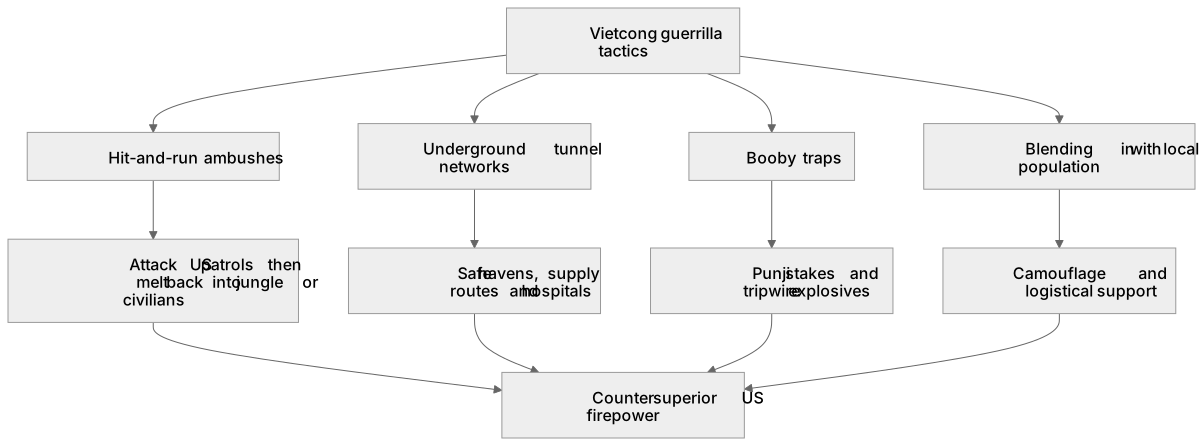
Key words
Say what each word means before you turn the card.
Terrain
Try answering aloud or in your head before turning the card.
Guerrilla Tactics
Try answering aloud or in your head before turning the card.
See every definition
- Terrain
- The local surroundings, of which the Vietcong had deep knowledge and on which they relied alongside surprise and mobility.
- Guerrilla Tactics
- Methods including 'hit-and-run' ambushes, where fighters would attack US patrols and quickly melt back into the jungle or civilian population.
Label the diagram
Some boxes have lost their names. Pick the right name for each number.
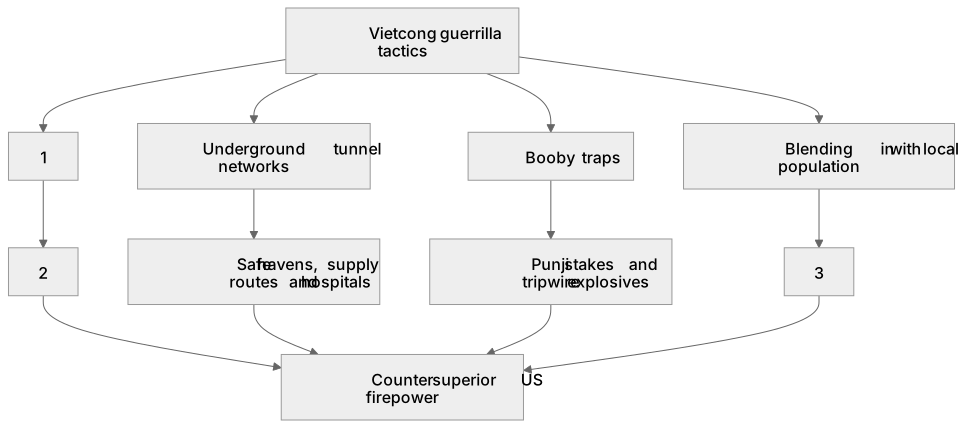
1Box 1
2Box 2
3Box 3
There is more to this lesson
The full lesson goes on to check your understanding and help you earn the marks. Create a free account to carry on, with your progress saved.
A week of Premium from your first lesson · Then the free plan continues · No card, no charge
Test your understanding of Option 33: Key topic 3: US involvement in the Vietnam War, 1954–75 - 3 The nature of the conflict in Vietnam, 1964–68: The guerrilla tactics used by the Vietcong.
Active recall beats re-reading. Take an instant quiz now to test what you’ve learned and lock it into long-term memory.
A week of Premium from your first lesson · Then the free plan continues · No card, no charge