Pearson Edexcel · GCSE · History
Course version: 1HI0 · Version from Sept 2016
Key topic 3: US involvement in the Vietnam War, 1954–75 - 4 Changes under…
Full specification wording
Option 33: Key topic 3: US involvement in the Vietnam War, 1954–75 - 4 Changes under Nixon, 1969–73: The key features of Vietnamisation. Reasons for its failure.
Vietnamisation, introduced by President Nixon in 1969, aimed to shift the burden of combat from US troops to the Army of the Republic of Vietnam (ARVN).
Checked against the Pearson Edexcel 1HI0 specification (opens in a new tab) on .
- Point 1 of 3
- 4 key terms
Study notes
From the checked teaching notes for this specification point.
The idea
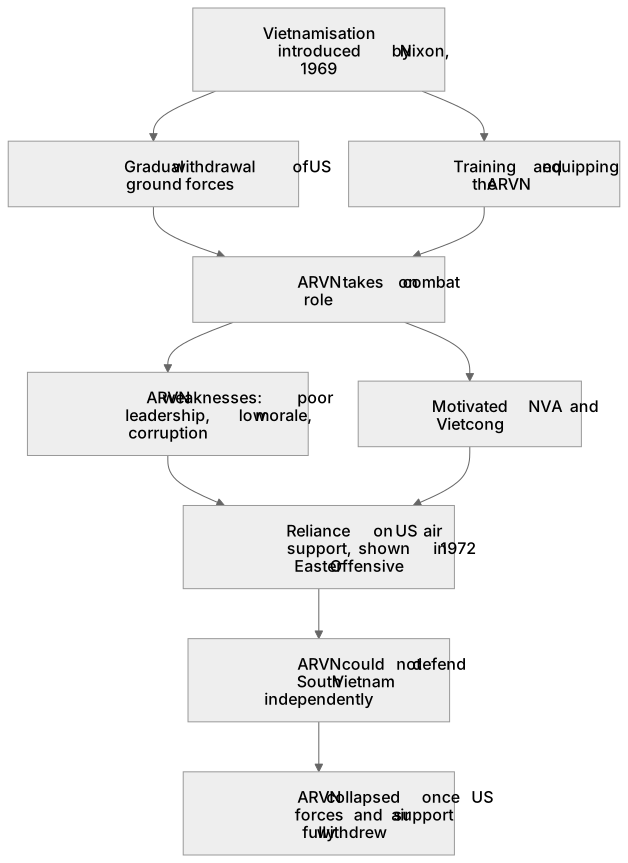
Vietnamisation, introduced by President Nixon in 1969, aimed to shift the burden of combat from US troops to the Army of the Republic of Vietnam (ARVN). Key features included the gradual withdrawal of US ground forces, extensive training, and equipping the ARVN with modern American weapons. However, Vietnamisation ultimately failed. The ARVN suffered from poor leadership, low morale, and widespread corruption, making them ineffective against the highly motivated North Vietnamese Army (NVA) and Vietcong. Furthermore, while massive US air support was critical in halting the 1972 Easter Offensive, this reliance demonstrated that the ARVN could not defend South Vietnam independently. Once US forces and air support fully withdrew, the ARVN collapsed.
What earns the marks
- Identify the main goal of Vietnamisation: transferring combat responsibilities to the ARVN while withdrawing US troops.
- Describe the methods used, such as supplying the ARVN with modern equipment and providing extensive training.
- Explain the reasons for failure related to the ARVN, including low morale, high desertion rates, and corrupt leadership.
- Explain the reasons for failure related to the enemy, noting the continued strength and motivation of the NVA and Vietcong.
Common mistakes and how to put them right
Claiming Vietnamisation meant an immediate end to all US involvement.
Put it right: Explain that it involved a gradual withdrawal of ground troops while maintaining significant US air support and funding.
Stating the ARVN was completely destroyed immediately after US withdrawal.
Put it right: Note that the ARVN continued to fight but struggled significantly without US ground support, eventually collapsing in 1975.
Confusing Vietnamisation with the Strategic Hamlet Program.
Put it right: Ensure Vietnamisation is clearly defined as Nixon's policy of building up the ARVN to replace US troops, not Kennedy's earlier pacification policy.
Exam tips
- When evaluating the success of Vietnamisation, contrast the theoretical aims with the practical realities of the ARVN's performance.
- Use specific examples, such as the ARVN's heavy reliance on US air power during the 1972 Easter Offensive, to illustrate the policy's failure to create an independent force.
Try the lesson
The start of the Option 33: Key topic 3: US involvement in the Vietnam War, 1954–75 - 4 Changes under Nixon, 1969–73: The key features of Vietnamisation. Reasons for its failure. lesson, made from checked teaching notes for this specification point.
Have a go first
What was the primary goal of President Nixon's policy of Vietnamisation?
Listen
Vietnamisation, introduced by President Nixon in 1969, aimed to shift the burden of combat from US troops to the Army of the Republic of Vietnam (ARVN). Key features included the gradual withdrawal of US ground forces, extensive training, and equipping the ARVN with modern American weapons. However, Vietnamisation ultimately failed. The ARVN suffered from poor leadership, low morale, and widespread corruption, making them ineffective against the highly motivated North Vietnamese Army (NVA) and Vietcong. Furthermore, while massive US air support was critical in halting the 1972 Easter Offensive, this reliance demonstrated that the ARVN could not defend South Vietnam independently. Once US forces and air support fully withdrew, the ARVN collapsed. A strong answer earns marks for these points. Identify the main goal of Vietnamisation: transferring combat responsibilities to the ARVN while withdrawing US troops. Describe the methods used, such as supplying the ARVN with modern equipment and providing extensive training. Explain the reasons for failure related to the ARVN, including low morale, high desertion rates, and corrupt leadership. Explain the reasons for failure related to the enemy, noting the continued strength and motivation of the NVA and Vietcong. A common slip: Claiming Vietnamisation meant an immediate end to all US involvement. Instead, Explain that it involved a gradual withdrawal of ground troops while maintaining significant US air support and funding. Exam tip: When evaluating the success of Vietnamisation, contrast the theoretical aims with the practical realities of the ARVN's performance.
See it
Key words
Say what each word means before you turn the card.
Vietnamisation
Try answering aloud or in your head before turning the card.
ARVN
Try answering aloud or in your head before turning the card.
NVA
Try answering aloud or in your head before turning the card.
Easter Offensive
Try answering aloud or in your head before turning the card.
See every definition
- Vietnamisation
- Policy introduced by President Nixon in 1969 that aimed to shift the burden of combat from US troops to the Army of the Republic of Vietnam.
- ARVN
- The Army of the Republic of Vietnam, which was to take over combat responsibilities, received modern American weapons and extensive training, but suffered from poor leadership, low morale and widespread corruption.
- NVA
- The highly motivated North Vietnamese Army, which the ARVN was ineffective against.
- Easter Offensive
- The 1972 offensive that massive US air support was critical in halting, demonstrating that the ARVN could not defend South Vietnam independently.
Label the diagram
Some boxes have lost their names. Pick the right name for each number.
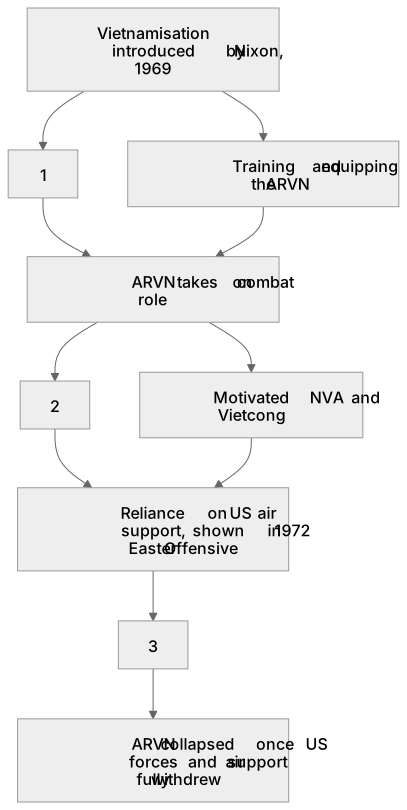
1Box 1
2Box 2
3Box 3
There is more to this lesson
The full lesson goes on to check your understanding and help you earn the marks. Create a free account to carry on, with your progress saved.
A week of Premium from your first lesson · Then the free plan continues · No card, no charge
Test your understanding of Option 33: Key topic 3: US involvement in the Vietnam War, 1954–75 - 4 Changes under Nixon, 1969–73: The key features of Vietnamisation. Reasons for its failure.
Active recall beats re-reading. Take an instant quiz now to test what you’ve learned and lock it into long-term memory.
A week of Premium from your first lesson · Then the free plan continues · No card, no charge