Pearson Edexcel · GCSE · History
Course version: 1HI0 · Version from Sept 2016
Key topic 1: Anglo-Saxon England and the Norman Conquest, 1060–66 - 1…
Full specification wording
Option B1: Key topic 1: Anglo-Saxon England and the Norman Conquest, 1060–66 - 1 Anglo-Saxon government, economy and society: Monarchy and government. The power of the English monarchy. Earldoms, local government and the legal system.
Anglo-Saxon England in 1060 was a highly organised state centred on the power of the English monarchy.
Checked against the Pearson Edexcel 1HI0 specification (opens in a new tab) on .
- Point 1 of 2
- 3 key terms
Study notes
From the checked teaching notes for this specification point.
The idea
Anglo-Saxon England in 1060 was a highly organised state centred on the power of the English monarchy. The king held supreme authority, controlling the minting of coin, raising the fyrd (army), and granting land. However, this power relied heavily on the earldoms, governed by powerful earls like the Godwins, who acted as the king's military and political deputies. Local government was sophisticated, divided into shires and hundreds, managed by shire reeves (sheriffs) who collected taxes and enforced royal decrees. The legal system relied on collective responsibility, using the tithing system and the hue and cry to maintain order, alongside trial by ordeal. This structure balanced centralised royal power with delegated local administration.
What earns the marks
- Details the extensive powers of the Anglo-Saxon monarch, including law-making, taxation, and military command.
- Explains the role and immense power of the earls in managing the large earldoms and advising the king in the Witan.
- Describes the structure of local government, specifically the division of land into shires and hundreds, and the role of the shire reeve.
- Outlines the mechanisms of the legal system, including tithings, the hue and cry, and the use of blood feuds or Wergild.
Common mistakes and how to put them right
Assuming the king had absolute, unchecked power.
Put it right by noting the king's reliance on the earls and the Witan for support and enforcement.
Confusing the roles of earls and shire reeves.
Put it right: Earls governed vast regions (earldoms), while shire reeves managed the smaller shires on behalf of the king.
Describing the legal system as primitive.
Put it right: Recognise it as a highly organised system based on community responsibility (tithings).
Exam tips
- Use specific Anglo-Saxon terminology such as 'fyrd', 'Witan', 'shire reeve', and 'tithing' to demonstrate precise knowledge.
- When discussing the power of the monarchy, always balance it by explaining the influence of the powerful Godwin family.
- Link local government directly to the legal system by explaining how shire reeves presided over shire courts to enforce the king's laws.
Try the lesson
The start of the Option B1: Key topic 1: Anglo-Saxon England and the Norman Conquest, 1060–66 - 1 Anglo-Saxon government, economy and society: Monarchy and government. The power of the English monarchy. Earldoms, local government and the legal system. lesson, made from checked teaching notes for this specification point.
Have a go first
In late Anglo-Saxon England, what was the primary role of the Witan?
Listen
Anglo-Saxon England in 1060 was a highly organised state centred on the power of the English monarchy. The king held supreme authority, controlling the minting of coin, raising the fyrd (army), and granting land. However, this power relied heavily on the earldoms, governed by powerful earls like the Godwins, who acted as the king's military and political deputies. Local government was sophisticated, divided into shires and hundreds, managed by shire reeves (sheriffs) who collected taxes and enforced royal decrees. The legal system relied on collective responsibility, using the tithing system and the hue and cry to maintain order, alongside trial by ordeal. This structure balanced centralised royal power with delegated local administration. A strong answer earns marks for these points. Details the extensive powers of the Anglo-Saxon monarch, including law-making, taxation, and military command. Explains the role and immense power of the earls in managing the large earldoms and advising the king in the Witan. Describes the structure of local government, specifically the division of land into shires and hundreds, and the role of the shire reeve. Outlines the mechanisms of the legal system, including tithings, the hue and cry, and the use of blood feuds or Wergild. A common slip: Assuming the king had absolute, unchecked power. Instead, noting the king's reliance on the earls and the Witan for support and enforcement. Exam tip: Use specific Anglo-Saxon terminology such as 'fyrd', 'Witan', 'shire reeve', and 'tithing' to demonstrate precise knowledge.
See it
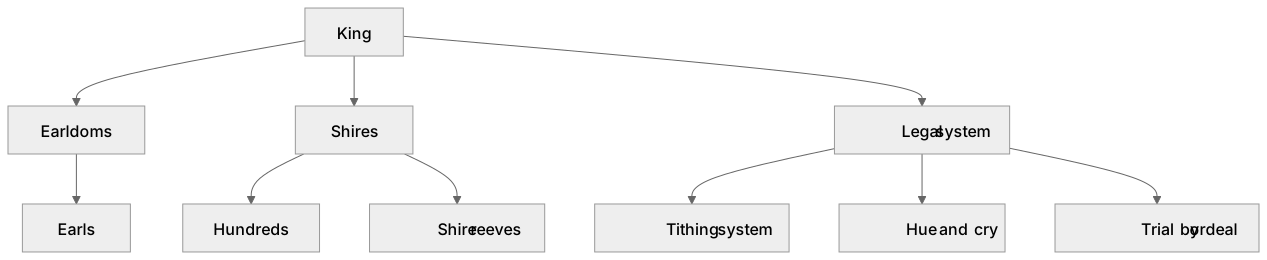
Key words
Say what each word means before you turn the card.
Royal authority
Try answering aloud or in your head before turning the card.
Local administration
Try answering aloud or in your head before turning the card.
Law and order
Try answering aloud or in your head before turning the card.
See every definition
- Royal authority
- The supreme power of the English monarchy, which controlled the minting of coin, raising the fyrd and granting land.
- Local administration
- A sophisticated system dividing land into shires and hundreds, managed by shire reeves who collected taxes and enforced royal decrees.
- Law and order
- A legal system relying on collective responsibility, using the tithing system and the hue and cry to maintain order, alongside trial by ordeal.
Label the diagram
Some boxes have lost their names. Pick the right name for each number.
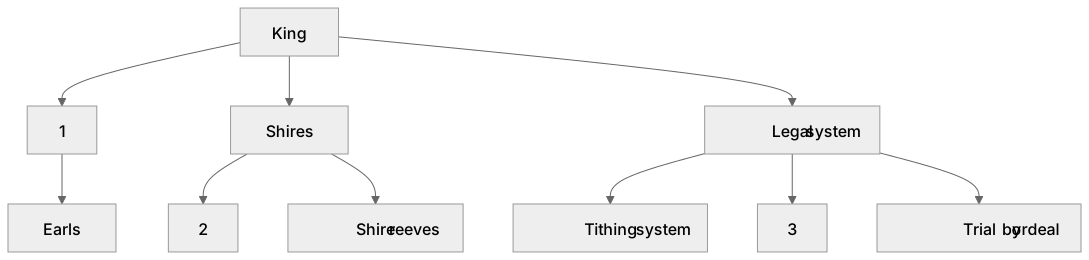
1Box 1
2Box 2
3Box 3
There is more to this lesson
The full lesson goes on to check your understanding and help you earn the marks. Create a free account to carry on, with your progress saved.
A week of Premium from your first lesson · Then the free plan continues · No card, no charge
Test your understanding of Option B1: Key topic 1: Anglo-Saxon England and the Norman Conquest, 1060–66 - 1 Anglo-Saxon government, economy and society: Monarchy and government. The power of the English monarchy. Earldoms, local government and the legal system.
Active recall beats re-reading. Take an instant quiz now to test what you’ve learned and lock it into long-term memory.
A week of Premium from your first lesson · Then the free plan continues · No card, no charge