Pearson Edexcel · GCSE · History
Course version: 1HI0 · Version from Sept 2016
Key topic 1: Anglo-Saxon England and the Norman Conquest, 1060–66 - 2 The…
Full specification wording
Option B1: Key topic 1: Anglo-Saxon England and the Norman Conquest, 1060–66 - 2 The last years of Edward the Confessor and the succession crisis: The significance and power of the house of Godwin. Harold Godwinson’s succession as Earl of Wessex.
The House of Godwin was the most formidable noble family in late Anglo-Saxon England, wielding immense political, economic, and military power.
Checked against the Pearson Edexcel 1HI0 specification (opens in a new tab) on .
- Point 1 of 2
- 4 key terms
Study notes
From the checked teaching notes for this specification point.
The idea
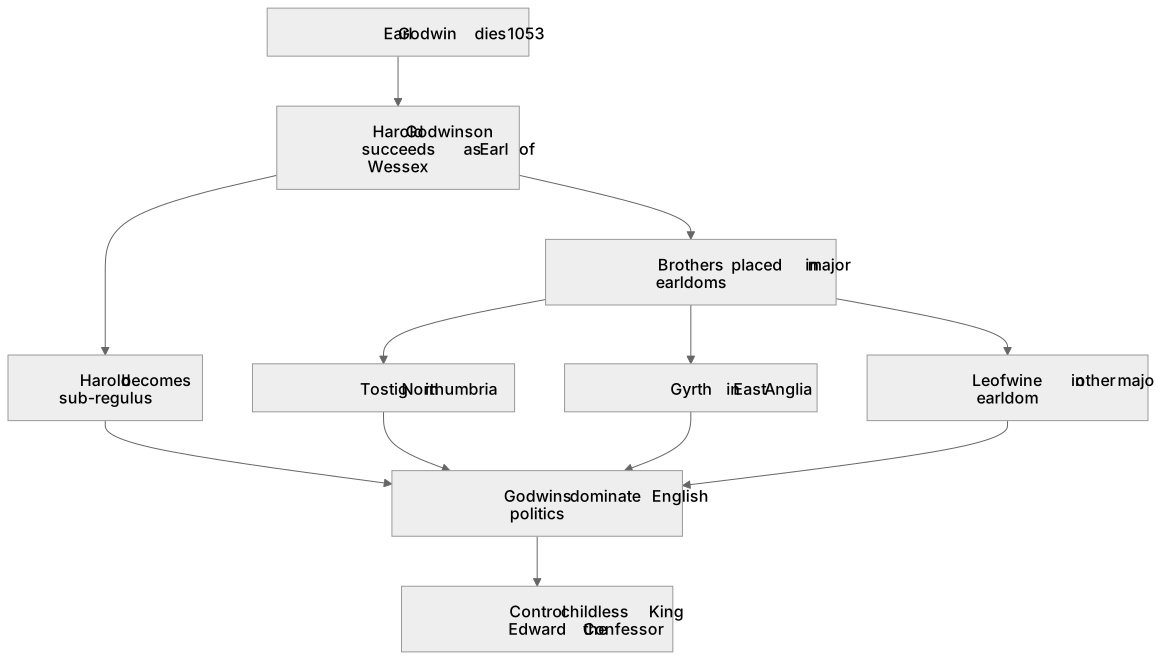
The House of Godwin was the most formidable noble family in late Anglo-Saxon England, wielding immense political, economic, and military power. Their significance stemmed from controlling vast earldoms, which provided them with wealth that rivalled the king's and the ability to raise massive armies (the fyrd). When Earl Godwin died in 1053, his son Harold Godwinson succeeded him as Earl of Wessex, the richest earldom in England. This succession consolidated Harold's position as the king's right-hand man (sub-regulus). By strategically placing his brothers—Tostig, Gyrth, and Leofwine—into other major earldoms, Harold ensured the Godwins dominated English politics, effectively surrounding and controlling the childless King Edward the Confessor.
What earns the marks
- Identify the vast landholdings of the Godwin family, noting that their combined wealth exceeded that of King Edward.
- Explain how Harold Godwinson's succession to the Earldom of Wessex in 1053 made him the most powerful noble in England.
- Describe the strategic placement of Harold's brothers (Tostig in Northumbria, Gyrth in East Anglia) to secure national dominance.
- Analyse the military power of the Godwins, specifically their ability to summon a massive fyrd and maintain a fleet of ships.
Common mistakes and how to put them right
Assuming King Edward had absolute power.
Put it right: Recognise that the Godwins held significant practical power and could pressure the king.
Confusing Earl Godwin with Harold Godwinson.
Put it right: Clearly distinguish between the father (Godwin) who died in 1053 and the son (Harold) who succeeded him.
Stating the Godwins controlled all of England.
Put it right: Note that Mercia remained under the control of a rival family (Aelfgar), providing a check on Godwin power.
Exam tips
- Use the term 'sub-regulus' (deputy king) to demonstrate high-level understanding of Harold Godwinson's status after 1053.
- When explaining Godwin power, explicitly link their vast land ownership to their ability to raise large armies.
- Reference the specific earldoms controlled by the brothers (Wessex, Northumbria, East Anglia) to provide concrete evidence of their dominance.
Try the lesson
The start of the Option B1: Key topic 1: Anglo-Saxon England and the Norman Conquest, 1060–66 - 2 The last years of Edward the Confessor and the succession crisis: The significance and power of the house of Godwin. Harold Godwinson’s succession as Earl of Wessex. lesson, made from checked teaching notes for this specification point.
Have a go first
Following the death of his father Godwin in 1053, what major title and territory did Harold Godwinson inherit?
Listen
The House of Godwin was the most formidable noble family in late Anglo-Saxon England, wielding immense political, economic, and military power. Their significance stemmed from controlling vast earldoms, which provided them with wealth that rivalled the king's and the ability to raise massive armies (the fyrd). When Earl Godwin died in 1053, his son Harold Godwinson succeeded him as Earl of Wessex, the richest earldom in England. This succession consolidated Harold's position as the king's right-hand man (sub-regulus). By strategically placing his brothers—Tostig, Gyrth, and Leofwine—into other major earldoms, Harold ensured the Godwins dominated English politics, effectively surrounding and controlling the childless King Edward the Confessor. A strong answer earns marks for these points. Identify the vast landholdings of the Godwin family, noting that their combined wealth exceeded that of King Edward. Explain how Harold Godwinson's succession to the Earldom of Wessex in 1053 made him the most powerful noble in England. Describe the strategic placement of Harold's brothers (Tostig in Northumbria, Gyrth in East Anglia) to secure national dominance. Analyse the military power of the Godwins, specifically their ability to summon a massive fyrd and maintain a fleet of ships. A common slip: Assuming King Edward had absolute power. Instead, recognise that the Godwins held significant practical power and could pressure the king. Exam tip: Use the term 'sub-regulus' (deputy king) to demonstrate high-level understanding of Harold Godwinson's status after 1053.
See it
Key words
Say what each word means before you turn the card.
Power and authority
Try answering aloud or in your head before turning the card.
Land and wealth
Try answering aloud or in your head before turning the card.
Succession and inheritance
Try answering aloud or in your head before turning the card.
Nobility and the King
Try answering aloud or in your head before turning the card.
See every definition
- Power and authority
- The Godwins held immense political, economic and military power and could pressure the king, rather than the king having absolute power.
- Land and wealth
- The family's vast landholdings and earldoms gave them wealth that rivalled or exceeded the king's.
- Succession and inheritance
- When Earl Godwin died in 1053, his son Harold Godwinson succeeded him as Earl of Wessex, the richest earldom in England.
- Nobility and the King
- Harold became the king's right-hand man, or sub-regulus, and the strategic placement of his brothers ensured the Godwins dominated English politics and effectively surrounded and controlled the childless King Edward the Confessor.
Label the diagram
Some boxes have lost their names. Pick the right name for each number.
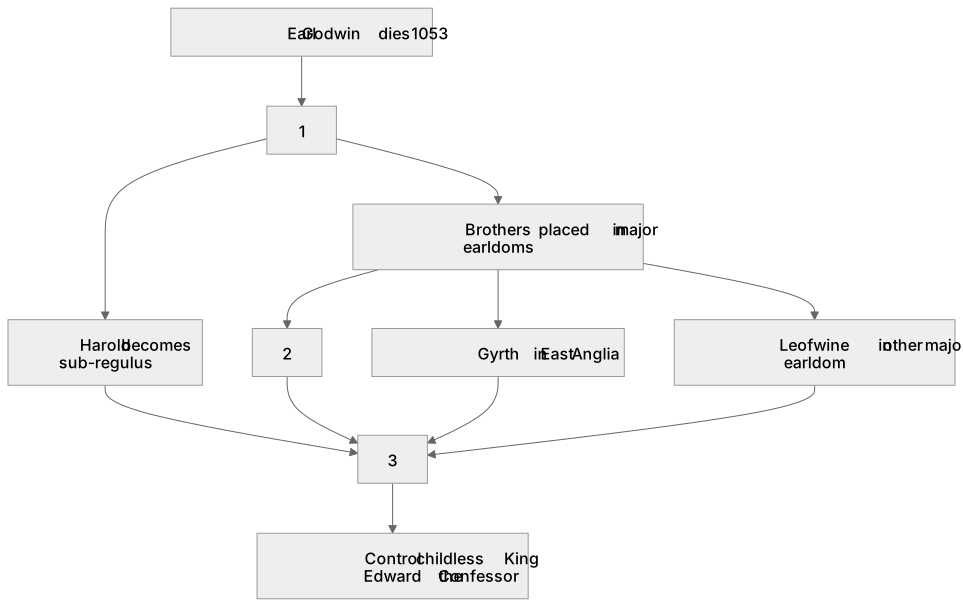
1Box 1
2Box 2
3Box 3
There is more to this lesson
The full lesson goes on to check your understanding and help you earn the marks. Create a free account to carry on, with your progress saved.
A week of Premium from your first lesson · Then the free plan continues · No card, no charge
Test your understanding of Option B1: Key topic 1: Anglo-Saxon England and the Norman Conquest, 1060–66 - 2 The last years of Edward the Confessor and the succession crisis: The significance and power of the house of Godwin. Harold Godwinson’s succession as Earl of Wessex.
Active recall beats re-reading. Take an instant quiz now to test what you’ve learned and lock it into long-term memory.
A week of Premium from your first lesson · Then the free plan continues · No card, no charge