Pearson Edexcel · GCSE · History
Course version: 1HI0 · Version from Sept 2016
Key topic 3: Norman England, 1066–88 - 3 The Norman aristocracy: The…
Full specification wording
Option B1: Key topic 3: Norman England, 1066–88 - 3 The Norman aristocracy: The culture and language of the Norman aristocracy.
The Norman aristocracy introduced a distinct culture that separated them from the conquered Anglo-Saxons.
Checked against the Pearson Edexcel 1HI0 specification (opens in a new tab) on .
- Point 1 of 2
- 3 key terms
Study notes
From the checked teaching notes for this specification point.
The idea
The Norman aristocracy introduced a distinct culture that separated them from the conquered Anglo-Saxons. They spoke Norman French, which became the language of government, law, and the elite, while Latin was used for written administration and the Church. English was relegated to the peasantry. Culturally, the Normans emphasised martial prowess, chivalry, and the display of wealth through grand stone castles and cathedrals. They introduced new naming conventions (like William and Richard) and altered aristocratic pastimes, notably establishing extensive royal forests for exclusive hunting privileges. This cultural and linguistic divide reinforced their status as an elite ruling class and visually demonstrated their dominance over the native population.
What earns the marks
- Identify Norman French as the spoken language of the elite and Latin as the language of written records.
- Explain how language created a social barrier, relegating English to the lower classes.
- Describe Norman aristocratic culture, including the emphasis on warfare, knighthood, and chivalric values.
- Detail the physical manifestations of Norman culture, such as castle building, patronage of the Church, and hunting in royal forests.
Common mistakes and how to put them right
Stating that the Normans forced the English peasants to speak French.
Put it right: The peasants continued to speak English; French was exclusively the language of the aristocracy and court.
Assuming Norman culture was identical to Anglo-Saxon culture.
Put it right: Norman culture was heavily militarised and focused on chivalry, contrasting with Anglo-Saxon traditions.
Claiming all written documents were in French.
Put it right: Latin was the primary language for official written administration and Church documents, not French.
Exam tips
- Use the introduction of the Forest Laws as a concrete example of how Norman aristocratic culture impacted the English landscape and people.
- Link the building of stone castles and cathedrals to the Norman desire to display wealth, piety, and permanence.
- When explaining the impact of the Norman Conquest, use language as a key factor in how the new elite segregated themselves from the native population.
Try the lesson
The start of the Option B1: Key topic 3: Norman England, 1066–88 - 3 The Norman aristocracy: The culture and language of the Norman aristocracy. lesson, made from checked teaching notes for this specification point.
Have a go first
Which language became the primary language of the aristocracy and royal court in England following the Norman Conquest?
Listen
The Norman aristocracy introduced a distinct culture that separated them from the conquered Anglo-Saxons. They spoke Norman French, which became the language of government, law, and the elite, while Latin was used for written administration and the Church. English was relegated to the peasantry. Culturally, the Normans emphasised martial prowess, chivalry, and the display of wealth through grand stone castles and cathedrals. They introduced new naming conventions (like William and Richard) and altered aristocratic pastimes, notably establishing extensive royal forests for exclusive hunting privileges. This cultural and linguistic divide reinforced their status as an elite ruling class and visually demonstrated their dominance over the native population. A strong answer earns marks for these points. Identify Norman French as the spoken language of the elite and Latin as the language of written records. Explain how language created a social barrier, relegating English to the lower classes. Describe Norman aristocratic culture, including the emphasis on warfare, knighthood, and chivalric values. Detail the physical manifestations of Norman culture, such as castle building, patronage of the Church, and hunting in royal forests. A common slip: Stating that the Normans forced the English peasants to speak French. Instead, The peasants continued to speak English; French was exclusively the language of the aristocracy and court. Exam tip: Use the introduction of the Forest Laws as a concrete example of how Norman aristocratic culture impacted the English landscape and people.
See it
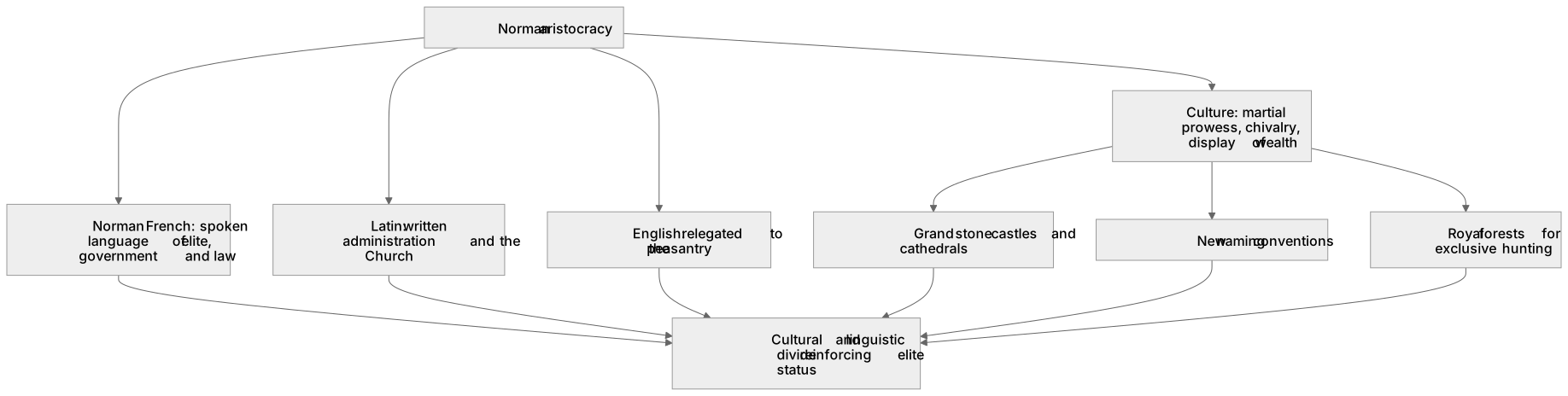
Key words
Say what each word means before you turn the card.
Norman French
Try answering aloud or in your head before turning the card.
Latin
Try answering aloud or in your head before turning the card.
Royal forests
Try answering aloud or in your head before turning the card.
See every definition
- Norman French
- The spoken language of the elite, which became the language of government, law and the aristocracy.
- Latin
- The language used for written administration and the Church.
- Royal forests
- Extensive areas established by the Normans for exclusive hunting privileges.
Label the diagram
Some boxes have lost their names. Pick the right name for each number.
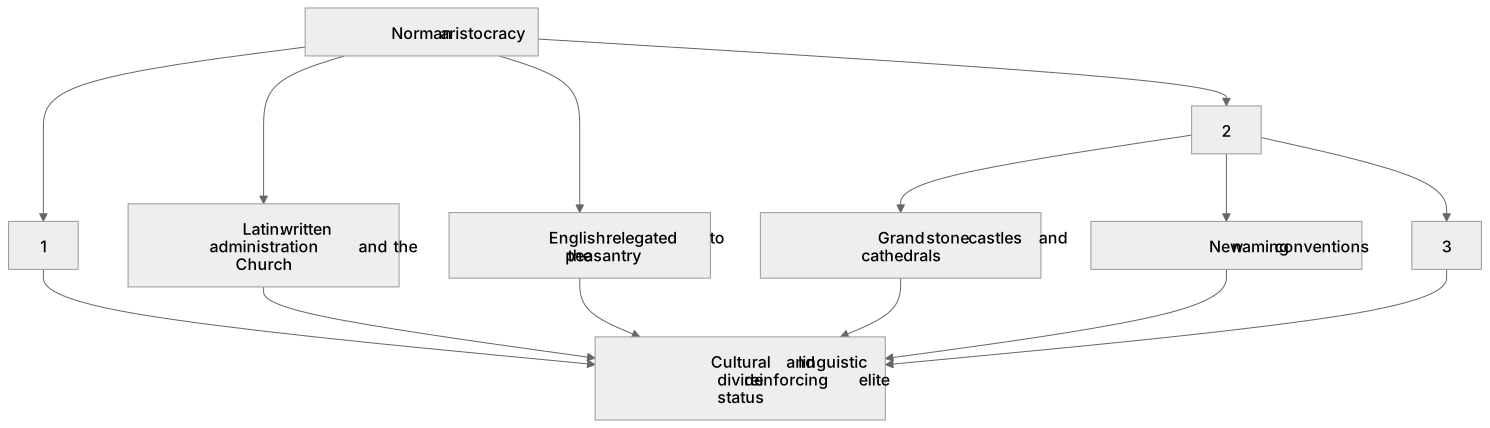
1Box 1
2Box 2
3Box 3
There is more to this lesson
The full lesson goes on to check your understanding and help you earn the marks. Create a free account to carry on, with your progress saved.
A week of Premium from your first lesson · Then the free plan continues · No card, no charge
Test your understanding of Option B1: Key topic 3: Norman England, 1066–88 - 3 The Norman aristocracy: The culture and language of the Norman aristocracy.
Active recall beats re-reading. Take an instant quiz now to test what you’ve learned and lock it into long-term memory.
A week of Premium from your first lesson · Then the free plan continues · No card, no charge