Pearson Edexcel · GCSE · History
Course version: 1HI0 · Version from Sept 2016
Key topic 3: Norman England, 1066–88 - 4 William I and the succession:…
Full specification wording
Option B1: Key topic 3: Norman England, 1066–88 - 4 William I and the succession: Character and personality of William I and his relations with Robert, including Robert’s revolt in Normandy (1077–80).
William I was a formidable, ruthless, and deeply religious leader, characterised by his unyielding demand for loyalty and his willingness to use extreme brutality, as seen in the Harrying of the…
Checked against the Pearson Edexcel 1HI0 specification (opens in a new tab) on .
- Point 1 of 2
- 4 key terms
Study notes
From the checked teaching notes for this specification point.
The idea
William I was a formidable, ruthless, and deeply religious leader, characterised by his unyielding demand for loyalty and his willingness to use extreme brutality, as seen in the Harrying of the North. His relationship with his eldest son, Robert Curthose, was highly strained. William viewed Robert as lazy and irresponsible, mocking his nickname 'Curthose' (short boots), while Robert felt denied real power in Normandy. This tension erupted into Robert's revolt (1077–1080), sparked by a prank by his younger brothers. Robert fled and launched attacks on William's lands, culminating in a battle at Gerberoi (1079) where Robert humiliated his father by unhorsing him. Matilda eventually brokered a fragile reconciliation in 1080.
What earns the marks
- Describe William I's character as strong-willed, militarily capable, ruthless, and deeply pious.
- Explain the causes of tension between William and Robert, including Robert's desire for power and William's refusal to share authority.
- Detail the trigger for the 1077 revolt: the water-throwing prank by William Rufus and Henry, and William I's failure to punish them.
- Describe the events of the revolt, specifically the Battle of Gerberoi (1079) where Robert wounded and unhorsed his father.
- Explain the resolution of the revolt, highlighting Queen Matilda's role in reconciling them in 1080.
Common mistakes and how to put them right
Stating that Robert's revolt took place in England.
Put it right: The revolt and the fighting, including the Battle of Gerberoi, took place in Normandy and surrounding French territories.
Claiming William I easily defeated Robert during the revolt.
Put it right: Robert actually humiliated William by unhorsing and wounding him at the Battle of Gerberoi in 1079.
Believing the revolt permanently severed their relationship.
Put it right: They were temporarily reconciled in 1080, largely due to the mediation of Queen Matilda, though tensions remained.
Exam tips
- Use the Battle of Gerberoi as a specific example of how Robert's revolt undermined William's military reputation and authority.
- Connect William's harsh personality to his refusal to grant Robert power, showing how character directly influenced political events.
- When discussing the succession, use the 1077-80 revolt to explain why William was reluctant to leave England to Robert upon his death.
Try the lesson
The start of the Option B1: Key topic 3: Norman England, 1066–88 - 4 William I and the succession: Character and personality of William I and his relations with Robert, including Robert’s revolt in Normandy (1077–80). lesson, made from checked teaching notes for this specification point.
Have a go first
What was the primary cause of the initial conflict between William I and his eldest son, Robert Curthose, in 1077?
Listen
William I was a formidable, ruthless, and deeply religious leader, characterised by his unyielding demand for loyalty and his willingness to use extreme brutality, as seen in the Harrying of the North. His relationship with his eldest son, Robert Curthose, was highly strained. William viewed Robert as lazy and irresponsible, mocking his nickname 'Curthose' (short boots), while Robert felt denied real power in Normandy. This tension erupted into Robert's revolt (1077–1080), sparked by a prank by his younger brothers. Robert fled and launched attacks on William's lands, culminating in a battle at Gerberoi (1079) where Robert humiliated his father by unhorsing him. Matilda eventually brokered a fragile reconciliation in 1080. A strong answer earns marks for these points. Describe William I's character as strong-willed, militarily capable, ruthless, and deeply pious. Explain the causes of tension between William and Robert, including Robert's desire for power and William's refusal to share authority. Detail the trigger for the 1077 revolt: the water-throwing prank by William Rufus and Henry, and William I's failure to punish them. Describe the events of the revolt, specifically the Battle of Gerberoi (1079) where Robert wounded and unhorsed his father. A common slip: Stating that Robert's revolt took place in England. Instead, The revolt and the fighting, including the Battle of Gerberoi, took place in Normandy and surrounding French territories. Exam tip: Use the Battle of Gerberoi as a specific example of how Robert's revolt undermined William's military reputation and authority.
See it
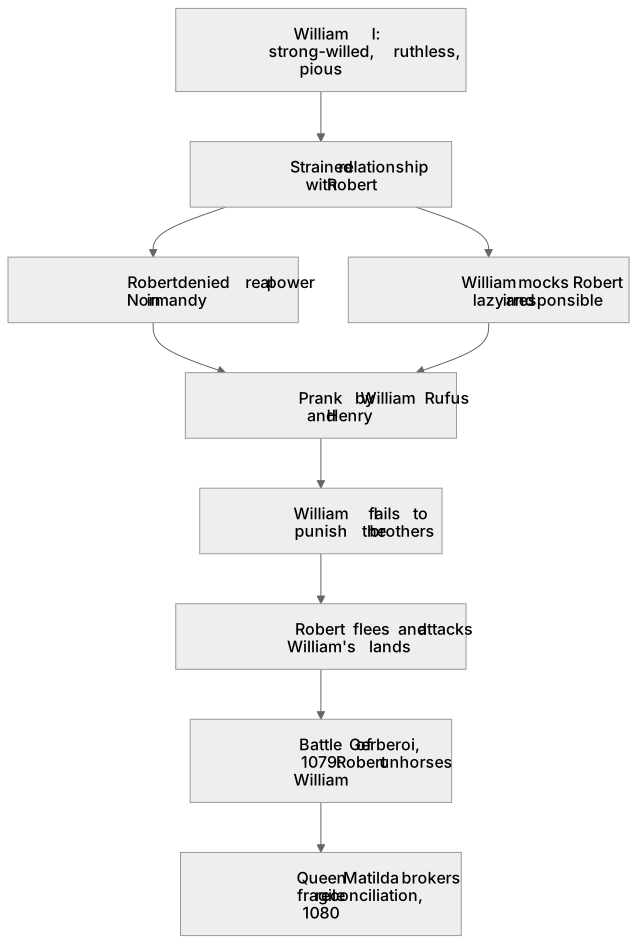
Put the events in order
Put these events in the order they happened, earliest first.
- 1. Robert's revolt in Normandy began after his brothers' water-throwing prank
- 2. Queen Matilda brokered a fragile reconciliation between William and Robert
- 3. Robert humiliated his father by unhorsing him at the Battle of Gerberoi
Key words
Say what each word means before you turn the card.
Royal succession
Try answering aloud or in your head before turning the card.
Family conflict
Try answering aloud or in your head before turning the card.
Leadership and character
Try answering aloud or in your head before turning the card.
Rebellion
Try answering aloud or in your head before turning the card.
See every definition
- Royal succession
- The question of who would follow William I, shaped by his strained relationship with his eldest son Robert and his reluctance to leave England to him.
- Family conflict
- The highly strained relationship between William I and Robert Curthose, which erupted into Robert's revolt in Normandy between 1077 and 1080.
- Leadership and character
- William I's traits as a formidable, ruthless and deeply religious leader, marked by an unyielding demand for loyalty and a willingness to use extreme brutality.
- Rebellion
- Robert's revolt in Normandy from 1077 to 1080, sparked by a prank by his younger brothers and culminating in the battle at Gerberoi in 1079.
Label the diagram
Some boxes have lost their names. Pick the right name for each number.
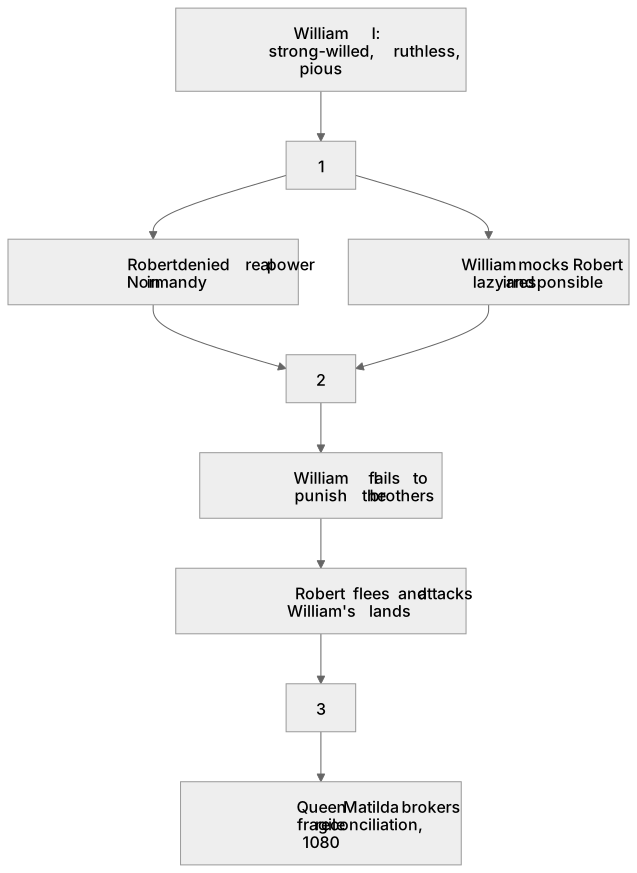
1Box 1
2Box 2
3Box 3
There is more to this lesson
The full lesson goes on to check your understanding and help you earn the marks. Create a free account to carry on, with your progress saved.
A week of Premium from your first lesson · Then the free plan continues · No card, no charge
Test your understanding of Option B1: Key topic 3: Norman England, 1066–88 - 4 William I and the succession: Character and personality of William I and his relations with Robert, including Robert’s revolt in Normandy (1077–80).
Active recall beats re-reading. Take an instant quiz now to test what you’ve learned and lock it into long-term memory.
A week of Premium from your first lesson · Then the free plan continues · No card, no charge