Pearson Edexcel · GCSE · History
Course version: 1HI0 · Version from Sept 2016
Key topic 1: Life and government in England, 1189–1216 - 1 The feudal…
Full specification wording
Option B2: Key topic 1: Life and government in England, 1189–1216 - 1 The feudal system: The role and influence of the Church.
The medieval Church wielded immense spiritual, economic, and political influence in England between 1189 and 1216.
Checked against the Pearson Edexcel 1HI0 specification (opens in a new tab) on .
- Point 2 of 2
- 4 key terms
Study notes
From the checked teaching notes for this specification point.
The idea
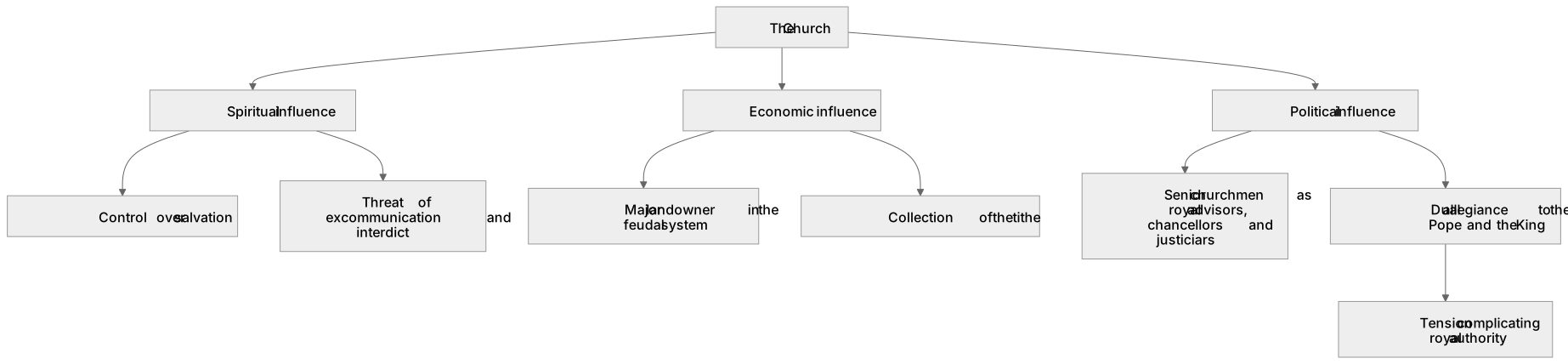
The medieval Church wielded immense spiritual, economic, and political influence in England between 1189 and 1216. Spiritually, it controlled salvation, using the threat of excommunication and interdict to enforce obedience. Economically, the Church was a major landowner within the feudal system, holding vast estates and collecting the tithe (a ten percent tax on agricultural produce). Politically, senior churchmen like archbishops and bishops served as key royal advisors, chancellors, and justiciars, due to their literacy and administrative skills. This dual role often created tension, as clerics owed allegiance to both the Pope in Rome and the English King, complicating royal authority and feudal obligations.
What earns the marks
- Explain the spiritual power of the Church, including its control over the sacraments and the use of excommunication.
- Describe the economic wealth of the Church, derived from extensive landholding and the collection of tithes.
- Identify the political role of churchmen, who often served as literate administrators and royal advisors.
- Analyse the tension caused by the dual loyalty of English clerics to both the King and the Pope.
Common mistakes and how to put them right
Viewing the Church solely as a religious institution.
Put it right: It was also a massive economic and political power within the feudal system.
Assuming the King had absolute control over the Church.
Put it right: The Pope held ultimate spiritual authority, leading to frequent jurisdictional clashes.
Forgetting that bishops and abbots were also feudal lords who owed knight service to the King for their lands.
Exam tips
- Highlight the collection of the tithe when discussing the economic burdens on the peasantry.
- Use the roles of specific churchmen, such as Hubert Walter, to illustrate the administrative reliance of the Crown on the clergy.
- Connect the Church's landholding to the feudal hierarchy, noting that senior clergy were tenants-in-chief.
Try the lesson
The start of the Option B2: Key topic 1: Life and government in England, 1189–1216 - 1 The feudal system: The role and influence of the Church. lesson, made from checked teaching notes for this specification point.
Have a go first
Which of the following best describes a major economic role of the Church in England between 1189 and 1216?
Listen
The medieval Church wielded immense spiritual, economic, and political influence in England between 1189 and 1216. Spiritually, it controlled salvation, using the threat of excommunication and interdict to enforce obedience. Economically, the Church was a major landowner within the feudal system, holding vast estates and collecting the tithe (a ten percent tax on agricultural produce). Politically, senior churchmen like archbishops and bishops served as key royal advisors, chancellors, and justiciars, due to their literacy and administrative skills. This dual role often created tension, as clerics owed allegiance to both the Pope in Rome and the English King, complicating royal authority and feudal obligations. A strong answer earns marks for these points. Explain the spiritual power of the Church, including its control over the sacraments and the use of excommunication. Describe the economic wealth of the Church, derived from extensive landholding and the collection of tithes. Identify the political role of churchmen, who often served as literate administrators and royal advisors. Analyse the tension caused by the dual loyalty of English clerics to both the King and the Pope. Exam tip: Highlight the collection of the tithe when discussing the economic burdens on the peasantry.
See it
Key words
Say what each word means before you turn the card.
Spiritual authority
Try answering aloud or in your head before turning the card.
Economic power
Try answering aloud or in your head before turning the card.
Political administration
Try answering aloud or in your head before turning the card.
Church vs State
Try answering aloud or in your head before turning the card.
See every definition
- Spiritual authority
- The Church controlled salvation, using the threat of excommunication and interdict to enforce obedience.
- Economic power
- The Church was a major landowner within the feudal system, holding vast estates and collecting the tithe, a ten percent tax on agricultural produce.
- Political administration
- Senior churchmen like archbishops and bishops served as key royal advisors, chancellors, and justiciars, due to their literacy and administrative skills.
- Church vs State
- Clerics owed allegiance to both the Pope in Rome and the English King, complicating royal authority and feudal obligations.
Label the diagram
Some boxes have lost their names. Pick the right name for each number.
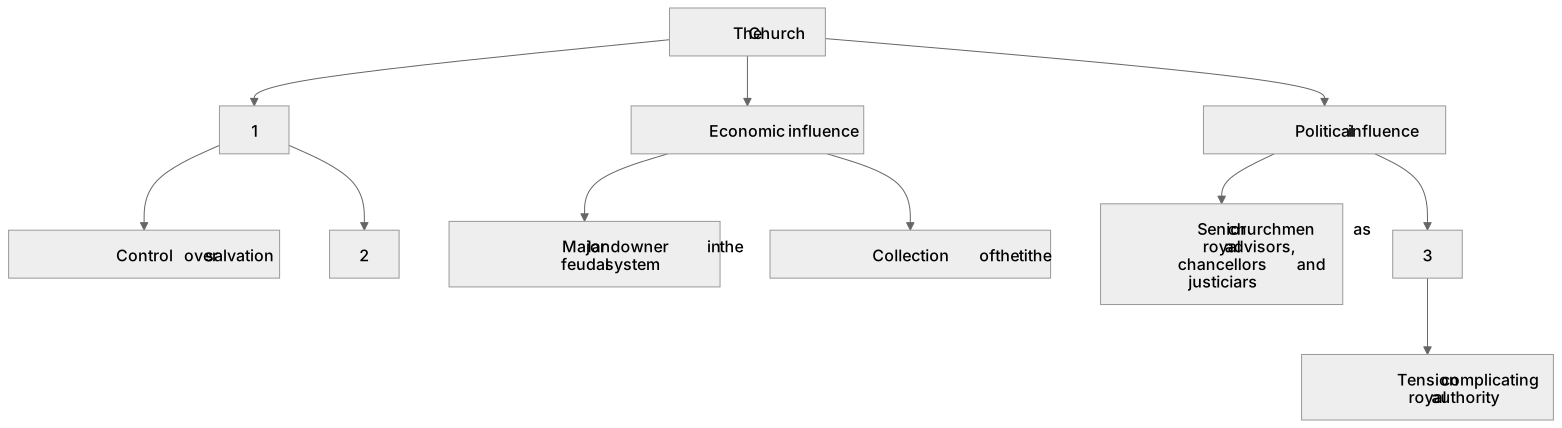
1Box 1
2Box 2
3Box 3
There is more to this lesson
The full lesson goes on to check your understanding and help you earn the marks. Create a free account to carry on, with your progress saved.
A week of Premium from your first lesson · Then the free plan continues · No card, no charge
Test your understanding of Option B2: Key topic 1: Life and government in England, 1189–1216 - 1 The feudal system: The role and influence of the Church.
Active recall beats re-reading. Take an instant quiz now to test what you’ve learned and lock it into long-term memory.
A week of Premium from your first lesson · Then the free plan continues · No card, no charge