Pearson Edexcel · GCSE · History
Course version: 1HI0 · Version from Sept 2016
Key topic 1: Life and government in England, 1189–1216 - 2 Kingship and…
Full specification wording
Option B2: Key topic 1: Life and government in England, 1189–1216 - 2 Kingship and succession: Richard I as king: his claim to the throne; how power was secured; his character.
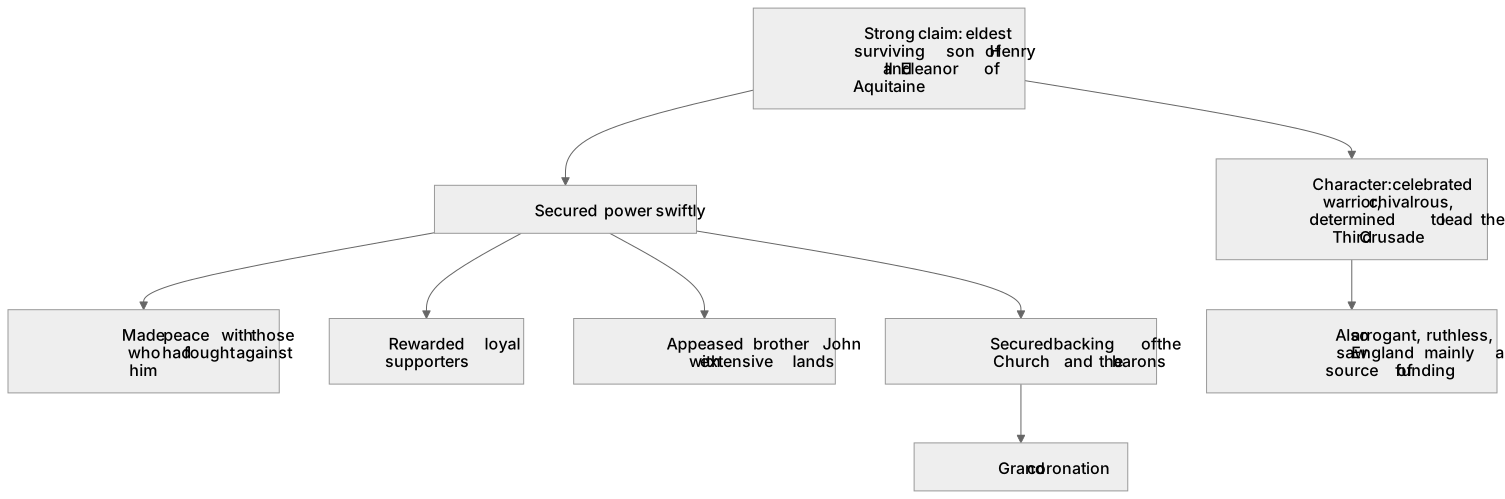
Richard I's claim to the throne in 1189 was strong, as he was the eldest surviving son of Henry II and Eleanor of Aquitaine.
Checked against the Pearson Edexcel 1HI0 specification (opens in a new tab) on .
- Point 2 of 3
- 4 key terms
Study notes
From the checked teaching notes for this specification point.
The idea
Richard I's claim to the throne in 1189 was strong, as he was the eldest surviving son of Henry II and Eleanor of Aquitaine. He secured power swiftly by making peace with those who had fought against him, rewarding loyal supporters, and appeasing his ambitious brother John with extensive lands. Richard also secured the backing of the Church and the barons before his grand coronation. His character was defined by his martial prowess; he was a celebrated warrior, deeply chivalrous, and fiercely determined to lead the Third Crusade. However, he could also be arrogant, ruthless, and viewed England primarily as a source of funding for his military campaigns abroad.
What earns the marks
- Explain Richard's claim as the eldest surviving legitimate son of Henry II, following the principle of primogeniture.
- Describe how Richard secured power by appeasing potential rivals, notably granting his brother John lands and titles.
- Detail Richard's use of patronage to reward loyal followers and secure the support of powerful barons.
- Analyse Richard's character as a chivalrous and capable military leader, but also as a king who saw England mainly as a financial resource.
Common mistakes and how to put them right
Stating Richard had to fight a war of succession to become king.
Put it right: Richard's succession was relatively smooth as he was the undisputed heir after his older brothers died.
Assuming Richard was a bad king because he was rarely in England.
Put it right: In the medieval context, his absence to fight a crusade was seen as fulfilling his duty as a Christian warrior king.
Believing John was completely excluded from power in 1189.
Put it right: Richard gave John significant estates to keep him loyal, though he did not give him castles.
Exam tips
- Highlight the contrast between modern views of Richard's absence and the medieval expectation that a king should be a great warrior.
- Mention Eleanor of Aquitaine's role in helping to secure Richard's power in England while he was delayed in France.
- Use the term 'primogeniture' when explaining why Richard's claim to the throne was undisputed.
Try the lesson
The start of the Option B2: Key topic 1: Life and government in England, 1189–1216 - 2 Kingship and succession: Richard I as king: his claim to the throne; how power was secured; his character. lesson, made from checked teaching notes for this specification point.
Have a go first
Why did Richard I have a strong claim to the English throne in 1189?
Listen
Richard I's claim to the throne in 1189 was strong, as he was the eldest surviving son of Henry II and Eleanor of Aquitaine. He secured power swiftly by making peace with those who had fought against him, rewarding loyal supporters, and appeasing his ambitious brother John with extensive lands. Richard also secured the backing of the Church and the barons before his grand coronation. His character was defined by his martial prowess; he was a celebrated warrior, deeply chivalrous, and fiercely determined to lead the Third Crusade. However, he could also be arrogant, ruthless, and viewed England primarily as a source of funding for his military campaigns abroad. A strong answer earns marks for these points. Explain Richard's claim as the eldest surviving legitimate son of Henry II, following the principle of primogeniture. Describe how Richard secured power by appeasing potential rivals, notably granting his brother John lands and titles. Detail Richard's use of patronage to reward loyal followers and secure the support of powerful barons. Analyse Richard's character as a chivalrous and capable military leader, but also as a king who saw England mainly as a financial resource. A common slip: Stating Richard had to fight a war of succession to become king. Instead, Richard's succession was relatively smooth as he was the undisputed heir after his older brothers died. Exam tip: Highlight the contrast between modern views of Richard's absence and the medieval expectation that a king should be a great warrior.
See it
Key words
Say what each word means before you turn the card.
Primogeniture
Try answering aloud or in your head before turning the card.
Patronage
Try answering aloud or in your head before turning the card.
Chivalrous
Try answering aloud or in your head before turning the card.
Succession
Try answering aloud or in your head before turning the card.
See every definition
- Primogeniture
- The principle by which Richard's claim as the eldest surviving legitimate son of Henry II was based.
- Patronage
- Used by Richard to reward loyal followers and secure the support of powerful barons.
- Chivalrous
- A description of Richard's character as a celebrated warrior, deeply chivalrous and fiercely determined to lead the Third Crusade.
- Succession
- Richard's succession was relatively smooth as he was the undisputed heir after his older brothers died.
Label the diagram
Some boxes have lost their names. Pick the right name for each number.
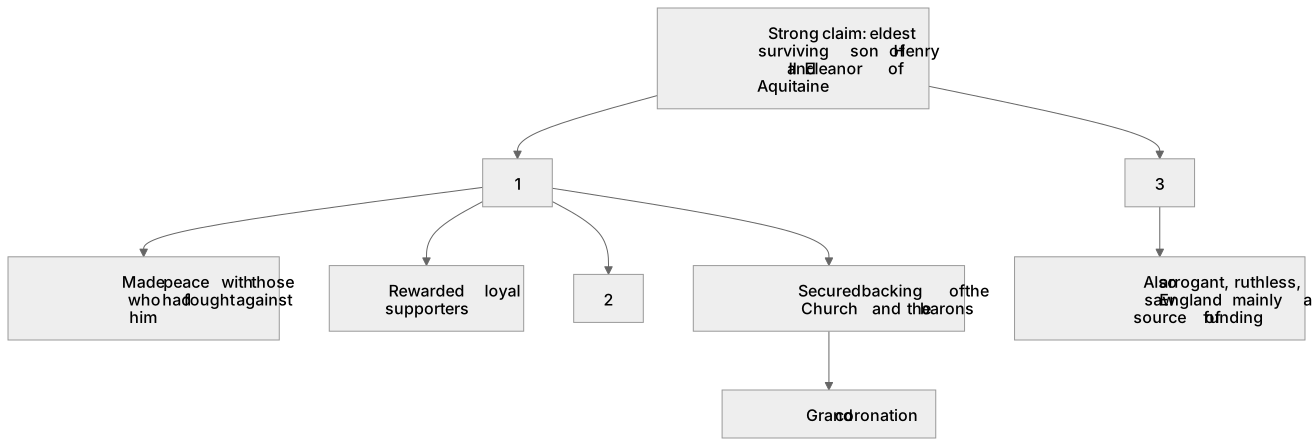
1Box 1
2Box 2
3Box 3
There is more to this lesson
The full lesson goes on to check your understanding and help you earn the marks. Create a free account to carry on, with your progress saved.
A week of Premium from your first lesson · Then the free plan continues · No card, no charge
Test your understanding of Option B2: Key topic 1: Life and government in England, 1189–1216 - 2 Kingship and succession: Richard I as king: his claim to the throne; how power was secured; his character.
Active recall beats re-reading. Take an instant quiz now to test what you’ve learned and lock it into long-term memory.
A week of Premium from your first lesson · Then the free plan continues · No card, no charge