Pearson Edexcel · GCSE · History
Course version: 1HI0 · Version from Sept 2016
Key topic 2: Involvements overseas, 1189–1204 - 2 Richard and the Third…
Full specification wording
Option B2: Key topic 2: Involvements overseas, 1189–1204 - 2 Richard and the Third Crusade: The failure to recapture Jerusalem.
Richard I's primary objective during the Third Crusade was to recapture Jerusalem from Saladin, but he ultimately failed.
Checked against the Pearson Edexcel 1HI0 specification (opens in a new tab) on .
- Point 3 of 3
- 2 key terms
Study notes
From the checked teaching notes for this specification point.
The idea
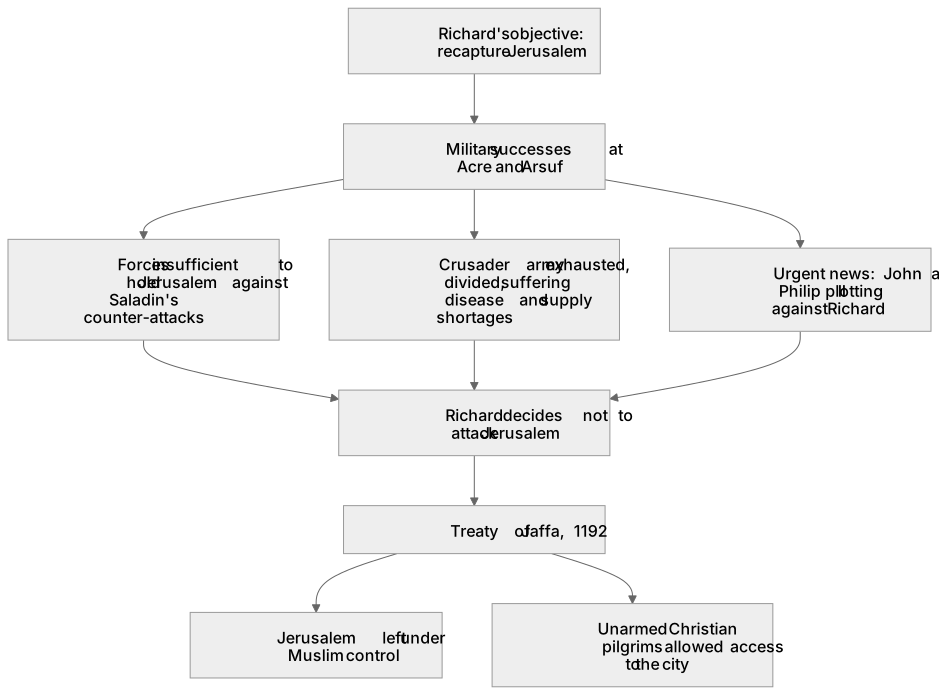
Richard I's primary objective during the Third Crusade was to recapture Jerusalem from Saladin, but he ultimately failed. Despite military successes at Acre and Arsuf, Richard realised that even if he took Jerusalem, his forces were insufficient to hold it against Saladin's inevitable counter-attacks. The crusader army was exhausted, divided, and suffering from disease and supply shortages. Furthermore, Richard received urgent news that his brother John and Philip II of France were plotting against him, threatening his Angevin Empire. Consequently, Richard negotiated the Treaty of Jaffa in 1192, which left Jerusalem under Muslim control but allowed unarmed Christian pilgrims access to the city, ending the crusade without its main prize.
What earns the marks
- Explain the strategic reasons why Richard decided not to attack Jerusalem, such as the inability to hold the city once captured.
- Describe the impact of supply line vulnerabilities and the harsh climate on the crusader army's morale and effectiveness.
- Analyse the role of political pressures from Europe, specifically the actions of John and Philip II, in forcing Richard's withdrawal.
- Evaluate the terms of the Treaty of Jaffa (1192) as a compromise resulting from the failure to take Jerusalem.
Common mistakes and how to put them right
Claiming Richard was defeated in battle at Jerusalem.
Put it right: Richard never actually laid siege to Jerusalem, choosing to turn back before attacking.
Stating the Third Crusade was a complete failure.
Put it right: While Jerusalem was not recaptured, the crusade secured the coastal cities and pilgrim access through the Treaty of Jaffa.
Ignoring the logistical challenges.
Put it right: Emphasise that the lack of water, disease, and overstretched supply lines were critical factors in the decision not to attack.
Exam tips
- When discussing the failure to take Jerusalem, balance military and logistical factors in the Holy Land with political threats back in Europe.
- Use the Treaty of Jaffa as evidence of the compromise Richard was forced to make due to his inability to capture the city.
- Link Richard's decision to turn back to his skills as a military commander who understood the strategic impossibility of holding the city.
Try the lesson
The start of the Option B2: Key topic 2: Involvements overseas, 1189–1204 - 2 Richard and the Third Crusade: The failure to recapture Jerusalem. lesson, made from checked teaching notes for this specification point.
Have a go first
Which of the following was a primary reason why Richard I decided not to attack Jerusalem in 1192?
Listen
Richard I's primary objective during the Third Crusade was to recapture Jerusalem from Saladin, but he ultimately failed. Despite military successes at Acre and Arsuf, Richard realised that even if he took Jerusalem, his forces were insufficient to hold it against Saladin's inevitable counter-attacks. The crusader army was exhausted, divided, and suffering from disease and supply shortages. Furthermore, Richard received urgent news that his brother John and Philip II of France were plotting against him, threatening his Angevin Empire. Consequently, Richard negotiated the Treaty of Jaffa in 1192, which left Jerusalem under Muslim control but allowed unarmed Christian pilgrims access to the city, ending the crusade without its main prize. A strong answer earns marks for these points. Explain the strategic reasons why Richard decided not to attack Jerusalem, such as the inability to hold the city once captured. Describe the impact of supply line vulnerabilities and the harsh climate on the crusader army's morale and effectiveness. Analyse the role of political pressures from Europe, specifically the actions of John and Philip II, in forcing Richard's withdrawal. Evaluate the terms of the Treaty of Jaffa (1192) as a compromise resulting from the failure to take Jerusalem. A common slip: Claiming Richard was defeated in battle at Jerusalem. Instead, Richard never actually laid siege to Jerusalem, choosing to turn back before attacking. Exam tip: When discussing the failure to take Jerusalem, balance military and logistical factors in the Holy Land with political threats back in Europe.
See it
Key words
Say what each word means before you turn the card.
Third Crusade
Try answering aloud or in your head before turning the card.
Treaty of Jaffa
Try answering aloud or in your head before turning the card.
See every definition
- Third Crusade
- A campaign in which Richard I's primary objective was to recapture Jerusalem from Saladin, but which ended without its main prize.
- Treaty of Jaffa
- The 1192 agreement that left Jerusalem under Muslim control but allowed unarmed Christian pilgrims access to the city, ending the crusade.
Label the diagram
Some boxes have lost their names. Pick the right name for each number.
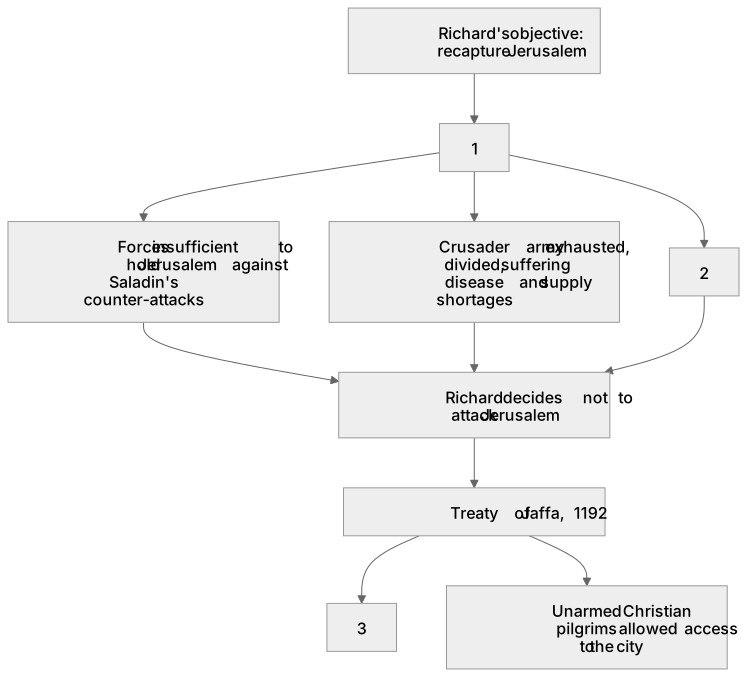
1Box 1
2Box 2
3Box 3
There is more to this lesson
The full lesson goes on to check your understanding and help you earn the marks. Create a free account to carry on, with your progress saved.
A week of Premium from your first lesson · Then the free plan continues · No card, no charge
Test your understanding of Option B2: Key topic 2: Involvements overseas, 1189–1204 - 2 Richard and the Third Crusade: The failure to recapture Jerusalem.
Active recall beats re-reading. Take an instant quiz now to test what you’ve learned and lock it into long-term memory.
A week of Premium from your first lesson · Then the free plan continues · No card, no charge