Pearson Edexcel · GCSE · History
Course version: 1HI0 · Version from Sept 2016
Key topic 2: Involvements overseas, 1189–1204 - 4 Richard, John and the…
Full specification wording
Option B2: Key topic 2: Involvements overseas, 1189–1204 - 4 Richard, John and the loss of Normandy: John and the fall of Chateau Gaillard; the loss of Normandy (1204).
The fall of Chateau Gaillard in March 1204 was a pivotal disaster for King John, directly leading to the loss of Normandy.
Checked against the Pearson Edexcel 1HI0 specification (opens in a new tab) on .
- Point 3 of 3
- 4 key terms
Study notes
From the checked teaching notes for this specification point.
The idea
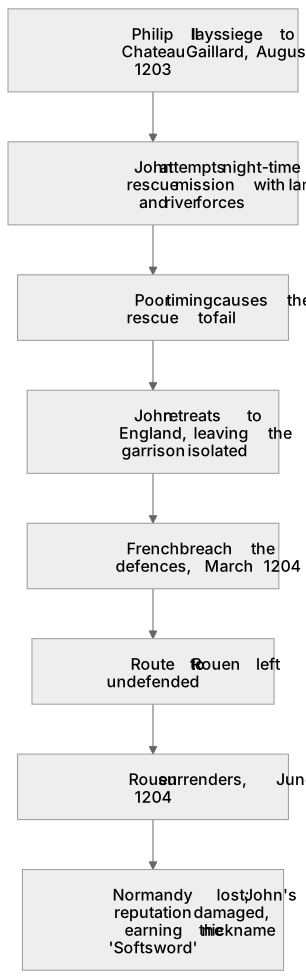
The fall of Chateau Gaillard in March 1204 was a pivotal disaster for King John, directly leading to the loss of Normandy. King Philip II of France laid siege to the fortress in August 1203. John attempted a complex night-time rescue mission using both land and river forces, but poor timing caused it to fail. John then retreated to England, leaving the garrison isolated. After a gruelling siege, the French breached the defences, allegedly through a chapel window or latrine chute. Without this vital stronghold, the route to Rouen was left completely undefended. Rouen surrendered in June 1204, completing the French conquest of Normandy. This catastrophic loss severely damaged John's reputation, earning him the nickname 'Softsword'.
What earns the marks
- Describe Philip II's siege tactics and the isolation of the garrison after John returned to England in late 1203.
- Explain the failure of John's complex relief effort, which relied on poorly coordinated land and river attacks.
- Detail how the fall of the castle in March 1204 opened the route to Rouen, leading to its surrender.
- Analyse the consequences of losing Normandy in 1204, including the loss of baronial lands and the damage to John's prestige.
Common mistakes and how to put them right
Claiming John did nothing to try and save the castle.
Put it right: Acknowledge that John did attempt a relief mission, but it failed due to poor coordination and timing.
Confusing the dates of the siege and the loss of Normandy.
Put it right: Ensure you state the castle fell in March 1204, followed by the complete loss of Normandy by June 1204.
Stating the loss of Normandy had no impact on England.
Put it right: Explain that it caused a major financial and political crisis, angering English barons who lost their Norman estates.
Exam tips
- Connect the fall of Chateau Gaillard directly to the subsequent surrender of Rouen to show a chain of causation.
- Use John's failed relief attempt to evaluate his military leadership compared to Richard's.
- Mention the nickname 'Softsword' to illustrate the political and reputational damage John suffered after 1204.
Try the lesson
The start of the Option B2: Key topic 2: Involvements overseas, 1189–1204 - 4 Richard, John and the loss of Normandy: John and the fall of Chateau Gaillard; the loss of Normandy (1204). lesson, made from checked teaching notes for this specification point.
Have a go first
In which year did Château Gaillard finally fall to the forces of King Philip II of France?
Listen
The fall of Chateau Gaillard in March 1204 was a pivotal disaster for King John, directly leading to the loss of Normandy. King Philip II of France laid siege to the fortress in August 1203. John attempted a complex night-time rescue mission using both land and river forces, but poor timing caused it to fail. John then retreated to England, leaving the garrison isolated. After a gruelling siege, the French breached the defences, allegedly through a chapel window or latrine chute. Without this vital stronghold, the route to Rouen was left completely undefended. Rouen surrendered in June 1204, completing the French conquest of Normandy. This catastrophic loss severely damaged John's reputation, earning him the nickname 'Softsword'. A strong answer earns marks for these points. Describe Philip II's siege tactics and the isolation of the garrison after John returned to England in late 1203. Explain the failure of John's complex relief effort, which relied on poorly coordinated land and river attacks. Detail how the fall of the castle in March 1204 opened the route to Rouen, leading to its surrender. Analyse the consequences of losing Normandy in 1204, including the loss of baronial lands and the damage to John's prestige. A common slip: Claiming John did nothing to try and save the castle. Instead, Acknowledge that John did attempt a relief mission, but it failed due to poor coordination and timing. Exam tip: Connect the fall of Chateau Gaillard directly to the subsequent surrender of Rouen to show a chain of causation.
See it
Put it in order
Put these steps in the order they happen.
- 1. French breach the defences, March 1204
- 2. Normandy lost; John's reputation damaged, earning the nickname 'Softsword'
- 3. Route to Rouen left undefended
- 4. Philip II lays siege to Chateau Gaillard, August 1203
- 5. John attempts night-time rescue mission with land and river forces
- 6. Rouen surrenders, June 1204
- 7. Poor timing causes the rescue to fail
- 8. John retreats to England, leaving the garrison isolated
Key words
Say what each word means before you turn the card.
Military failure
Try answering aloud or in your head before turning the card.
Royal reputation
Try answering aloud or in your head before turning the card.
Loss of empire
Try answering aloud or in your head before turning the card.
Baronial discontent
Try answering aloud or in your head before turning the card.
See every definition
- Military failure
- John's complex night-time rescue mission using land and river forces failed because of poor timing and poor coordination.
- Royal reputation
- The catastrophic loss severely damaged John's reputation, earning him the nickname 'Softsword'.
- Loss of empire
- Without the vital stronghold the route to Rouen was left undefended, and Rouen surrendered in June 1204, completing the French conquest of Normandy.
- Baronial discontent
- Losing Normandy caused a major financial and political crisis, angering English barons who lost their Norman estates.
Label the diagram
Some boxes have lost their names. Pick the right name for each number.
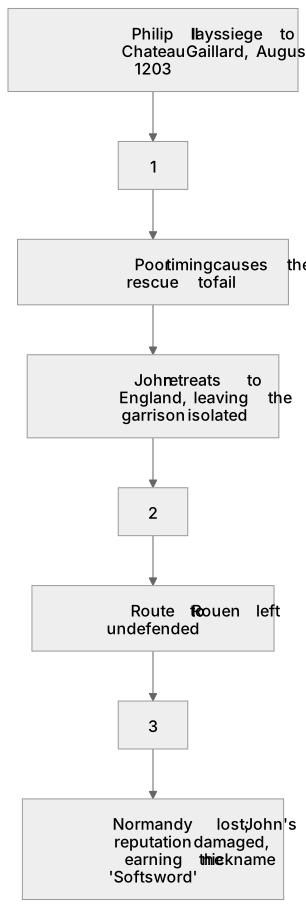
1Box 1
2Box 2
3Box 3
There is more to this lesson
The full lesson goes on to check your understanding and help you earn the marks. Create a free account to carry on, with your progress saved.
A week of Premium from your first lesson · Then the free plan continues · No card, no charge
Test your understanding of Option B2: Key topic 2: Involvements overseas, 1189–1204 - 4 Richard, John and the loss of Normandy: John and the fall of Chateau Gaillard; the loss of Normandy (1204).
Active recall beats re-reading. Take an instant quiz now to test what you’ve learned and lock it into long-term memory.
A week of Premium from your first lesson · Then the free plan continues · No card, no charge