Pearson Edexcel · GCSE · History
Course version: 1HI0 · Version from Sept 2016
Key topic 3: King John’s downfall, 1205–16 - 1 The dispute with the…
Full specification wording
Option B2: Key topic 3: King John’s downfall, 1205–16 - 1 The dispute with the Papacy: The Interdict and its impact on everyday life.
In response to King John's refusal to accept Stephen Langton, Pope Innocent III placed England under an Interdict in March 1208.
Checked against the Pearson Edexcel 1HI0 specification (opens in a new tab) on .
- Point 2 of 3
- 4 key terms
Study notes
From the checked teaching notes for this specification point.
The idea
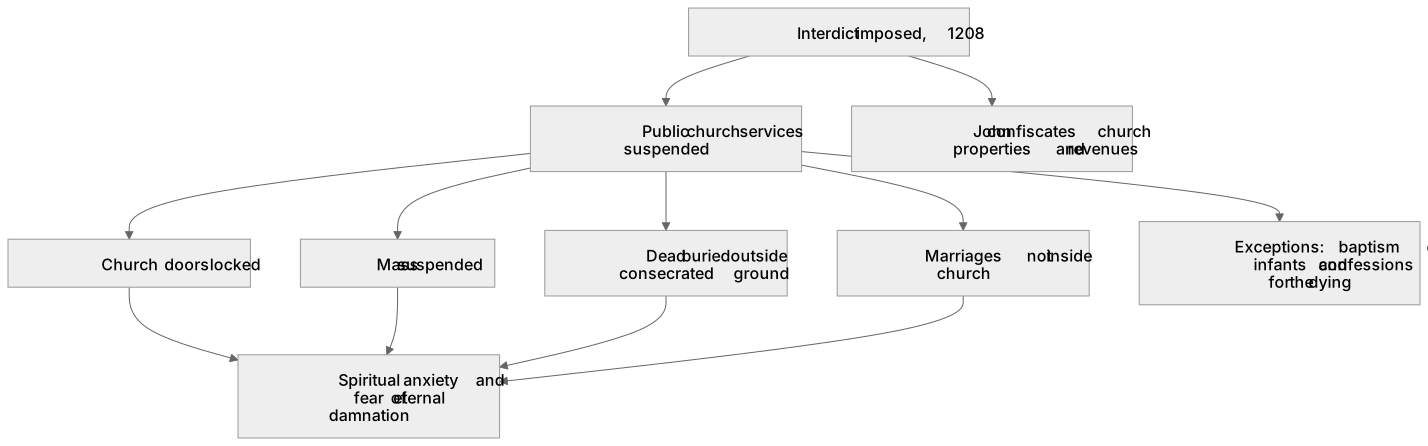
In response to King John's refusal to accept Stephen Langton, Pope Innocent III placed England under an Interdict in March 1208. This was a severe papal strike that suspended all public church services, profoundly impacting everyday medieval life. For the deeply religious population, the consequences were terrifying. Church doors were locked, mass was suspended, and the dead could not be buried in consecrated ground, leading to fears of eternal damnation. Marriages could not take place inside the church, though baptisms of infants and confessions for the dying were still permitted. While the Interdict caused immense spiritual anxiety among ordinary people, John exploited the situation financially by confiscating church properties.
What earns the marks
- Define the Interdict as a papal decree imposed in 1208 that suspended public church services in England.
- Detail the specific impacts on religious life, such as locked churches, suspended masses, and burials outside consecrated ground.
- Identify the exceptions allowed during the Interdict, specifically the baptism of infants and the administration of last rites.
- Explain the psychological impact on the population, who feared for their salvation without access to the sacraments.
- Describe John's financial exploitation of the Interdict by seizing the lands and revenues of the clergy who observed it.
Common mistakes and how to put them right
Claiming that absolutely no religious services were allowed.
Put it right: Specify that baptisms for infants and confessions for the dying were still permitted.
Stating that the Interdict ruined King John financially.
Put it right: Explain that John actually profited from the Interdict by confiscating church lands and revenues.
Confusing the Interdict with Excommunication.
Put it right: Distinguish between the Interdict (a strike on the whole country's religious services in 1208) and Excommunication (the personal expulsion of John from the Church in 1209).
Exam tips
- Provide specific examples of how everyday life changed, such as burials in unhallowed ground, to secure higher marks.
- Contrast the spiritual anxiety of the ordinary people with the financial benefits gained by King John.
- Ensure you clearly separate the effects of the Interdict from the later Excommunication of King John.
Try the lesson
The start of the Option B2: Key topic 3: King John’s downfall, 1205–16 - 1 The dispute with the Papacy: The Interdict and its impact on everyday life. lesson, made from checked teaching notes for this specification point.
Have a go first
What was the immediate consequence of the Interdict placed on England by Pope Innocent III in 1208?
Listen
In response to King John's refusal to accept Stephen Langton, Pope Innocent III placed England under an Interdict in March 1208. This was a severe papal strike that suspended all public church services, profoundly impacting everyday medieval life. For the deeply religious population, the consequences were terrifying. Church doors were locked, mass was suspended, and the dead could not be buried in consecrated ground, leading to fears of eternal damnation. Marriages could not take place inside the church, though baptisms of infants and confessions for the dying were still permitted. While the Interdict caused immense spiritual anxiety among ordinary people, John exploited the situation financially by confiscating church properties. A strong answer earns marks for these points. Define the Interdict as a papal decree imposed in 1208 that suspended public church services in England. Detail the specific impacts on religious life, such as locked churches, suspended masses, and burials outside consecrated ground. Identify the exceptions allowed during the Interdict, specifically the baptism of infants and the administration of last rites. Explain the psychological impact on the population, who feared for their salvation without access to the sacraments. A common slip: Claiming that absolutely no religious services were allowed. Instead, Specify that baptisms for infants and confessions for the dying were still permitted. Exam tip: Provide specific examples of how everyday life changed, such as burials in unhallowed ground, to secure higher marks.
See it
Key words
Say what each word means before you turn the card.
Interdict
Try answering aloud or in your head before turning the card.
Papal authority
Try answering aloud or in your head before turning the card.
Religion and society
Try answering aloud or in your head before turning the card.
Medieval beliefs
Try answering aloud or in your head before turning the card.
See every definition
- Interdict
- A papal decree imposed in 1208 that suspended all public church services in England.
- Papal authority
- The power of the Pope, shown here through a severe papal strike on the whole country's religious services.
- Religion and society
- The place of religious practice in everyday medieval life, which the Interdict profoundly affected.
- Medieval beliefs
- The deeply religious convictions of the population, who feared eternal damnation without access to the sacraments.
Label the diagram
Some boxes have lost their names. Pick the right name for each number.
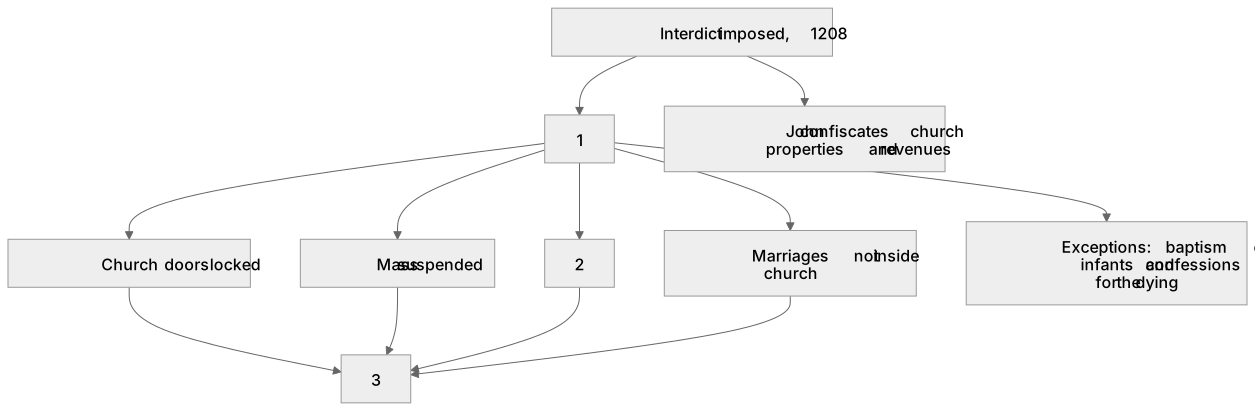
1Box 1
2Box 2
3Box 3
There is more to this lesson
The full lesson goes on to check your understanding and help you earn the marks. Create a free account to carry on, with your progress saved.
A week of Premium from your first lesson · Then the free plan continues · No card, no charge
Test your understanding of Option B2: Key topic 3: King John’s downfall, 1205–16 - 1 The dispute with the Papacy: The Interdict and its impact on everyday life.
Active recall beats re-reading. Take an instant quiz now to test what you’ve learned and lock it into long-term memory.
A week of Premium from your first lesson · Then the free plan continues · No card, no charge