Pearson Edexcel · GCSE · History
Course version: 1HI0 · Version from Sept 2016
Key topic 3: King John’s downfall, 1205–16 - 2 Worsening relations with…
Full specification wording
Option B2: Key topic 3: King John’s downfall, 1205–16 - 2 Worsening relations with the barons: Growing financial impositions to raise money for war with France: taxation and ‘fines’; John’s use of arbitrary power. The plot of 1212.
To fund campaigns to reclaim Normandy, King John imposed severe financial burdens on his barons, destroying relations.
Checked against the Pearson Edexcel 1HI0 specification (opens in a new tab) on .
- Point 1 of 3
- 4 key terms
Study notes
From the checked teaching notes for this specification point.
The idea
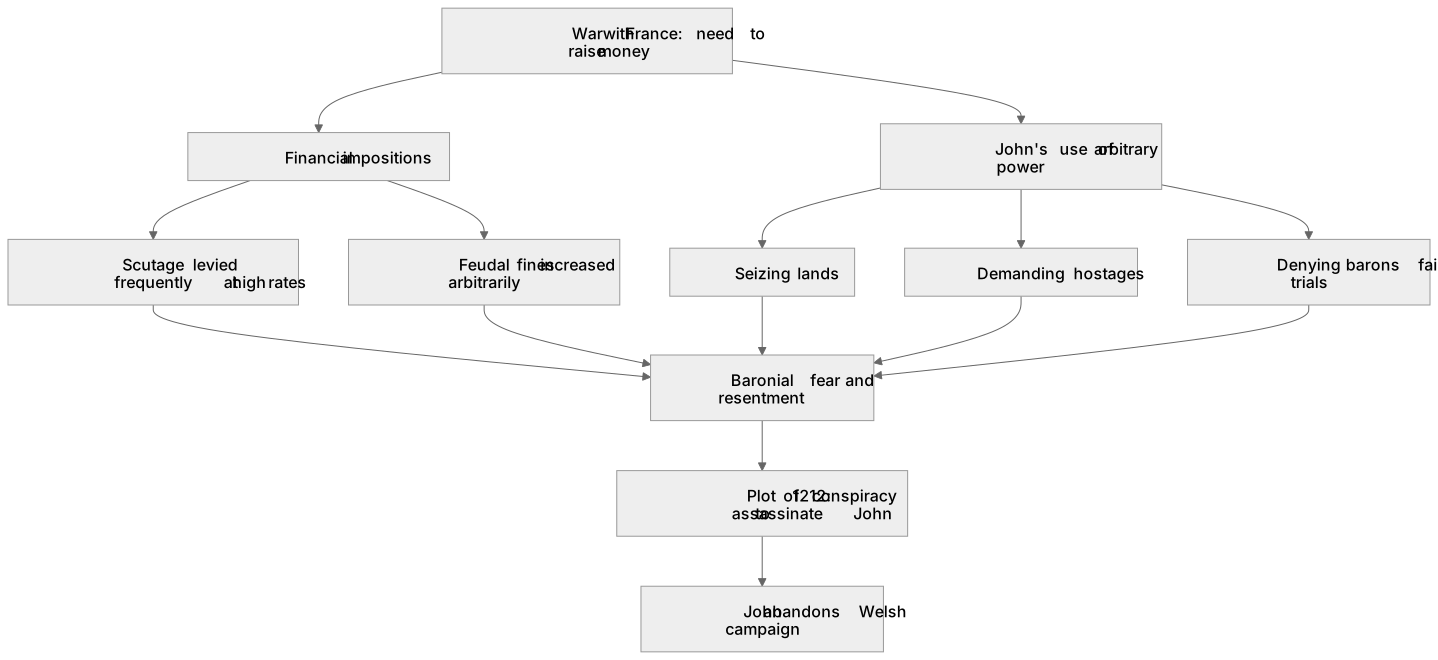
To fund campaigns to reclaim Normandy, King John imposed severe financial burdens on his barons, destroying relations. He levied record levels of scutage (tax paid in lieu of military service) and exploited feudal rights by charging exorbitant 'fines' for inheritances and marriages. John's use of arbitrary power—punishing barons without trial and demanding hostages to ensure loyalty—created intense fear and resentment. This culminated in the plot of 1212, where prominent barons, including Robert Fitzwalter and Eustace de Vesci, conspired to assassinate John during a Welsh campaign. The plot forced John to abandon his campaign and highlighted the dangerous level of baronial alienation caused by his financial extortion and tyrannical methods.
What earns the marks
- John levied scutage frequently and at high rates to fund his planned wars in France.
- Feudal fines, such as reliefs for inheriting land, were increased arbitrarily to extract maximum wealth from the nobility.
- John exercised arbitrary power by seizing lands, demanding hostages, and denying barons fair trials.
- The 1212 plot involved a conspiracy by barons like Fitzwalter and de Vesci to kill John or leave him to be captured by the Welsh.
Common mistakes and how to put them right
Assuming scutage was a new tax invented by John.
Put it right: Scutage existed before, but John used it much more frequently and charged higher rates than his predecessors.
Thinking the 1212 plot was a widespread national rebellion.
Put it right: It was a conspiracy by a small group of powerful, deeply alienated barons.
Confusing 'fines' with modern criminal penalties.
Put it right: In this context, fines were payments made to the king for feudal privileges, inheritances, or to regain his favour.
Exam tips
- Use specific examples of financial impositions, such as the frequent use of scutage, to explain the root causes of baronial discontent.
- Connect John's use of arbitrary power to the specific grievances later addressed in Magna Carta (e.g., Clause 39 on fair trials).
- Discuss the 1212 plot as a turning point that demonstrated the failure of John's coercive methods to secure loyalty.
Try the lesson
The start of the Option B2: Key topic 3: King John’s downfall, 1205–16 - 2 Worsening relations with the barons: Growing financial impositions to raise money for war with France: taxation and ‘fines’; John’s use of arbitrary power. The plot of 1212. lesson, made from checked teaching notes for this specification point.
Have a go first
Which financial method did King John increasingly use in an arbitrary manner to raise funds for his planned war with France?
Listen
To fund campaigns to reclaim Normandy, King John imposed severe financial burdens on his barons, destroying relations. He levied record levels of scutage (tax paid in lieu of military service) and exploited feudal rights by charging exorbitant 'fines' for inheritances and marriages. John's use of arbitrary power—punishing barons without trial and demanding hostages to ensure loyalty—created intense fear and resentment. This culminated in the plot of 1212, where prominent barons, including Robert Fitzwalter and Eustace de Vesci, conspired to assassinate John during a Welsh campaign. The plot forced John to abandon his campaign and highlighted the dangerous level of baronial alienation caused by his financial extortion and tyrannical methods. A strong answer earns marks for these points. John levied scutage frequently and at high rates to fund his planned wars in France. Feudal fines, such as reliefs for inheriting land, were increased arbitrarily to extract maximum wealth from the nobility. John exercised arbitrary power by seizing lands, demanding hostages, and denying barons fair trials. The 1212 plot involved a conspiracy by barons like Fitzwalter and de Vesci to kill John or leave him to be captured by the Welsh. A common slip: Assuming scutage was a new tax invented by John. Instead, Scutage existed before, but John used it much more frequently and charged higher rates than his predecessors. Exam tip: Use specific examples of financial impositions, such as the frequent use of scutage, to explain the root causes of baronial discontent.
See it
Key words
Say what each word means before you turn the card.
Scutage
Try answering aloud or in your head before turning the card.
Fines
Try answering aloud or in your head before turning the card.
Arbitrary power
Try answering aloud or in your head before turning the card.
Plot of 1212
Try answering aloud or in your head before turning the card.
See every definition
- Scutage
- A tax paid in lieu of military service, which John levied frequently and at high rates to fund his planned wars in France.
- Fines
- Payments made to the king for feudal privileges, inheritances, or to regain his favour, increased arbitrarily to extract maximum wealth from the nobility.
- Arbitrary power
- John's use of power by seizing lands, demanding hostages, and denying barons fair trials, which created intense fear and resentment.
- Plot of 1212
- A conspiracy by a small group of powerful, deeply alienated barons to kill John or leave him to be captured by the Welsh.
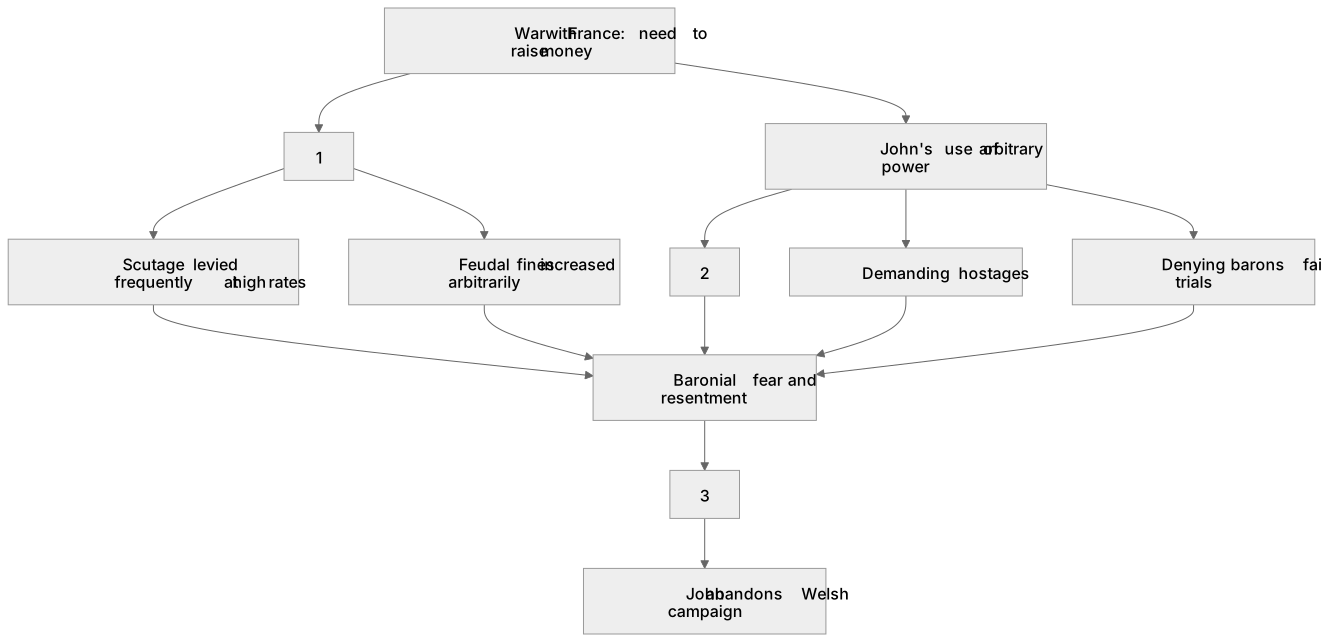
Label the diagram
Some boxes have lost their names. Pick the right name for each number.
1Box 1
2Box 2
3Box 3
There is more to this lesson
The full lesson goes on to check your understanding and help you earn the marks. Create a free account to carry on, with your progress saved.
A week of Premium from your first lesson · Then the free plan continues · No card, no charge
Test your understanding of Option B2: Key topic 3: King John’s downfall, 1205–16 - 2 Worsening relations with the barons: Growing financial impositions to raise money for war with France: taxation and ‘fines’; John’s use of arbitrary power. The plot of 1212.
Active recall beats re-reading. Take an instant quiz now to test what you’ve learned and lock it into long-term memory.
A week of Premium from your first lesson · Then the free plan continues · No card, no charge