Pearson Edexcel · GCSE · History
Course version: 1HI0 · Version from Sept 2016
Key topic 3: King John’s downfall, 1205–16 - 2 Worsening relations with…
Full specification wording
Option B2: Key topic 3: King John’s downfall, 1205–16 - 2 Worsening relations with the barons: The rebellion of 1215: Northampton, Lincoln, the march on London.
The baronial rebellion of 1215 escalated rapidly as negotiations with King John broke down.
Checked against the Pearson Edexcel 1HI0 specification (opens in a new tab) on .
- Point 3 of 3
- 4 key terms
Study notes
From the checked teaching notes for this specification point.
The idea
The baronial rebellion of 1215 escalated rapidly as negotiations with King John broke down. In May 1215, the rebel barons renounced their fealty to John and mustered their forces at Northampton, though they failed to capture its castle. The rebellion gained momentum as it spread, with rebels successfully taking control of Lincoln, a vital strategic and economic centre. The decisive turning point was the rebels' march on London. Aided by sympathetic citizens who opened the city gates, the barons captured the capital without resistance. Taking London gave the rebels control of the kingdom's financial hub and trapped John, forcing him to the negotiating table at Runnymede, where he was compelled to seal Magna Carta to buy time and regain control.
What earns the marks
- The rebels formally defied King John in May 1215 and initially gathered at Northampton.
- The capture of Lincoln demonstrated the growing geographical spread and military threat of the baronial rebellion.
- The march on London was successful because disgruntled Londoners, angry at John's taxation, opened the gates to the rebels.
- Capturing London was the crucial victory that forced King John to negotiate and agree to Magna Carta at Runnymede.
Common mistakes and how to put them right
Assuming the rebels won a major military battle against John's army.
Put it right: The rebellion succeeded largely through capturing key locations like London without pitched battles, as John's forces were divided.
Thinking the capture of Northampton was a great success.
Put it right: The rebels mustered there but actually failed to take Northampton Castle, showing their initial military weakness.
Believing London was taken by force.
Put it right: The city was handed over by its citizens who sympathised with the barons' cause.
Exam tips
- Highlight the capture of London as the most significant event of the rebellion, as it deprived John of his capital and treasury.
- Use the events at Northampton and Lincoln to show how the rebellion developed from a regional uprising into a national crisis.
- Connect the success of the march on London directly to John's decision to seal Magna Carta.
Try the lesson
The start of the Option B2: Key topic 3: King John’s downfall, 1205–16 - 2 Worsening relations with the barons: The rebellion of 1215: Northampton, Lincoln, the march on London. lesson, made from checked teaching notes for this specification point.
Have a go first
During the baronial rebellion of 1215, which major city did the rebels successfully march on and capture in May, significantly strengthening their position?
Listen
The baronial rebellion of 1215 escalated rapidly as negotiations with King John broke down. In May 1215, the rebel barons renounced their fealty to John and mustered their forces at Northampton, though they failed to capture its castle. The rebellion gained momentum as it spread, with rebels successfully taking control of Lincoln, a vital strategic and economic centre. The decisive turning point was the rebels' march on London. Aided by sympathetic citizens who opened the city gates, the barons captured the capital without resistance. Taking London gave the rebels control of the kingdom's financial hub and trapped John, forcing him to the negotiating table at Runnymede, where he was compelled to seal Magna Carta to buy time and regain control. A strong answer earns marks for these points. The rebels formally defied King John in May 1215 and initially gathered at Northampton. The capture of Lincoln demonstrated the growing geographical spread and military threat of the baronial rebellion. The march on London was successful because disgruntled Londoners, angry at John's taxation, opened the gates to the rebels. Capturing London was the crucial victory that forced King John to negotiate and agree to Magna Carta at Runnymede. A common slip: Assuming the rebels won a major military battle against John's army. Instead, The rebellion succeeded largely through capturing key locations like London without pitched battles, as John's forces were divided. Exam tip: Highlight the capture of London as the most significant event of the rebellion, as it deprived John of his capital and treasury.
See it
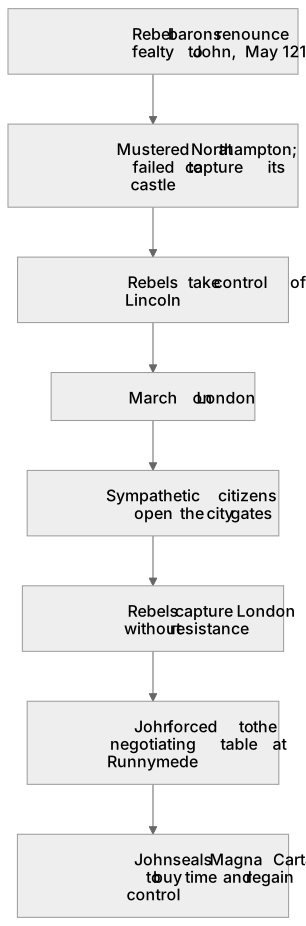
Put it in order
Put these steps in the order they happen.
- 1. Sympathetic citizens open the city gates
- 2. John seals Magna Carta to buy time and regain control
- 3. Rebels capture London without resistance
- 4. Rebel barons renounce fealty to John, May 1215
- 5. Mustered at Northampton; failed to capture its castle
- 6. John forced to the negotiating table at Runnymede
- 7. Rebels take control of Lincoln
- 8. March on London
Key words
Say what each word means before you turn the card.
Conflict and rebellion
Try answering aloud or in your head before turning the card.
Royal authority and power
Try answering aloud or in your head before turning the card.
Economy and finance
Try answering aloud or in your head before turning the card.
Society and population
Try answering aloud or in your head before turning the card.
See every definition
- Conflict and rebellion
- The baronial rebellion of 1215 escalated rapidly as negotiations with King John broke down, with the rebels renouncing their fealty and mustering their forces.
- Royal authority and power
- Capturing London trapped John and forced him to the negotiating table at Runnymede, where he was compelled to seal Magna Carta to buy time and regain control.
- Economy and finance
- Taking London gave the rebels control of the kingdom's financial hub, and disgruntled Londoners angry at John's taxation opened the gates to them.
- Society and population
- Sympathetic citizens opened the city gates, allowing the barons to capture the capital without resistance.
Label the diagram
Some boxes have lost their names. Pick the right name for each number.
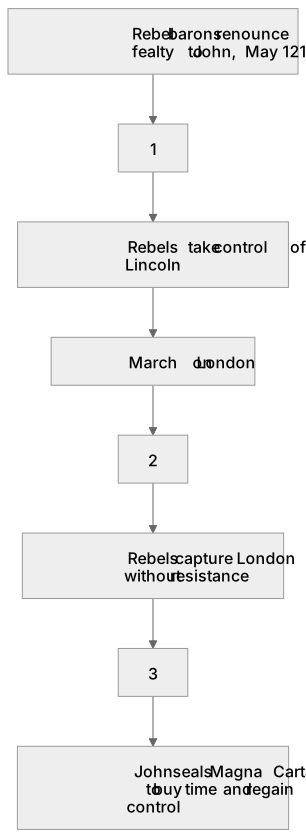
1Box 1
2Box 2
3Box 3
There is more to this lesson
The full lesson goes on to check your understanding and help you earn the marks. Create a free account to carry on, with your progress saved.
A week of Premium from your first lesson · Then the free plan continues · No card, no charge
Test your understanding of Option B2: Key topic 3: King John’s downfall, 1205–16 - 2 Worsening relations with the barons: The rebellion of 1215: Northampton, Lincoln, the march on London.
Active recall beats re-reading. Take an instant quiz now to test what you’ve learned and lock it into long-term memory.
A week of Premium from your first lesson · Then the free plan continues · No card, no charge