Pearson Edexcel · GCSE · History
Course version: 1HI0 · Version from Sept 2016
Key topic 3: King John’s downfall, 1205–16 - 4 England in 1216 ● The…
Full specification wording
Option B2: Key topic 3: King John’s downfall, 1205–16 - 4 England in 1216 ● The condition of England at the time of John’s death.: The problem of the succession.
When King John died in October 1216, England faced a severe succession crisis.
Checked against the Pearson Edexcel 1HI0 specification (opens in a new tab) on .
- Point 1 of 2
- 4 key terms
Study notes
From the checked teaching notes for this specification point.
The idea
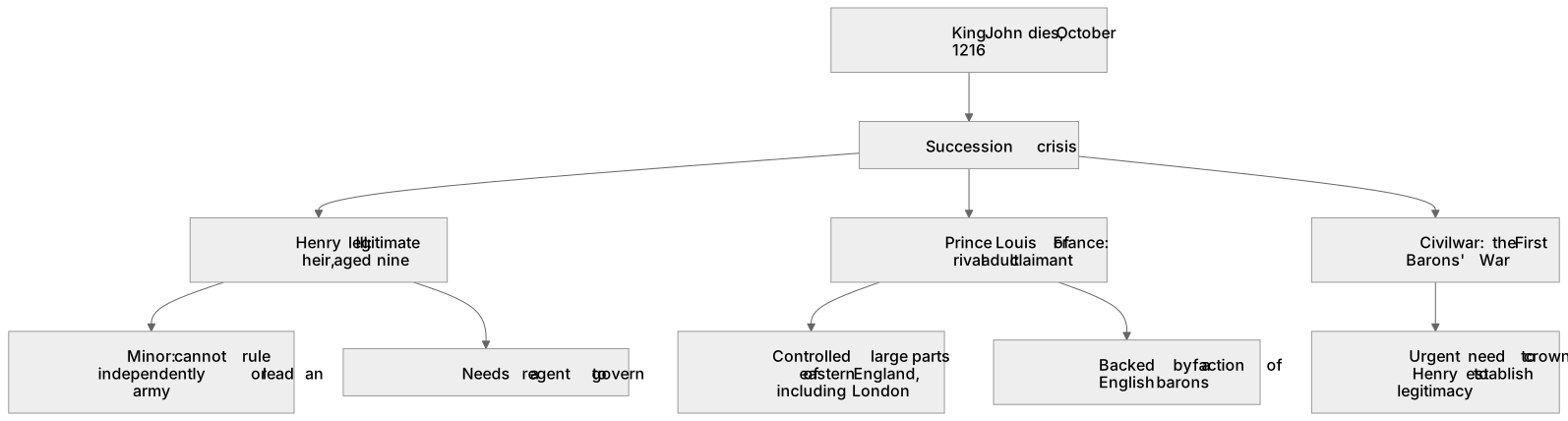
When King John died in October 1216, England faced a severe succession crisis. The legitimate heir, Henry III, was only nine years old, making him a minor incapable of ruling independently or leading an army. This was highly problematic during a civil war. Furthermore, the country was deeply divided: a significant faction of English barons had already sworn allegiance to Prince Louis of France, who controlled large parts of eastern England, including London. The presence of a rival, adult claimant with substantial military backing threatened the Plantagenet dynasty's survival. The succession problem required urgent political manoeuvring by John's loyalists to secure Henry's coronation and legitimize his reign amidst widespread rebellion and foreign occupation.
What earns the marks
- Identify Henry III's young age (nine years old) as a primary vulnerability for the royalist cause.
- Explain the threat posed by Prince Louis of France, who was an adult, experienced military leader claiming the throne.
- Describe the divided loyalty of the English barons, many of whom supported Louis over the young Henry.
- Analyse the urgency of crowning Henry quickly to establish his legitimacy against Louis's claims.
Common mistakes and how to put them right
Stating that Henry III immediately took full control of the country upon John's death.
Put it right: Explain that Henry was a minor and required a regent (William Marshal) to govern on his behalf.
Ignoring the presence of Prince Louis when discussing the succession.
Put it right: Include Louis as the rival claimant who controlled significant territory and had baronial support.
Assuming the succession was peaceful.
Put it right: Emphasise that the succession occurred in the middle of the First Barons' War, making it highly contested and dangerous.
Exam tips
- Emphasise the contrast between the nine-year-old Henry and the adult, militarily capable Prince Louis.
- Discuss how John's death actually helped the royalist cause by removing the main source of baronial grievance.
- Link the problem of the succession to the need for a strong Protector to guide the young king.
Try the lesson
The start of the Option B2: Key topic 3: King John’s downfall, 1205–16 - 4 England in 1216 ● The condition of England at the time of John’s death.: The problem of the succession. lesson, made from checked teaching notes for this specification point.
Have a go first
Who was the immediate heir to the English throne upon the death of King John in October 1216?
Listen
When King John died in October 1216, England faced a severe succession crisis. The legitimate heir, Henry III, was only nine years old, making him a minor incapable of ruling independently or leading an army. This was highly problematic during a civil war. Furthermore, the country was deeply divided: a significant faction of English barons had already sworn allegiance to Prince Louis of France, who controlled large parts of eastern England, including London. The presence of a rival, adult claimant with substantial military backing threatened the Plantagenet dynasty's survival. The succession problem required urgent political manoeuvring by John's loyalists to secure Henry's coronation and legitimize his reign amidst widespread rebellion and foreign occupation. A strong answer earns marks for these points. Identify Henry III's young age (nine years old) as a primary vulnerability for the royalist cause. Explain the threat posed by Prince Louis of France, who was an adult, experienced military leader claiming the throne. Describe the divided loyalty of the English barons, many of whom supported Louis over the young Henry. Analyse the urgency of crowning Henry quickly to establish his legitimacy against Louis's claims. A common slip: Stating that Henry III immediately took full control of the country upon John's death. Instead, Explain that Henry was a minor and required a regent (William Marshal) to govern on his behalf. Exam tip: Emphasise the contrast between the nine-year-old Henry and the adult, militarily capable Prince Louis.
See it
Key words
Say what each word means before you turn the card.
Monarchy and succession
Try answering aloud or in your head before turning the card.
Civil war and instability
Try answering aloud or in your head before turning the card.
Legitimacy and royal authority
Try answering aloud or in your head before turning the card.
Foreign intervention
Try answering aloud or in your head before turning the card.
See every definition
- Monarchy and succession
- When King John died in October 1216, England faced a severe succession crisis because the legitimate heir, Henry III, was only nine years old.
- Civil war and instability
- The succession occurred in the middle of the First Barons' War, making it highly contested and dangerous.
- Legitimacy and royal authority
- The succession problem required urgent political manoeuvring by John's loyalists to secure Henry's coronation and legitimize his reign.
- Foreign intervention
- A significant faction of English barons had sworn allegiance to Prince Louis of France, who controlled large parts of eastern England, including London.
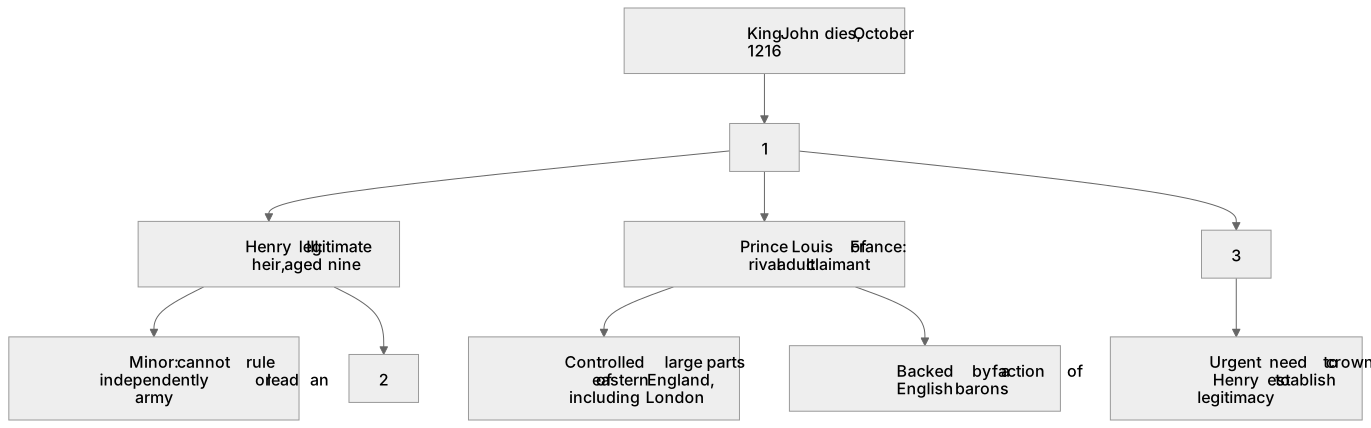
Label the diagram
Some boxes have lost their names. Pick the right name for each number.
1Box 1
2Box 2
3Box 3
There is more to this lesson
The full lesson goes on to check your understanding and help you earn the marks. Create a free account to carry on, with your progress saved.
A week of Premium from your first lesson · Then the free plan continues · No card, no charge
Test your understanding of Option B2: Key topic 3: King John’s downfall, 1205–16 - 4 England in 1216 ● The condition of England at the time of John’s death.: The problem of the succession.
Active recall beats re-reading. Take an instant quiz now to test what you’ve learned and lock it into long-term memory.
A week of Premium from your first lesson · Then the free plan continues · No card, no charge