Pearson Edexcel · GCSE · History
Course version: 1HI0 · Version from Sept 2016
Key topic 1: Henry VIII and Wolsey, 1509–29 - 4 Wolsey, Catherine, the…
Full specification wording
Option B3: Key topic 1: Henry VIII and Wolsey, 1509–29 - 4 Wolsey, Catherine, the succession and annulment: Catherine of Aragon and the succession.
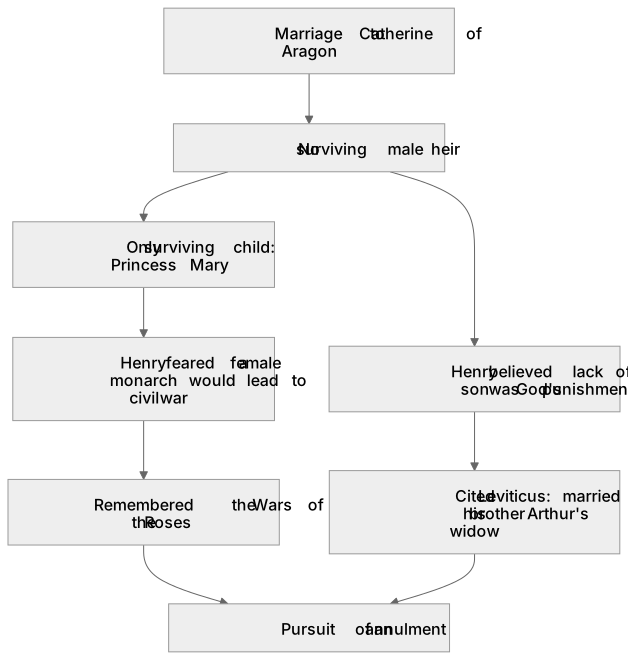
Henry VIII's marriage to Catherine of Aragon failed to produce a surviving male heir, creating a severe succession crisis.
Checked against the Pearson Edexcel 1HI0 specification (opens in a new tab) on .
- Point 1 of 3
- 4 key terms
Study notes
From the checked teaching notes for this specification point.
The idea
Henry VIII's marriage to Catherine of Aragon failed to produce a surviving male heir, creating a severe succession crisis. By 1527, Catherine was past childbearing age, and their only surviving child was Princess Mary. Henry feared that a female monarch would lead to civil war, remembering the recent Wars of the Roses. He believed his lack of a son was God's punishment for marrying his brother Arthur's widow, citing Leviticus. This succession issue drove Henry's desire for an annulment, fundamentally altering English history.
What earns the marks
- Identify Catherine of Aragon's failure to provide a surviving male heir as the root of the succession crisis.
- Explain Henry's fear of dynastic instability and civil war if a female (Princess Mary) inherited the throne.
- Describe Henry's religious justification, using Leviticus to argue the marriage was cursed because Catherine was his brother's widow.
- Link the succession crisis directly to Henry's subsequent pursuit of an annulment (the 'Great Matter').
Common mistakes and how to put them right
Stating Catherine had no children.
Put it right: Catherine had several pregnancies, but only Princess Mary survived infancy.
Claiming Henry wanted a divorce simply because he fell in love with Anne Boleyn.
Put it right: While Anne was a factor, the primary driver was the genuine political need for a legitimate male heir to secure the succession.
Confusing divorce with annulment.
Put it right: Henry sought an annulment (declaring the marriage invalid from the start), not a divorce (ending a valid marriage).
Exam tips
- Always link Catherine's age and lack of a male heir to the broader context of Tudor dynastic security.
- Use the term 'annulment' rather than 'divorce' to demonstrate accurate historical understanding.
- Mention the Wars of the Roses to explain why Henry was so terrified of a disputed succession.
Try the lesson
The start of the Option B3: Key topic 1: Henry VIII and Wolsey, 1509–29 - 4 Wolsey, Catherine, the succession and annulment: Catherine of Aragon and the succession. lesson, made from checked teaching notes for this specification point.
Have a go first
What was the primary concern regarding the succession during Henry VIII's marriage to Catherine of Aragon?
Listen
Henry VIII's marriage to Catherine of Aragon failed to produce a surviving male heir, creating a severe succession crisis. By 1527, Catherine was past childbearing age, and their only surviving child was Princess Mary. Henry feared that a female monarch would lead to civil war, remembering the recent Wars of the Roses. He believed his lack of a son was God's punishment for marrying his brother Arthur's widow, citing Leviticus. This succession issue drove Henry's desire for an annulment, fundamentally altering English history. A strong answer earns marks for these points. Identify Catherine of Aragon's failure to provide a surviving male heir as the root of the succession crisis. Explain Henry's fear of dynastic instability and civil war if a female (Princess Mary) inherited the throne. Describe Henry's religious justification, using Leviticus to argue the marriage was cursed because Catherine was his brother's widow. Link the succession crisis directly to Henry's subsequent pursuit of an annulment (the 'Great Matter'). A common slip: Stating Catherine had no children. Instead, Catherine had several pregnancies, but only Princess Mary survived infancy. Exam tip: Always link Catherine's age and lack of a male heir to the broader context of Tudor dynastic security.
See it
Key words
Say what each word means before you turn the card.
Succession crisis
Try answering aloud or in your head before turning the card.
Dynastic security
Try answering aloud or in your head before turning the card.
Annulment
Try answering aloud or in your head before turning the card.
Leviticus
Try answering aloud or in your head before turning the card.
See every definition
- Succession crisis
- The severe problem created because Henry VIII's marriage to Catherine of Aragon failed to produce a surviving male heir.
- Dynastic security
- The safety of the Tudor dynasty, threatened because Henry feared a female monarch would lead to civil war.
- Annulment
- Declaring the marriage invalid from the start, which Henry sought after citing Leviticus to argue the marriage was cursed.
- Leviticus
- The biblical text Henry cited to argue his marriage was cursed because Catherine was his brother Arthur's widow.
Label the diagram
Some boxes have lost their names. Pick the right name for each number.
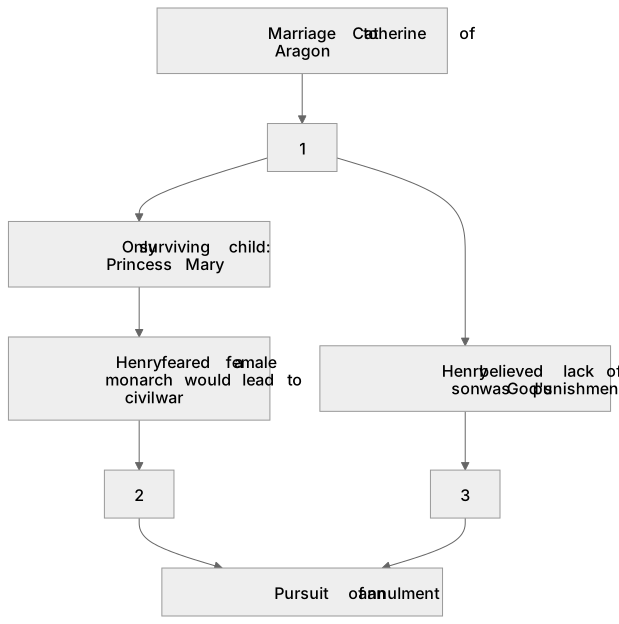
1Box 1
2Box 2
3Box 3
There is more to this lesson
The full lesson goes on to check your understanding and help you earn the marks. Create a free account to carry on, with your progress saved.
A week of Premium from your first lesson · Then the free plan continues · No card, no charge
Test your understanding of Option B3: Key topic 1: Henry VIII and Wolsey, 1509–29 - 4 Wolsey, Catherine, the succession and annulment: Catherine of Aragon and the succession.
Active recall beats re-reading. Take an instant quiz now to test what you’ve learned and lock it into long-term memory.
A week of Premium from your first lesson · Then the free plan continues · No card, no charge