Pearson Edexcel · GCSE · History
Course version: 1HI0 · Version from Sept 2016
Key topic 1: Henry VIII and Wolsey, 1509–29 - 4 Wolsey, Catherine, the…
Full specification wording
Option B3: Key topic 1: Henry VIII and Wolsey, 1509–29 - 4 Wolsey, Catherine, the succession and annulment: Reasons for Wolsey’s fall from power, including the failure of the divorce proceedings in London and the influence of the Boleyns.
Thomas Wolsey's fall from power in 1529 was triggered by his failure to secure Henry VIII's annulment.
Checked against the Pearson Edexcel 1HI0 specification (opens in a new tab) on .
- Point 3 of 3
- 3 key terms
Study notes
From the checked teaching notes for this specification point.
The idea
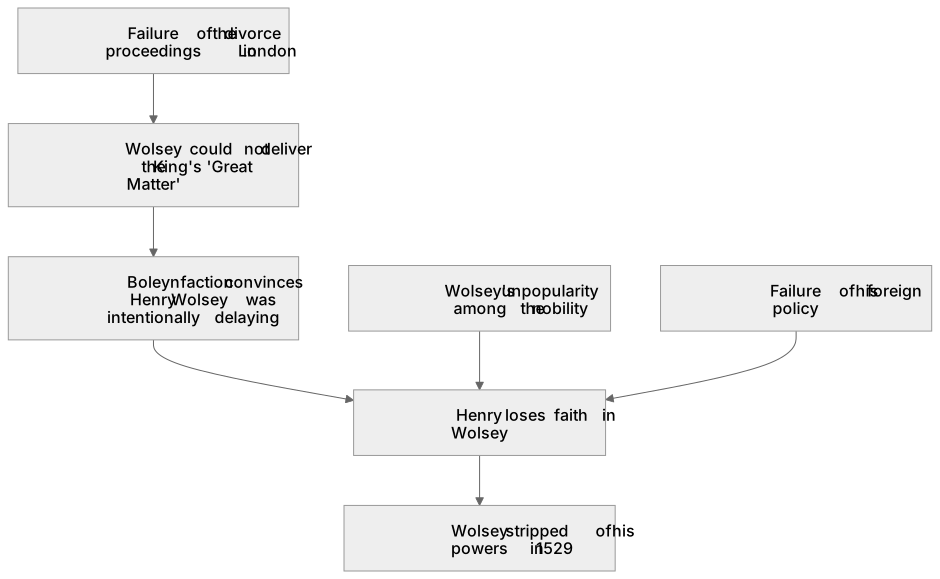
Thomas Wolsey's fall from power in 1529 was triggered by his failure to secure Henry VIII's annulment. The collapse of the legatine court at Blackfriars in London, when Campeggio adjourned proceedings to Rome, proved Wolsey could not deliver the King's 'Great Matter'. This failure allowed his enemies, particularly the Boleyn faction led by Anne and her father, to convince Henry that Wolsey was intentionally delaying the process. Additionally, Wolsey's unpopularity among the nobility and the failure of his foreign policy compounded his downfall.
What earns the marks
- Explain how the failure of the Blackfriars court in London directly led to Henry losing faith in Wolsey.
- Describe the role of the Boleyn faction in poisoning Henry's mind against Wolsey, accusing him of serving the Pope over the King.
- Identify Wolsey's failure to secure the annulment as the primary catalyst for his dismissal.
- Note underlying factors contributing to his fall, such as his arrogance, unpopularity with nobles, and foreign policy failures.
Common mistakes and how to put them right
Stating Wolsey was executed in 1529.
Put it right: Wolsey was stripped of his powers in 1529 and died of illness in 1530 while travelling to face treason charges.
Attributing Wolsey's fall solely to Anne Boleyn.
Put it right: While the Boleyns were influential, Wolsey's failure to secure the annulment at the London proceedings was the fundamental cause.
Ignoring Wolsey's foreign policy.
Put it right: Wolsey's diplomatic failures, leaving England isolated and unable to pressure Charles V, directly contributed to the annulment's failure.
Exam tips
- Link the failure of the London divorce proceedings directly to the rise of the Boleyn faction's influence over Henry.
- Use the term 'praemunire' (serving a foreign power over the king) when discussing the charges brought against Wolsey.
- Structure answers on Wolsey's fall by weighing the immediate trigger (the annulment) against long-term resentments (noble opposition).
Try the lesson
The start of the Option B3: Key topic 1: Henry VIII and Wolsey, 1509–29 - 4 Wolsey, Catherine, the succession and annulment: Reasons for Wolsey’s fall from power, including the failure of the divorce proceedings in London and the influence of the Boleyns. lesson, made from checked teaching notes for this specification point.
Have a go first
What was the most significant immediate cause of Thomas Wolsey's fall from power in 1529?
Listen
Thomas Wolsey's fall from power in 1529 was triggered by his failure to secure Henry VIII's annulment. The collapse of the legatine court at Blackfriars in London, when Campeggio adjourned proceedings to Rome, proved Wolsey could not deliver the King's 'Great Matter'. This failure allowed his enemies, particularly the Boleyn faction led by Anne and her father, to convince Henry that Wolsey was intentionally delaying the process. Additionally, Wolsey's unpopularity among the nobility and the failure of his foreign policy compounded his downfall. A strong answer earns marks for these points. Explain how the failure of the Blackfriars court in London directly led to Henry losing faith in Wolsey. Describe the role of the Boleyn faction in poisoning Henry's mind against Wolsey, accusing him of serving the Pope over the King. Identify Wolsey's failure to secure the annulment as the primary catalyst for his dismissal. Note underlying factors contributing to his fall, such as his arrogance, unpopularity with nobles, and foreign policy failures. A common slip: Stating Wolsey was executed in 1529. Instead, Wolsey was stripped of his powers in 1529 and died of illness in 1530 while travelling to face treason charges. Exam tip: Link the failure of the London divorce proceedings directly to the rise of the Boleyn faction's influence over Henry.
See it
Key words
Say what each word means before you turn the card.
The 'Great Matter'
Try answering aloud or in your head before turning the card.
Boleyn faction
Try answering aloud or in your head before turning the card.
Praemunire
Try answering aloud or in your head before turning the card.
See every definition
- The 'Great Matter'
- The King's annulment, which Wolsey failed to secure, proving he could not deliver it.
- Boleyn faction
- The group led by Anne and her father who convinced Henry that Wolsey was intentionally delaying the process.
- Praemunire
- Serving a foreign power over the king, the charge brought against Wolsey.
Label the diagram
Some boxes have lost their names. Pick the right name for each number.
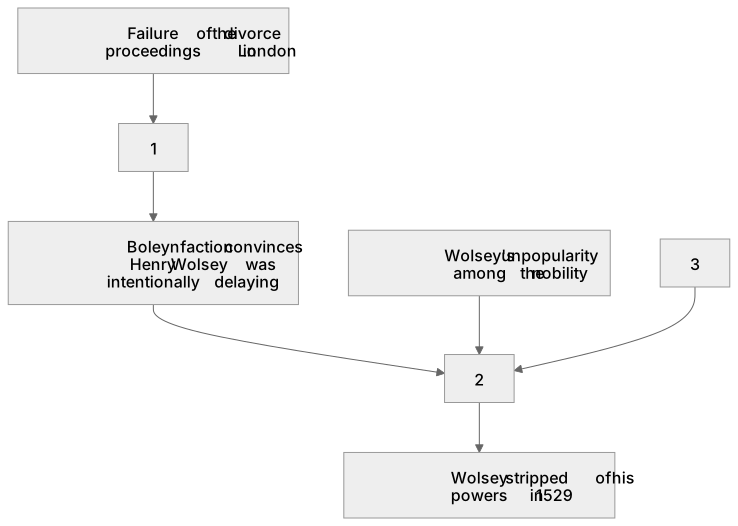
1Box 1
2Box 2
3Box 3
There is more to this lesson
The full lesson goes on to check your understanding and help you earn the marks. Create a free account to carry on, with your progress saved.
A week of Premium from your first lesson · Then the free plan continues · No card, no charge
Test your understanding of Option B3: Key topic 1: Henry VIII and Wolsey, 1509–29 - 4 Wolsey, Catherine, the succession and annulment: Reasons for Wolsey’s fall from power, including the failure of the divorce proceedings in London and the influence of the Boleyns.
Active recall beats re-reading. Take an instant quiz now to test what you’ve learned and lock it into long-term memory.
A week of Premium from your first lesson · Then the free plan continues · No card, no charge