Pearson Edexcel · GCSE · History
Course version: 1HI0 · Version from Sept 2016
Key topic 2: Henry VIII and Cromwell, 1529–40 - 1 Cromwell’s rise to…
Full specification wording
Option B3: Key topic 2: Henry VIII and Cromwell, 1529–40 - 1 Cromwell’s rise to power, 1529–34: Handling of the king’s annulment and influence over Henry. Role as the king’s Chief Minister.
Thomas Cromwell rose to power by succeeding where Wolsey failed: securing Henry VIII's annulment from Catherine of Aragon.
Checked against the Pearson Edexcel 1HI0 specification (opens in a new tab) on .
- Point 2 of 2
Study notes
From the checked teaching notes for this specification point.
The idea
Thomas Cromwell rose to power by succeeding where Wolsey failed: securing Henry VIII's annulment from Catherine of Aragon. Cromwell achieved this by shifting the power to grant the annulment from the Pope to Henry himself, using Parliament to pass laws like the Act in Restraint of Appeals (1533). This demonstrated his immense influence over Henry, offering the King both his desired marriage to Anne Boleyn and unprecedented royal supremacy. As Chief Minister from 1534, Cromwell managed the government, finances, and the Church, transforming the role into a powerful administrative position that executed the King's will while centralising state power.
What earns the marks
- Explain how Cromwell used Parliament to secure the annulment, referencing specific legislation like the Act in Restraint of Appeals.
- Describe Cromwell's strategy of breaking with Rome to solve the King's 'Great Matter'.
- Analyse how securing the annulment increased Cromwell's influence over Henry VIII.
- Evaluate Cromwell's role as Chief Minister, including his control over government administration, the Church and finances.
Common mistakes and how to put them right
Confusing Cromwell's methods with Wolsey's.
Put it right: Wolsey tried to persuade the Pope diplomatically; Cromwell used Parliament to bypass the Pope entirely.
Stating Cromwell was Chief Minister during the initial annulment crisis.
Put it right: Cromwell rose to prominence during the crisis but officially became Chief Minister in 1534 after the annulment was secured.
Assuming Cromwell acted independently of the King.
Put it right: Cromwell was a highly effective servant who executed Henry's desires, though he shaped the innovative methods used.
Exam tips
- Link Cromwell's handling of the annulment directly to his rise in influence and subsequent appointment as Chief Minister.
- Use specific legislation, such as the Act in Restraint of Appeals, to demonstrate Cromwell's parliamentary methods.
- Contrast Cromwell's successful parliamentary approach with Wolsey's failed diplomatic approach to highlight Cromwell's value to Henry.
Try the lesson
The start of the Option B3: Key topic 2: Henry VIII and Cromwell, 1529–40 - 1 Cromwell’s rise to power, 1529–34: Handling of the king’s annulment and influence over Henry. Role as the king’s Chief Minister. lesson, made from checked teaching notes for this specification point.
Have a go first
What was Thomas Cromwell's primary strategy for securing Henry VIII's annulment from Catherine of Aragon?
Listen
Thomas Cromwell rose to power by succeeding where Wolsey failed: securing Henry VIII's annulment from Catherine of Aragon. Cromwell achieved this by shifting the power to grant the annulment from the Pope to Henry himself, using Parliament to pass laws like the Act in Restraint of Appeals (1533). This demonstrated his immense influence over Henry, offering the King both his desired marriage to Anne Boleyn and unprecedented royal supremacy. As Chief Minister from 1534, Cromwell managed the government, finances, and the Church, transforming the role into a powerful administrative position that executed the King's will while centralising state power. A strong answer earns marks for these points. Explain how Cromwell used Parliament to secure the annulment, referencing specific legislation like the Act in Restraint of Appeals. Describe Cromwell's strategy of breaking with Rome to solve the King's 'Great Matter'. Analyse how securing the annulment increased Cromwell's influence over Henry VIII. Evaluate Cromwell's role as Chief Minister, including his control over government administration, the Church and finances. A common slip: Confusing Cromwell's methods with Wolsey's. Instead, Wolsey tried to persuade the Pope diplomatically; Cromwell used Parliament to bypass the Pope entirely. Exam tip: Link Cromwell's handling of the annulment directly to his rise in influence and subsequent appointment as Chief Minister.
See it
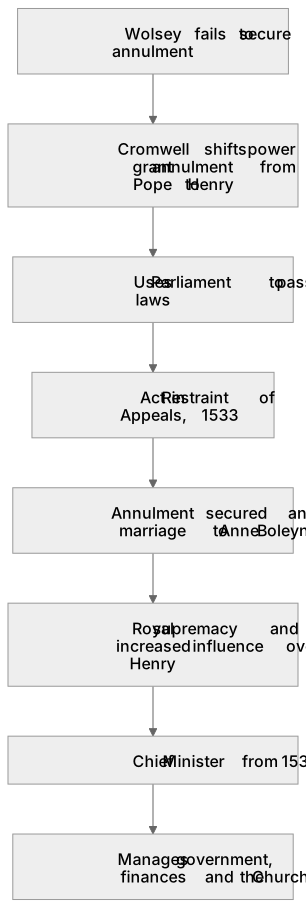
Put it in order
Put these steps in the order they happen.
- 1. Annulment secured and marriage to Anne Boleyn
- 2. Manages government, finances and the Church
- 3. Royal supremacy and increased influence over Henry
- 4. Wolsey fails to secure annulment
- 5. Cromwell shifts power to grant annulment from Pope to Henry
- 6. Chief Minister from 1534
- 7. Uses Parliament to pass laws
- 8. Act in Restraint of Appeals, 1533
Label the diagram
Some boxes have lost their names. Pick the right name for each number.
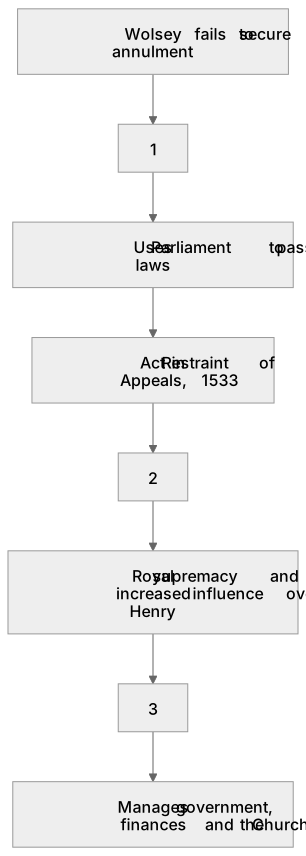
1Box 1
2Box 2
3Box 3
There is more to this lesson
The full lesson goes on to check your understanding and help you earn the marks. Create a free account to carry on, with your progress saved.
A week of Premium from your first lesson · Then the free plan continues · No card, no charge
Test your understanding of Option B3: Key topic 2: Henry VIII and Cromwell, 1529–40 - 1 Cromwell’s rise to power, 1529–34: Handling of the king’s annulment and influence over Henry. Role as the king’s Chief Minister.
Active recall beats re-reading. Take an instant quiz now to test what you’ve learned and lock it into long-term memory.
A week of Premium from your first lesson · Then the free plan continues · No card, no charge