Pearson Edexcel · GCSE · History
Course version: 1HI0 · Version from Sept 2016
Key topic 1: Queen, government and religion, 1558–69 - 3 Challenge to the…
Full specification wording
Option B4: Key topic 1: Queen, government and religion, 1558–69 - 3 Challenge to the religious settlement: The nature and extent of the Puritan challenge.
The Puritan challenge to Elizabeth's Religious Settlement stemmed from their belief that the reforms did not go far enough to eradicate Catholic practices.
Checked against the Pearson Edexcel 1HI0 specification (opens in a new tab) on .
- Point 1 of 2
Study notes
From the checked teaching notes for this specification point.
The idea
The Puritan challenge to Elizabeth's Religious Settlement stemmed from their belief that the reforms did not go far enough to eradicate Catholic practices. The nature of their challenge focused on specific grievances, such as the use of crucifixes in churches and the wearing of elaborate clerical vestments, which they viewed as idolatrous. The extent of the challenge was significant because Puritans were often vocal, highly educated, and held influential positions within the Church and Parliament. However, their threat was limited by their minority status and their unwillingness to overthrow Elizabeth, whom they preferred over a Catholic alternative. The Queen successfully managed the challenge by making minor concessions or enforcing conformity.
What earns the marks
- Identify the core Puritan belief that the Religious Settlement was too Catholic and needed further purification.
- Describe the specific controversies, such as the Crucifix Controversy and the Vestment Controversy.
- Evaluate the extent of the threat, noting the influence of Puritans in Parliament and the Privy Council.
- Explain why the Puritan challenge was ultimately limited, focusing on their lack of desire to replace Elizabeth with a Catholic monarch.
Common mistakes and how to put them right
Confusing Puritans with Catholics.
Put it right: Puritans were extreme Protestants who wanted to remove all Catholic elements from the Church.
Overstating the Puritan threat to Elizabeth's life.
Put it right: Unlike some Catholics, Puritans did not plot to assassinate or overthrow the Queen.
Treating Puritans as a unified group.
Put it right: They had varying degrees of radicalism, from moderate conformists to separatists.
Exam tips
- Use the Crucifix and Vestment controversies as concrete examples of the nature of the Puritan challenge.
- Highlight the dilemma Puritans faced: they wanted reform but feared a Catholic succession if they destabilised Elizabeth's rule.
- When assessing the 'extent' of the challenge, contrast their vocal influence with their actual ability to force change.
Try the lesson
The start of the Option B4: Key topic 1: Queen, government and religion, 1558–69 - 3 Challenge to the religious settlement: The nature and extent of the Puritan challenge. lesson, made from checked teaching notes for this specification point.
Have a go first
What was the main goal of the Puritans regarding the Elizabethan religious settlement?
Listen
The Puritan challenge to Elizabeth's Religious Settlement stemmed from their belief that the reforms did not go far enough to eradicate Catholic practices. The nature of their challenge focused on specific grievances, such as the use of crucifixes in churches and the wearing of elaborate clerical vestments, which they viewed as idolatrous. The extent of the challenge was significant because Puritans were often vocal, highly educated, and held influential positions within the Church and Parliament. However, their threat was limited by their minority status and their unwillingness to overthrow Elizabeth, whom they preferred over a Catholic alternative. The Queen successfully managed the challenge by making minor concessions or enforcing conformity. A strong answer earns marks for these points. Identify the core Puritan belief that the Religious Settlement was too Catholic and needed further purification. Describe the specific controversies, such as the Crucifix Controversy and the Vestment Controversy. Evaluate the extent of the threat, noting the influence of Puritans in Parliament and the Privy Council. Explain why the Puritan challenge was ultimately limited, focusing on their lack of desire to replace Elizabeth with a Catholic monarch. Exam tip: Use the Crucifix and Vestment controversies as concrete examples of the nature of the Puritan challenge.
See it
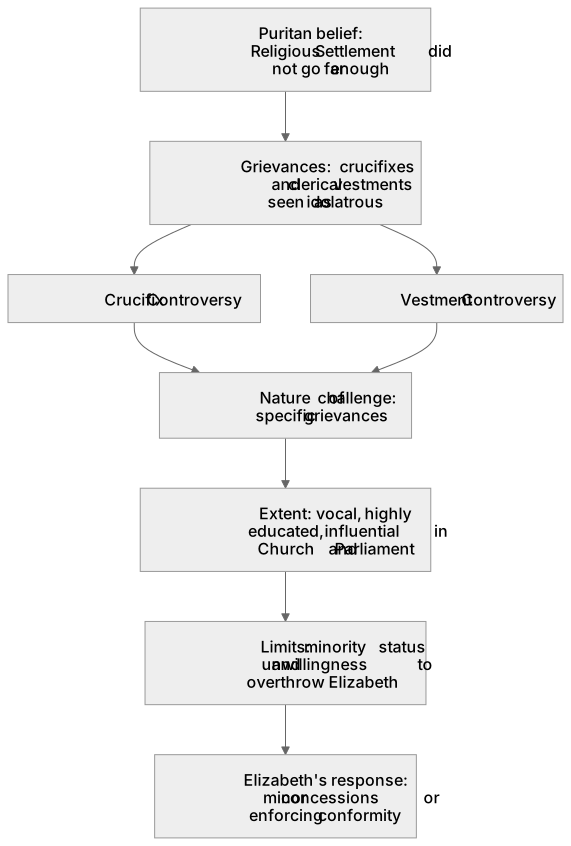
Label the diagram
Some boxes have lost their names. Pick the right name for each number.
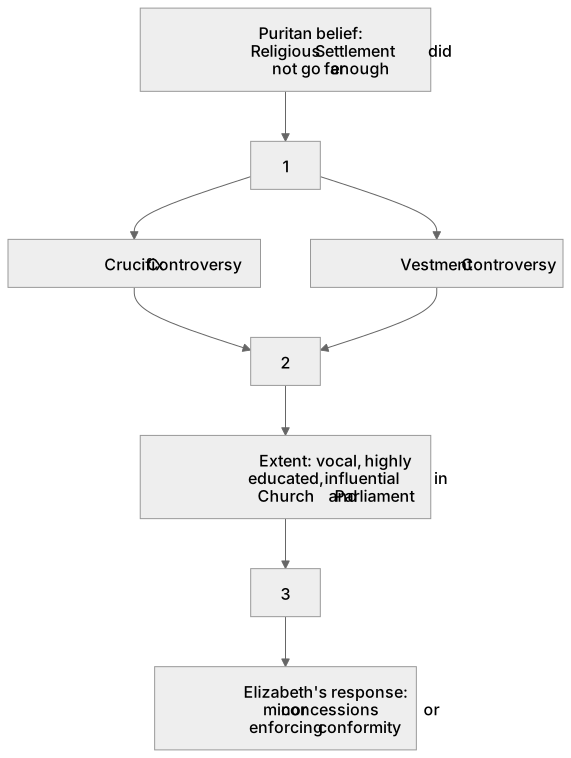
1Box 1
2Box 2
3Box 3
There is more to this lesson
The full lesson goes on to check your understanding and help you earn the marks. Create a free account to carry on, with your progress saved.
A week of Premium from your first lesson · Then the free plan continues · No card, no charge
Test your understanding of Option B4: Key topic 1: Queen, government and religion, 1558–69 - 3 Challenge to the religious settlement: The nature and extent of the Puritan challenge.
Active recall beats re-reading. Take an instant quiz now to test what you’ve learned and lock it into long-term memory.
A week of Premium from your first lesson · Then the free plan continues · No card, no charge