Pearson Edexcel · GCSE · History
Course version: 1HI0 · Version from Sept 2016
Key topic 2: Challenges to Elizabeth at home and abroad, 1569–88 - 1 Plots…
Full specification wording
Option B4: Key topic 2: Challenges to Elizabeth at home and abroad, 1569–88 - 1 Plots and revolts at home: The reasons for, and significance of, Mary Queen of Scots’ execution in 1587.
Mary's death was triggered by her clear implication in the Babington Plot (1586), uncovered by Walsingham's spy network.
Checked against the Pearson Edexcel 1HI0 specification (opens in a new tab) on .
- Point 3 of 3
Study notes
From the checked teaching notes for this specification point.
The idea
Mary's death was triggered by her clear implication in the Babington Plot (1586), uncovered by Walsingham's spy network. This provided undeniable proof of her complicity in attempting to assassinate Elizabeth. Parliament and the Privy Council pressured a reluctant Elizabeth to sign the death warrant. The execution removed the Catholic figurehead for domestic rebellions, reducing internal threats. However, it significantly escalated foreign danger, giving Philip II of Spain the justification he needed to launch the Armada, as he claimed to be avenging a Catholic martyr. It also established a dangerous precedent by executing an anointed monarch.
What earns the marks
- Explain the role of the Babington Plot and Walsingham's spies in providing evidence against Mary.
- Discuss the pressure exerted on Elizabeth by her Privy Council and Parliament to sign the death warrant.
- Analyse the domestic significance: the removal of the primary Catholic alternative to Elizabeth, reducing the threat of internal plots.
- Evaluate the international significance: how the execution provided Philip II with a religious and political pretext to launch the Spanish Armada.
Common mistakes and how to put them right
Claiming Mary was executed solely for her religion.
Put it right by explaining she was executed for treason following her involvement in the Babington Plot.
Stating Elizabeth eagerly executed Mary.
Put it right by noting Elizabeth hesitated for months and was furious when the warrant was dispatched.
Confusing the Ridolfi or Throckmorton plots with the final trigger.
Put it right by specifying the Babington Plot (1586) led directly to her trial and execution.
Exam tips
- When discussing significance, ensure you cover both domestic consequences (fewer plots) and foreign consequences (Spanish Armada).
- Use specific evidence, such as the intercepted letters in the Babington Plot, to explain why the execution happened in 1587 and not earlier.
- Link Mary's execution to the broader theme of Elizabeth's insecurity and the ongoing Catholic threat.
Try the lesson
The start of the Option B4: Key topic 2: Challenges to Elizabeth at home and abroad, 1569–88 - 1 Plots and revolts at home: The reasons for, and significance of, Mary Queen of Scots’ execution in 1587. lesson, made from checked teaching notes for this specification point.
Have a go first
Which plot directly led to the trial and execution of Mary, Queen of Scots in 1587?
Listen
Mary's death was triggered by her clear implication in the Babington Plot (1586), uncovered by Walsingham's spy network. This provided undeniable proof of her complicity in attempting to assassinate Elizabeth. Parliament and the Privy Council pressured a reluctant Elizabeth to sign the death warrant. The execution removed the Catholic figurehead for domestic rebellions, reducing internal threats. However, it significantly escalated foreign danger, giving Philip II of Spain the justification he needed to launch the Armada, as he claimed to be avenging a Catholic martyr. It also established a dangerous precedent by executing an anointed monarch. A strong answer earns marks for these points. Explain the role of the Babington Plot and Walsingham's spies in providing evidence against Mary. Discuss the pressure exerted on Elizabeth by her Privy Council and Parliament to sign the death warrant. Analyse the domestic significance: the removal of the primary Catholic alternative to Elizabeth, reducing the threat of internal plots. Evaluate the international significance: how the execution provided Philip II with a religious and political pretext to launch the Spanish Armada. A common slip: Claiming Mary was executed solely for her religion. Instead, explaining she was executed for treason following her involvement in the Babington Plot. Exam tip: When discussing significance, ensure you cover both domestic consequences (fewer plots) and foreign consequences (Spanish Armada).
See it
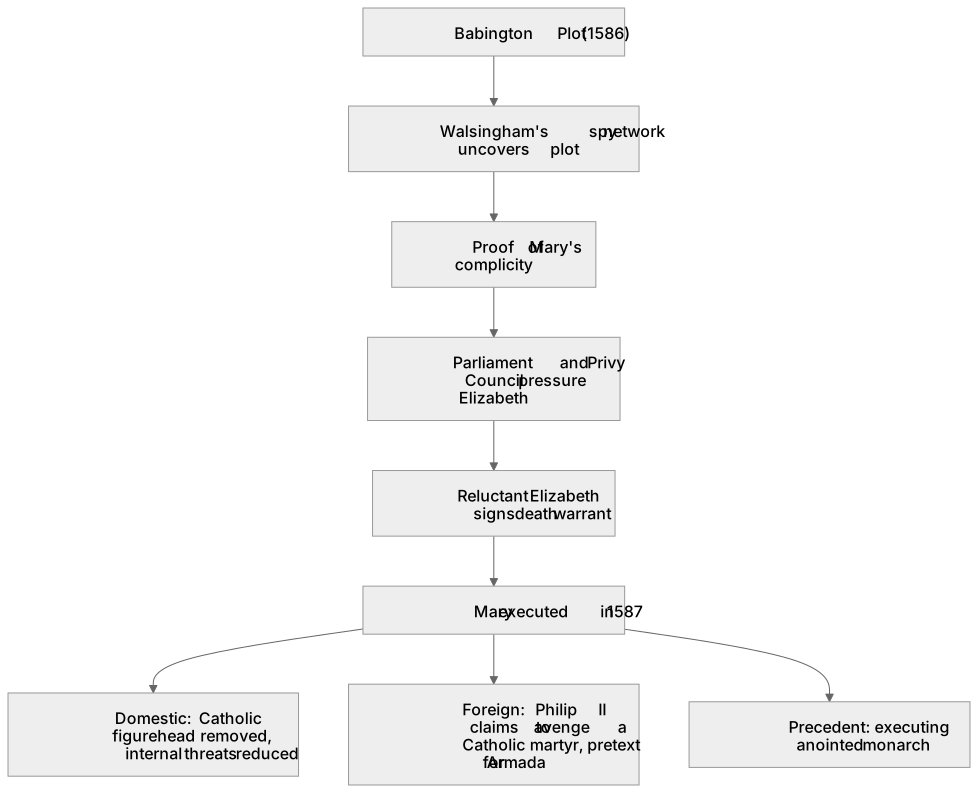
Label the diagram
Some boxes have lost their names. Pick the right name for each number.
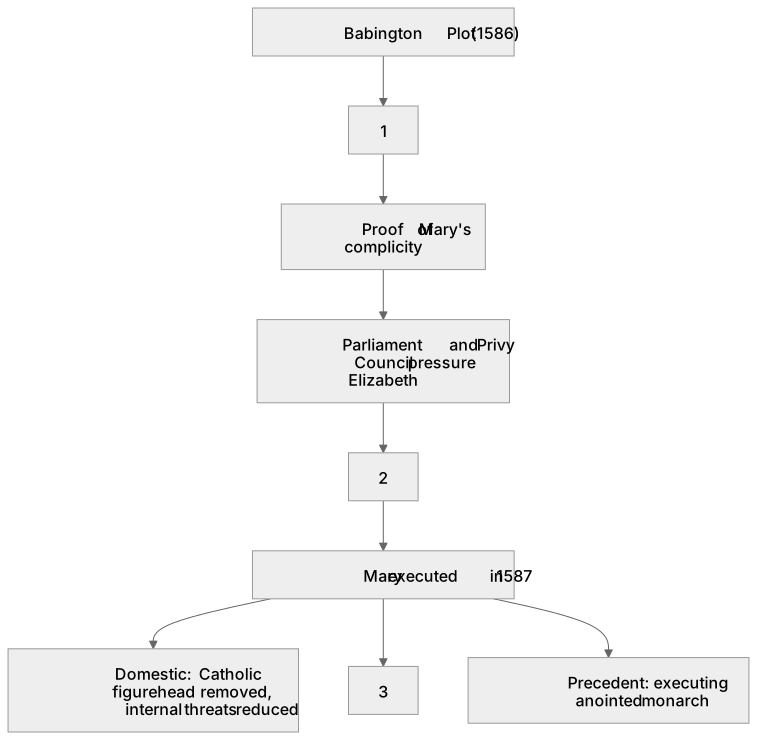
1Box 1
2Box 2
3Box 3
There is more to this lesson
The full lesson goes on to check your understanding and help you earn the marks. Create a free account to carry on, with your progress saved.
A week of Premium from your first lesson · Then the free plan continues · No card, no charge
Test your understanding of Option B4: Key topic 2: Challenges to Elizabeth at home and abroad, 1569–88 - 1 Plots and revolts at home: The reasons for, and significance of, Mary Queen of Scots’ execution in 1587.
Active recall beats re-reading. Take an instant quiz now to test what you’ve learned and lock it into long-term memory.
A week of Premium from your first lesson · Then the free plan continues · No card, no charge