Pearson Edexcel · GCSE · History
Course version: 1HI0 · Version from Sept 2016
Key topic 2: Challenges to Elizabeth at home and abroad, 1569–88 - 1 Plots…
Full specification wording
Option B4: Key topic 2: Challenges to Elizabeth at home and abroad, 1569–88 - 1 Plots and revolts at home: The reasons for, and significance of, the Revolt of the Northern Earls, 1569–70.
The Revolt of the Northern Earls (1569–70) was driven by religious and political grievances.
Checked against the Pearson Edexcel 1HI0 specification (opens in a new tab) on .
- Point 1 of 3
- 4 key terms
Study notes
From the checked teaching notes for this specification point.
The idea
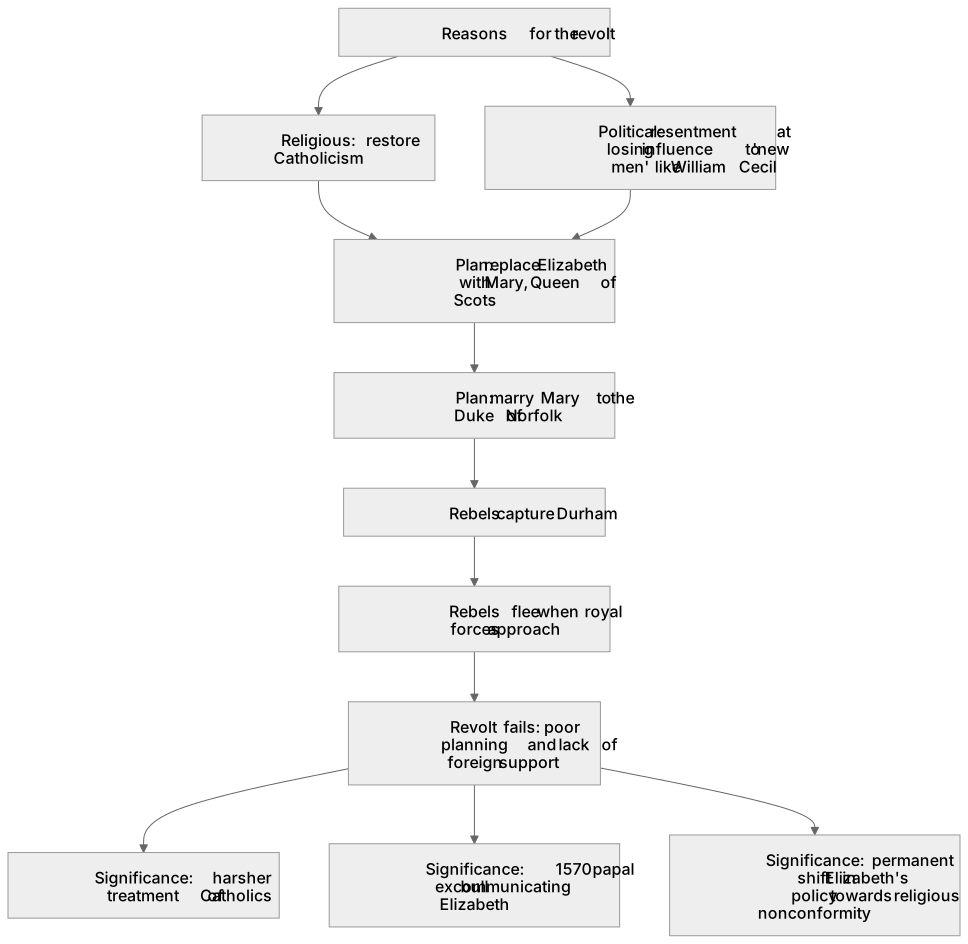
The Revolt of the Northern Earls (1569–70) was driven by religious and political grievances. Catholic Earls Northumberland and Westmorland sought to restore Catholicism and replace Elizabeth with Mary, Queen of Scots, planning to marry her to the Duke of Norfolk. Politically, the earls resented losing influence to 'new men' like William Cecil. The revolt's significance lies in it being the first major Catholic rebellion against Elizabeth, demonstrating the potent threat of Mary's presence. Although the rebellion failed due to poor planning and lack of foreign support, it marked a turning point. It led to harsher treatment of Catholics, the 1570 papal bull excommunicating Elizabeth, and a permanent shift in Elizabeth's policy towards religious nonconformity.
What earns the marks
- Identify the restoration of Catholicism as a primary ideological reason for the revolt.
- Explain the political marginalisation of the Northern Earls by Elizabeth's new Protestant advisors.
- Describe the specific plan to marry Mary, Queen of Scots to the Duke of Norfolk to secure the succession.
- Evaluate the significance of the revolt in triggering the 1570 Papal Bull and harsher anti-Catholic legislation.
Common mistakes and how to put them right
Claiming the revolt was entirely successful in the north (Correction.
Put it right: The rebels captured Durham but ultimately fled when royal forces approached).
Stating the Pope excommunicated Elizabeth before the revolt began (Correction.
Put it right: The Papal Bull was issued in 1570, after the revolt had already failed, though it worsened the aftermath).
Ignoring the political motives of the Earls (Correction.
Put it right: The Earls were heavily motivated by a loss of political power and court patronage, not solely by religion).
Exam tips
- Clearly separate the 'reasons for' and the 'significance of' the revolt in your answers to address both parts of the specification.
- Mention specific individuals like the Earls of Northumberland and Westmorland to add precise historical detail.
- Link the failure of the revolt to the subsequent increase in government paranoia regarding English Catholics.
Try the lesson
The start of the Option B4: Key topic 2: Challenges to Elizabeth at home and abroad, 1569–88 - 1 Plots and revolts at home: The reasons for, and significance of, the Revolt of the Northern Earls, 1569–70. lesson, made from checked teaching notes for this specification point.
Have a go first
Which two prominent English noblemen led the Revolt of the Northern Earls in 1569?
Listen
The Revolt of the Northern Earls (1569–70) was driven by religious and political grievances. Catholic Earls Northumberland and Westmorland sought to restore Catholicism and replace Elizabeth with Mary, Queen of Scots, planning to marry her to the Duke of Norfolk. Politically, the earls resented losing influence to 'new men' like William Cecil. The revolt's significance lies in it being the first major Catholic rebellion against Elizabeth, demonstrating the potent threat of Mary's presence. Although the rebellion failed due to poor planning and lack of foreign support, it marked a turning point. It led to harsher treatment of Catholics, the 1570 papal bull excommunicating Elizabeth, and a permanent shift in Elizabeth's policy towards religious nonconformity. A strong answer earns marks for these points. Identify the restoration of Catholicism as a primary ideological reason for the revolt. Explain the political marginalisation of the Northern Earls by Elizabeth's new Protestant advisors. Describe the specific plan to marry Mary, Queen of Scots to the Duke of Norfolk to secure the succession. Evaluate the significance of the revolt in triggering the 1570 Papal Bull and harsher anti-Catholic legislation. Exam tip: Clearly separate the 'reasons for' and the 'significance of' the revolt in your answers to address both parts of the specification.
See it
Key words
Say what each word means before you turn the card.
Rebellion and treason
Try answering aloud or in your head before turning the card.
Religious change
Try answering aloud or in your head before turning the card.
Court politics
Try answering aloud or in your head before turning the card.
Government control
Try answering aloud or in your head before turning the card.
See every definition
- Rebellion and treason
- The Revolt of the Northern Earls was the first major Catholic rebellion against Elizabeth, driven by religious and political grievances.
- Religious change
- The Catholic Earls sought to restore Catholicism, which was a primary ideological reason for the revolt.
- Court politics
- The earls resented losing influence to 'new men' like William Cecil, which was a political motive for the revolt.
- Government control
- The revolt led to harsher treatment of Catholics and a permanent shift in Elizabeth's policy towards religious nonconformity.
Label the diagram
Some boxes have lost their names. Pick the right name for each number.
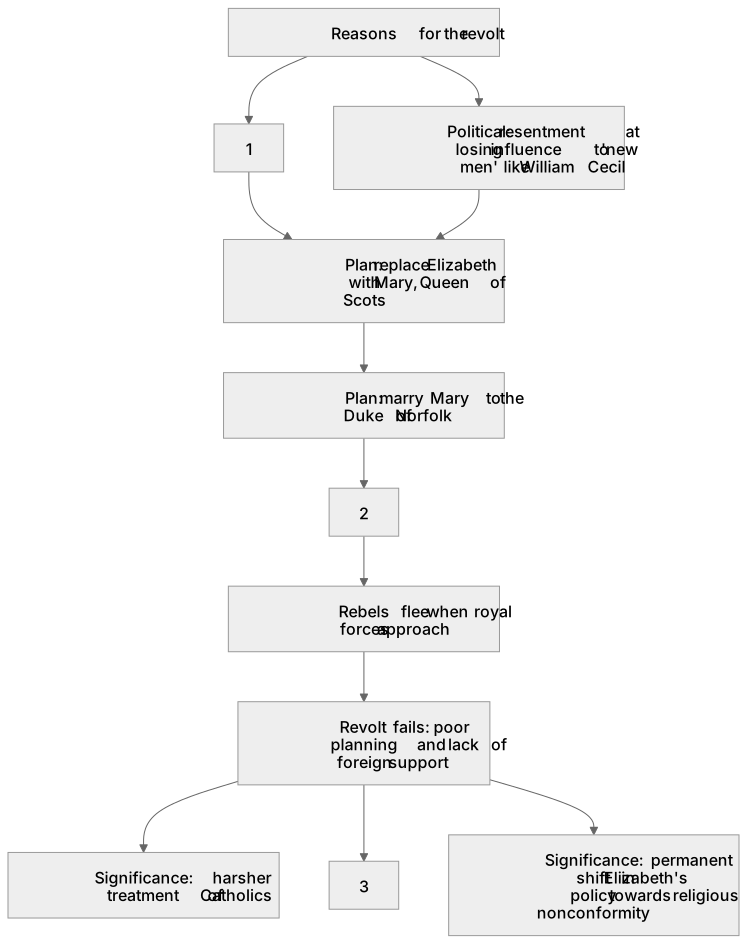
1Box 1
2Box 2
3Box 3
There is more to this lesson
The full lesson goes on to check your understanding and help you earn the marks. Create a free account to carry on, with your progress saved.
A week of Premium from your first lesson · Then the free plan continues · No card, no charge
Test your understanding of Option B4: Key topic 2: Challenges to Elizabeth at home and abroad, 1569–88 - 1 Plots and revolts at home: The reasons for, and significance of, the Revolt of the Northern Earls, 1569–70.
Active recall beats re-reading. Take an instant quiz now to test what you’ve learned and lock it into long-term memory.
A week of Premium from your first lesson · Then the free plan continues · No card, no charge