Pearson Edexcel · GCSE · History
Course version: 1HI0 · Version from Sept 2016
Key topic 2: Challenges to Elizabeth at home and abroad, 1569–88 - 2…
Full specification wording
Option B4: Key topic 2: Challenges to Elizabeth at home and abroad, 1569–88 - 2 Relations with Spain: Political, religious and commercial rivalry.
Anglo-Spanish tensions grew from a complex mix of factors.
Checked against the Pearson Edexcel 1HI0 specification (opens in a new tab) on .
- Point 1 of 2
- 3 key terms
Study notes
From the checked teaching notes for this specification point.
The idea
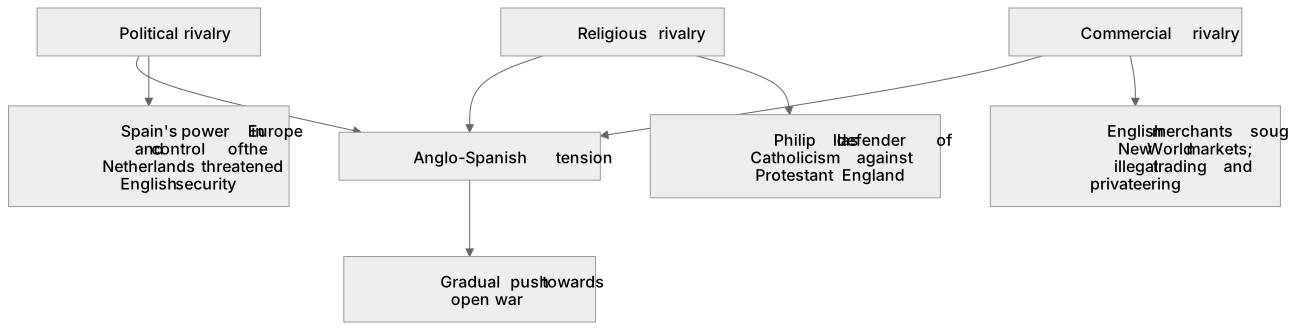
Anglo-Spanish tensions grew from a complex mix of factors. Politically, Spain's power in Europe and its control of the Netherlands threatened English security, while England's growing influence challenged Spanish dominance. Religiously, Philip II saw himself as the defender of Catholicism against Protestant England, a tension exacerbated by Elizabeth's excommunication and her support for Protestant rebels. Commercially, English merchants sought access to the lucrative New World markets, leading to illegal trading and privateering attacks on Spanish treasure fleets, which directly undermined Spain's economic monopoly and infuriated Philip.
What earns the marks
- Detail the political threat posed by Spanish control of the Netherlands, which was geographically close to England.
- Explain the religious divide, focusing on Philip II's desire to restore Catholicism in England and Elizabeth's Protestant policies.
- Describe the commercial conflict over trade in the Americas, including English attempts to break the Spanish monopoly.
- Show how these three areas of rivalry interconnected to gradually push England and Spain towards open war.
Common mistakes and how to put them right
Focusing only on religion as the cause of conflict.
Put it right by ensuring political and commercial factors are given equal weight.
Assuming England and Spain were always enemies.
Put it right by noting that Philip II initially proposed marriage to Elizabeth and relations deteriorated over time.
Confusing commercial rivalry with outright war.
Put it right by explaining that early commercial conflicts were undeclared and often involved privateers rather than the royal navy.
Exam tips
- Use a structured approach to answer questions on this topic, dedicating a paragraph each to political, religious, and commercial factors.
- Provide specific examples for each type of rivalry, such as the Dutch Revolt for politics or John Hawkins' voyages for commerce.
- Consider which factor was the most significant catalyst for deteriorating relations in different time periods.
Try the lesson
The start of the Option B4: Key topic 2: Challenges to Elizabeth at home and abroad, 1569–88 - 2 Relations with Spain: Political, religious and commercial rivalry. lesson, made from checked teaching notes for this specification point.
Have a go first
What was the primary religious cause of rivalry between England and Spain during Elizabeth I's reign?
Listen
Anglo-Spanish tensions grew from a complex mix of factors. Politically, Spain's power in Europe and its control of the Netherlands threatened English security, while England's growing influence challenged Spanish dominance. Religiously, Philip II saw himself as the defender of Catholicism against Protestant England, a tension exacerbated by Elizabeth's excommunication and her support for Protestant rebels. Commercially, English merchants sought access to the lucrative New World markets, leading to illegal trading and privateering attacks on Spanish treasure fleets, which directly undermined Spain's economic monopoly and infuriated Philip. A strong answer earns marks for these points. Detail the political threat posed by Spanish control of the Netherlands, which was geographically close to England. Explain the religious divide, focusing on Philip II's desire to restore Catholicism in England and Elizabeth's Protestant policies. Describe the commercial conflict over trade in the Americas, including English attempts to break the Spanish monopoly. Show how these three areas of rivalry interconnected to gradually push England and Spain towards open war. A common slip: Focusing only on religion as the cause of conflict. Instead, ensuring political and commercial factors are given equal weight. Exam tip: Use a structured approach to answer questions on this topic, dedicating a paragraph each to political, religious, and commercial factors.
See it
Key words
Say what each word means before you turn the card.
Political rivalry
Try answering aloud or in your head before turning the card.
Religious conflict
Try answering aloud or in your head before turning the card.
Commercial rivalry
Try answering aloud or in your head before turning the card.
See every definition
- Political rivalry
- Spain's power in Europe and its control of the Netherlands threatened English security, while England's growing influence challenged Spanish dominance.
- Religious conflict
- Philip II saw himself as the defender of Catholicism against Protestant England, a tension exacerbated by Elizabeth's excommunication and her support for Protestant rebels.
- Commercial rivalry
- English merchants sought access to the lucrative New World markets, leading to illegal trading and privateering attacks on Spanish treasure fleets, which undermined Spain's economic monopoly.
Label the diagram
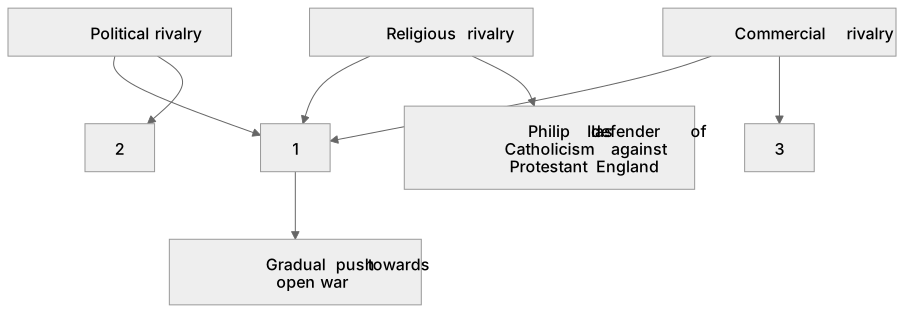
Some boxes have lost their names. Pick the right name for each number.
1Box 1
2Box 2
3Box 3
There is more to this lesson
The full lesson goes on to check your understanding and help you earn the marks. Create a free account to carry on, with your progress saved.
A week of Premium from your first lesson · Then the free plan continues · No card, no charge
Test your understanding of Option B4: Key topic 2: Challenges to Elizabeth at home and abroad, 1569–88 - 2 Relations with Spain: Political, religious and commercial rivalry.
Active recall beats re-reading. Take an instant quiz now to test what you’ve learned and lock it into long-term memory.
A week of Premium from your first lesson · Then the free plan continues · No card, no charge