Pearson Edexcel · GCSE · History
Course version: 1HI0 · Version from Sept 2016
Key topic 1: Spain reaches the Americas, c1490–1512 - 2 Columbus reaches…
Full specification wording
Option P1: Key topic 1: Spain reaches the Americas, c1490–1512 - 2 Columbus reaches the Americas: The impact of rivalry with Portugal, and the Treaty of Tordesillas (1494).
Columbus's discoveries intensified maritime rivalry between Spain and Portugal, as both vied for control over new territories.
Checked against the Pearson Edexcel 1HI0 specification (opens in a new tab) on .
- Point 3 of 3
Study notes
From the checked teaching notes for this specification point.
The idea
Columbus's discoveries intensified maritime rivalry between Spain and Portugal, as both vied for control over new territories. Portugal claimed Columbus's found lands belonged to them under previous treaties. To prevent war, the Pope intervened, leading to the Treaty of Tordesillas in 1494. This treaty established a meridian line 370 leagues west of the Cape Verde islands. It granted Spain exclusive rights to claim lands west of the line (most of the Americas), while Portugal received rights to the east (including Brazil and African routes). The impact was profound: it prevented immediate conflict, legally divided the non-European world between two powers, and permanently shaped the linguistic and cultural future of South America.
What earns the marks
- Explain the cause of the rivalry: competing claims over newly discovered lands and trade routes following Columbus's voyage.
- Describe the terms of the Treaty of Tordesillas (1494), specifically the drawing of a meridian line dividing the globe.
- Identify the territorial allocations: Spain gained rights to the west (most of the Americas), and Portugal to the east (Africa, Asia, and later Brazil).
- Analyse the impact of the treaty in preventing war between Spain and Portugal and shaping the colonisation of the Americas.
Common mistakes and how to put them right
Stating the Pope drew the final line in the Treaty of Tordesillas.
Put it right: The Pope drew an initial line in 1493, but the 1494 Treaty of Tordesillas moved the line further west after direct negotiations between Spain and Portugal.
Claiming the treaty divided the whole world among all European powers.
Put it right: The treaty only divided non-Christian lands between Spain and Portugal; other European nations ignored it.
Forgetting that the treaty gave Portugal a claim in the Americas.
Put it right: Because the line was moved west, it inadvertently gave Portugal the right to claim Brazil when it was later discovered.
Exam tips
- Clearly explain the geographical division created by the treaty (west for Spain, east for Portugal) to demonstrate secure knowledge.
- Discuss the role of the Papacy in mediating the dispute, highlighting the religious authority in 15th-century international relations.
- Evaluate the long-term significance of the treaty by mentioning how it explains why Portuguese is spoken in Brazil today.
Try the lesson
The start of the Option P1: Key topic 1: Spain reaches the Americas, c1490–1512 - 2 Columbus reaches the Americas: The impact of rivalry with Portugal, and the Treaty of Tordesillas (1494). lesson, made from checked teaching notes for this specification point.
Have a go first
What was the primary purpose of the Treaty of Tordesillas signed in 1494?
Listen
Columbus's discoveries intensified maritime rivalry between Spain and Portugal, as both vied for control over new territories. Portugal claimed Columbus's found lands belonged to them under previous treaties. To prevent war, the Pope intervened, leading to the Treaty of Tordesillas in 1494. This treaty established a meridian line 370 leagues west of the Cape Verde islands. It granted Spain exclusive rights to claim lands west of the line (most of the Americas), while Portugal received rights to the east (including Brazil and African routes). The impact was profound: it prevented immediate conflict, legally divided the non-European world between two powers, and permanently shaped the linguistic and cultural future of South America. A strong answer earns marks for these points. Explain the cause of the rivalry: competing claims over newly discovered lands and trade routes following Columbus's voyage. Describe the terms of the Treaty of Tordesillas (1494), specifically the drawing of a meridian line dividing the globe. Identify the territorial allocations: Spain gained rights to the west (most of the Americas), and Portugal to the east (Africa, Asia, and later Brazil). Analyse the impact of the treaty in preventing war between Spain and Portugal and shaping the colonisation of the Americas. A common slip: Stating the Pope drew the final line in the Treaty of Tordesillas. Instead, The Pope drew an initial line in 1493, but the 1494 Treaty of Tordesillas moved the line further west after direct negotiations between Spain and Portugal. Exam tip: Clearly explain the geographical division created by the treaty (west for Spain, east for Portugal) to demonstrate secure knowledge.
See it
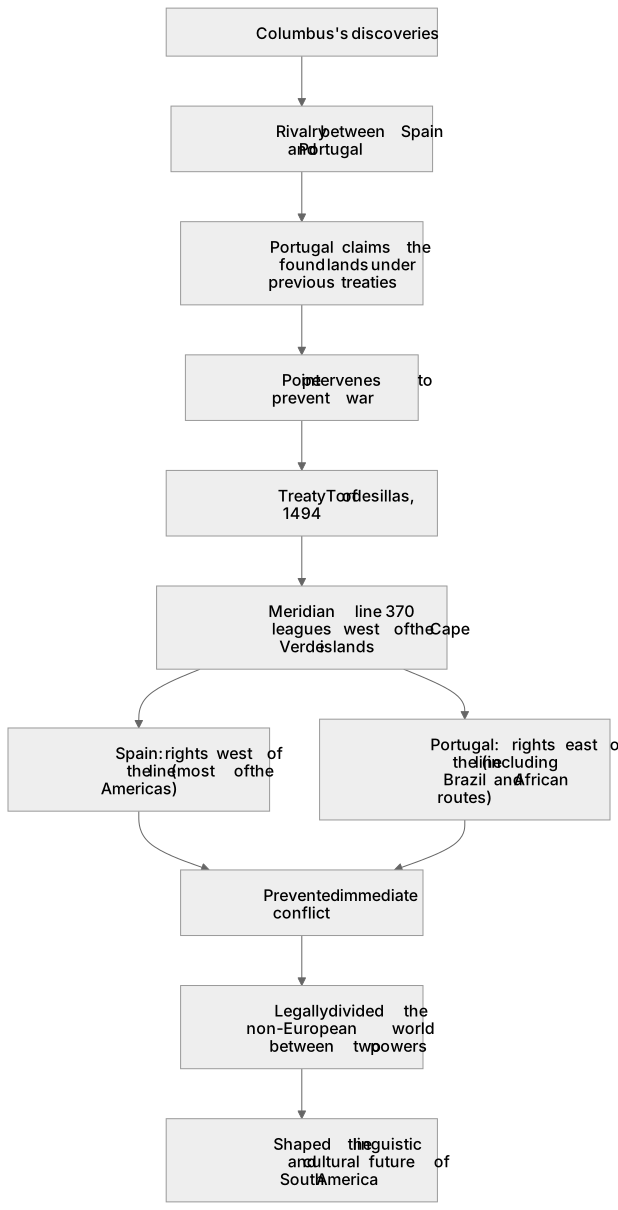
Label the diagram
Some boxes have lost their names. Pick the right name for each number.
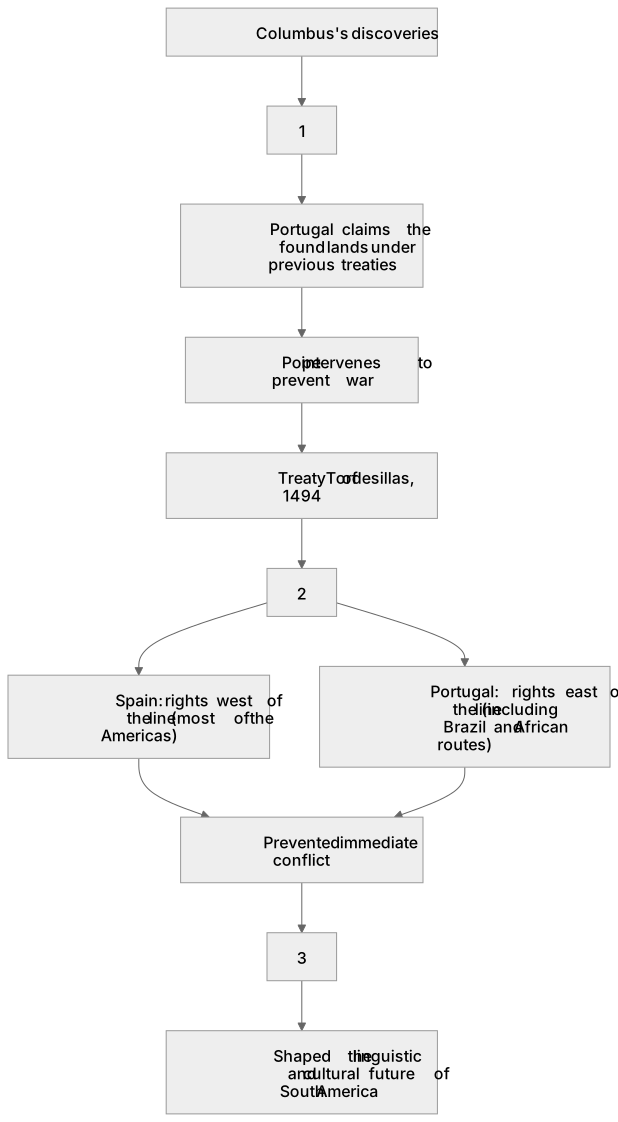
1Box 1
2Box 2
3Box 3
There is more to this lesson
The full lesson goes on to check your understanding and help you earn the marks. Create a free account to carry on, with your progress saved.
A week of Premium from your first lesson · Then the free plan continues · No card, no charge
Test your understanding of Option P1: Key topic 1: Spain reaches the Americas, c1490–1512 - 2 Columbus reaches the Americas: The impact of rivalry with Portugal, and the Treaty of Tordesillas (1494).
Active recall beats re-reading. Take an instant quiz now to test what you’ve learned and lock it into long-term memory.
A week of Premium from your first lesson · Then the free plan continues · No card, no charge