Pearson Edexcel · GCSE · History
Course version: 1HI0 · Version from Sept 2016
Key topic 2: The conquistadors, 1513–c1528 - 1 The start of an empire: The…
Full specification wording
Option P1: Key topic 2: The conquistadors, 1513–c1528 - 1 The start of an empire: The conquest of Cuba.
The 1511 conquest of Cuba, led by Diego Velázquez de Cuéllar, marked a pivotal expansion of the Spanish Empire from Hispaniola.
Checked against the Pearson Edexcel 1HI0 specification (opens in a new tab) on .
- Point 2 of 3
- 4 key terms
Study notes
From the checked teaching notes for this specification point.
The idea
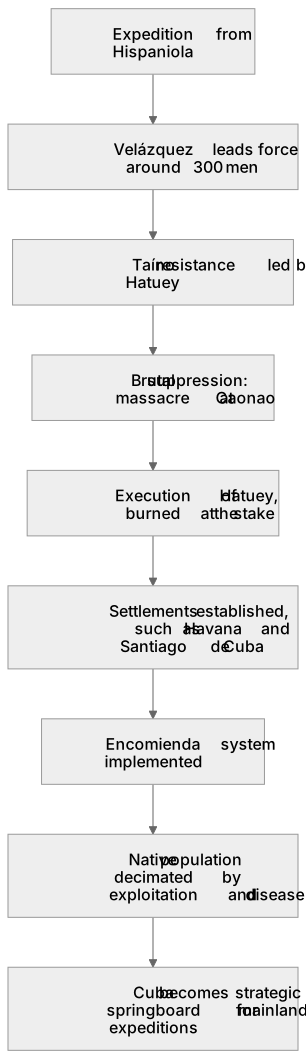
The 1511 conquest of Cuba, led by Diego Velázquez de Cuéllar, marked a pivotal expansion of the Spanish Empire from Hispaniola. Velázquez commanded a force of around 300 men, including Hernán Cortés, to subdue the indigenous Taíno population. The campaign was characterised by brutal suppression, notably the massacre at Caonao and the execution of the resistance leader Hatuey, who was burned at the stake. Following the conquest, Velázquez established settlements such as Havana and Santiago de Cuba, implementing the exploitative encomienda system. This system, combined with European diseases, decimated the native population. Crucially, Cuba became the strategic springboard for subsequent mainland expeditions, including the conquest of Mexico.
What earns the marks
- Diego Velázquez de Cuéllar led the 1511 expedition from Hispaniola to conquer Cuba.
- The indigenous Taíno people, led by figures like Hatuey, offered fierce but ultimately unsuccessful resistance.
- The Spanish established the encomienda system, leading to the severe exploitation and demographic collapse of the native population.
- Cuba served as a vital strategic base for further Spanish exploration and conquest of the American mainland.
Common mistakes and how to put them right
Confusing the conquest of Cuba with the earlier settlement of Hispaniola.
Put it right: Ensure you specify Velázquez's role in Cuba.
Stating that Hernán Cortés led the conquest of Cuba.
Put it right: Cortés was present but served under the command of Velázquez.
Underestimating the impact of European diseases.
Put it right: While military brutality was significant, disease was the primary cause of indigenous population collapse.
Exam tips
- Link the conquest of Cuba to later events by explaining how it provided the resources and staging ground for Cortés's expedition to Mexico.
- Use the story of Hatuey as a specific, concrete example of indigenous resistance to Spanish expansion.
- When discussing the consequences of the conquest, explicitly mention the introduction of the encomienda system.
Try the lesson
The start of the Option P1: Key topic 2: The conquistadors, 1513–c1528 - 1 The start of an empire: The conquest of Cuba. lesson, made from checked teaching notes for this specification point.
Have a go first
Which Spanish conquistador led the expedition to conquer Cuba in 1511?
Listen
The 1511 conquest of Cuba, led by Diego Velázquez de Cuéllar, marked a pivotal expansion of the Spanish Empire from Hispaniola. Velázquez commanded a force of around 300 men, including Hernán Cortés, to subdue the indigenous Taíno population. The campaign was characterised by brutal suppression, notably the massacre at Caonao and the execution of the resistance leader Hatuey, who was burned at the stake. Following the conquest, Velázquez established settlements such as Havana and Santiago de Cuba, implementing the exploitative encomienda system. This system, combined with European diseases, decimated the native population. Crucially, Cuba became the strategic springboard for subsequent mainland expeditions, including the conquest of Mexico. A strong answer earns marks for these points. Diego Velázquez de Cuéllar led the 1511 expedition from Hispaniola to conquer Cuba. The indigenous Taíno people, led by figures like Hatuey, offered fierce but ultimately unsuccessful resistance. The Spanish established the encomienda system, leading to the severe exploitation and demographic collapse of the native population. Cuba served as a vital strategic base for further Spanish exploration and conquest of the American mainland. Exam tip: Link the conquest of Cuba to later events by explaining how it provided the resources and staging ground for Cortés's expedition to Mexico.
See it
Key words
Say what each word means before you turn the card.
Imperial expansion
Try answering aloud or in your head before turning the card.
Indigenous resistance
Try answering aloud or in your head before turning the card.
Economic exploitation
Try answering aloud or in your head before turning the card.
Strategic settlement
Try answering aloud or in your head before turning the card.
See every definition
- Imperial expansion
- The 1511 conquest of Cuba marked a pivotal expansion of the Spanish Empire from Hispaniola.
- Indigenous resistance
- The Taíno people, led by figures like Hatuey, offered fierce but ultimately unsuccessful resistance to the Spanish.
- Economic exploitation
- The Spanish established the encomienda system, leading to the severe exploitation and demographic collapse of the native population.
- Strategic settlement
- Cuba served as a vital strategic base for further Spanish exploration and conquest of the American mainland.
Label the diagram
Some boxes have lost their names. Pick the right name for each number.
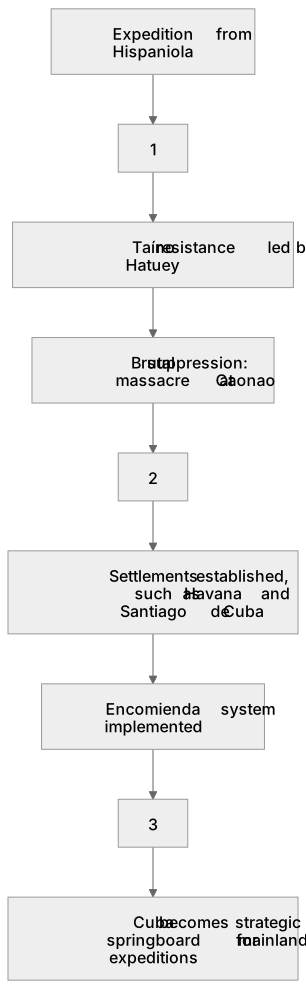
1Box 1
2Box 2
3Box 3
There is more to this lesson
The full lesson goes on to check your understanding and help you earn the marks. Create a free account to carry on, with your progress saved.
A week of Premium from your first lesson · Then the free plan continues · No card, no charge
Test your understanding of Option P1: Key topic 2: The conquistadors, 1513–c1528 - 1 The start of an empire: The conquest of Cuba.
Active recall beats re-reading. Take an instant quiz now to test what you’ve learned and lock it into long-term memory.
A week of Premium from your first lesson · Then the free plan continues · No card, no charge