Pearson Edexcel · GCSE · History
Course version: 1HI0 · Version from Sept 2016
Key topic 3: The Spanish Empire c1528–c1555 - 3 Impact of the 'New World'…
Full specification wording
Option P1: Key topic 3: The Spanish Empire c1528–c1555 - 3 Impact of the 'New World' on Spain: The impact on Spain of the slave trade and goods from the Americas.
The transatlantic slave trade and the importation of New World goods impacted Spain's economy between 1528 and 1555.
Checked against the Pearson Edexcel 1HI0 specification (opens in a new tab) on .
- Point 2 of 3
- 3 key terms
Study notes
From the checked teaching notes for this specification point.
The idea
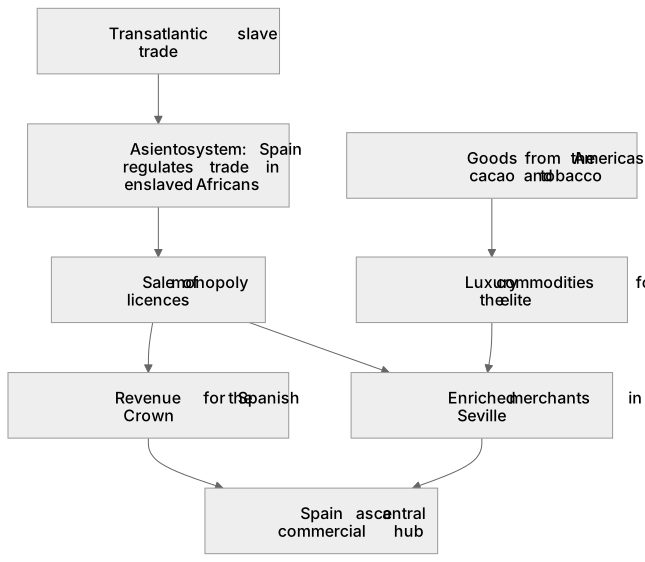
The transatlantic slave trade and the importation of New World goods impacted Spain's economy between 1528 and 1555. To supply labour to the Americas, Spain regulated the trade of enslaved Africans through the asiento system. Selling these monopoly licenses generated significant revenue for the Spanish Crown and enriched merchants in Seville. Simultaneously, the arrival of novel American goods began to influence Spanish society. While mass agricultural changes occurred later, early imports like cacao and tobacco were introduced as highly prized luxury commodities for the elite. Trading these exotic goods and managing the slave trade established Spain as a central commercial hub, boosting its mercantile wealth and royal revenues.
What earns the marks
- Explain the asiento system and how the Crown profited from selling monopoly licenses for the slave trade.
- Identify key goods imported from the Americas during this period, such as cacao and tobacco.
- Describe how these early imports functioned as luxury commodities for the Spanish elite rather than mass agricultural staples.
- Analyse how the monopoly on American goods and the slave trade enriched specific Spanish port cities, particularly Seville.
Common mistakes and how to put them right
Confusing the Columbian Exchange by listing European goods sent to the Americas.
Put it right: Focus strictly on goods brought from the Americas to Spain, like cacao and tobacco.
Claiming that potatoes and maize transformed Spanish diets and population growth before 1555.
Put it right: Acknowledge that during this specific period, American imports were primarily luxury goods for the elite, as mass agricultural transformation occurred later.
Exam tips
- Use the keyword asiento to demonstrate precise knowledge of how Spain managed and profited from the slave trade.
- List specific luxury goods from the Americas (e.g., cacao, tobacco) to support points about early economic and social impacts.
- Link the influx of goods and slave trade revenues directly to the growth and prosperity of Seville as the monopoly port.
Try the lesson
The start of the Option P1: Key topic 3: The Spanish Empire c1528–c1555 - 3 Impact of the 'New World' on Spain: The impact on Spain of the slave trade and goods from the Americas. lesson, made from checked teaching notes for this specification point.
Have a go first
Which Spanish city benefited most directly from the monopoly on trade and goods arriving from the Americas in the 16th century?
Listen
The transatlantic slave trade and the importation of New World goods impacted Spain's economy between 1528 and 1555. To supply labour to the Americas, Spain regulated the trade of enslaved Africans through the asiento system. Selling these monopoly licenses generated significant revenue for the Spanish Crown and enriched merchants in Seville. Simultaneously, the arrival of novel American goods began to influence Spanish society. While mass agricultural changes occurred later, early imports like cacao and tobacco were introduced as highly prized luxury commodities for the elite. Trading these exotic goods and managing the slave trade established Spain as a central commercial hub, boosting its mercantile wealth and royal revenues. A strong answer earns marks for these points. Explain the asiento system and how the Crown profited from selling monopoly licenses for the slave trade. Identify key goods imported from the Americas during this period, such as cacao and tobacco. Describe how these early imports functioned as luxury commodities for the Spanish elite rather than mass agricultural staples. Analyse how the monopoly on American goods and the slave trade enriched specific Spanish port cities, particularly Seville. A common slip: Focusing only on the impact of the slave trade on the Americas. Instead, The statement requires the impact on Spain, such as the wealth generated by the asiento licenses. Exam tip: Use the keyword asiento to demonstrate precise knowledge of how Spain managed and profited from the slave trade.
See it
Key words
Say what each word means before you turn the card.
Asiento system
Try answering aloud or in your head before turning the card.
Monopoly licenses
Try answering aloud or in your head before turning the card.
Cacao and tobacco
Try answering aloud or in your head before turning the card.
See every definition
- Asiento system
- A system through which Spain regulated the trade of enslaved Africans to supply labour to the Americas.
- Monopoly licenses
- Licenses sold by the Spanish Crown that generated significant revenue and enriched merchants in Seville.
- Cacao and tobacco
- Early imports from the Americas introduced as highly prized luxury commodities for the elite.
Label the diagram
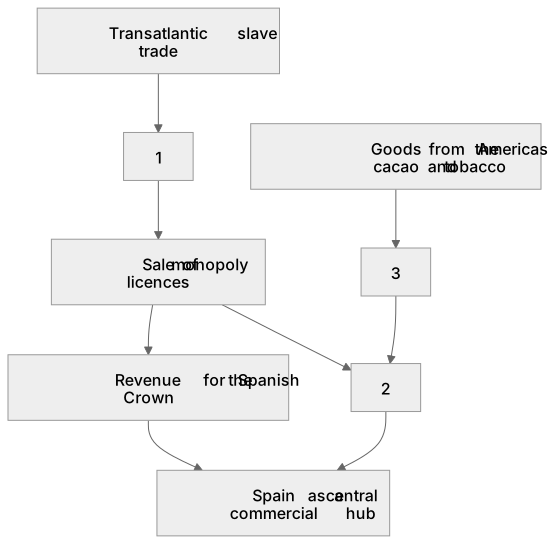
Some boxes have lost their names. Pick the right name for each number.
1Box 1
2Box 2
3Box 3
There is more to this lesson
The full lesson goes on to check your understanding and help you earn the marks. Create a free account to carry on, with your progress saved.
A week of Premium from your first lesson · Then the free plan continues · No card, no charge
Test your understanding of Option P1: Key topic 3: The Spanish Empire c1528–c1555 - 3 Impact of the 'New World' on Spain: The impact on Spain of the slave trade and goods from the Americas.
Active recall beats re-reading. Take an instant quiz now to test what you’ve learned and lock it into long-term memory.
A week of Premium from your first lesson · Then the free plan continues · No card, no charge