Pearson Edexcel · GCSE · History
Course version: 1HI0 · Version from Sept 2016
Key topic 1: British settlement in North America, 1713–41 - 1 Developments…
Full specification wording
Option P2: Key topic 1: British settlement in North America, 1713–41 - 1 Developments in colonial society: The suppression of piracy in American waters: King George I’s Proclamation and the Piracy Act (1717), the work of Governor Spotswood.
The suppression of piracy in American waters required coordinated legal and military action.
Checked against the Pearson Edexcel 1HI0 specification (opens in a new tab) on .
- Point 3 of 3
Study notes
From the checked teaching notes for this specification point.
The idea
The suppression of piracy in American waters required coordinated legal and military action. In 1717, King George I issued a Proclamation offering a royal pardon to pirates who surrendered, aiming to reduce their numbers peacefully. Concurrently, the 1717 Piracy Act strengthened legal frameworks, allowing pirates to be tried and executed in the colonies rather than being sent to London, speeding up justice. Governor Alexander Spotswood of Virginia played a pivotal role in enforcing these measures. He aggressively pursued pirates, notably funding and organising the naval expedition that successfully hunted down and killed Edward Teach ('Blackbeard') at Ocracoke Inlet in 1718, demonstrating the colonial resolve to secure trade routes.
What earns the marks
- Explain the purpose and terms of King George I's 1717 Proclamation, which offered a pardon to pirates who surrendered.
- Describe how the 1717 Piracy Act changed the legal process by allowing piracy trials to take place in colonial vice-admiralty courts.
- Detail the actions taken by Governor Spotswood of Virginia to combat piracy, including his use of naval forces.
- Evaluate the combined effectiveness of legal reforms and military actions in suppressing piracy in American waters.
Common mistakes and how to put them right
Believing the 1717 Proclamation only threatened punishment.
Put it right by explaining it primarily offered a royal pardon to encourage peaceful surrender.
Stating that pirates always had to be sent to London for trial after 1717.
Put it right by noting the Piracy Act allowed trials and executions to occur locally in the colonies.
Attributing the defeat of Blackbeard solely to the British Royal Navy.
Put it right by highlighting Governor Spotswood's crucial role in independently funding and organising the expedition.
Exam tips
- Contrast the 'carrot' approach of the 1717 Proclamation (pardons) with the 'stick' approach of the Piracy Act and military expeditions.
- Highlight Governor Spotswood as a key example of colonial leadership taking decisive action to protect local economic interests.
- Explain how the ability to try pirates locally under the 1717 Piracy Act served as a much stronger deterrent than the previous system.
Try the lesson
The start of the Option P2: Key topic 1: British settlement in North America, 1713–41 - 1 Developments in colonial society: The suppression of piracy in American waters: King George I’s Proclamation and the Piracy Act (1717), the work of Governor Spotswood. lesson, made from checked teaching notes for this specification point.
Have a go first
What was the primary purpose of King George I's Proclamation of 1717 regarding piracy?
Listen
The suppression of piracy in American waters required coordinated legal and military action. In 1717, King George I issued a Proclamation offering a royal pardon to pirates who surrendered, aiming to reduce their numbers peacefully. Concurrently, the 1717 Piracy Act strengthened legal frameworks, allowing pirates to be tried and executed in the colonies rather than being sent to London, speeding up justice. Governor Alexander Spotswood of Virginia played a pivotal role in enforcing these measures. He aggressively pursued pirates, notably funding and organising the naval expedition that successfully hunted down and killed Edward Teach ('Blackbeard') at Ocracoke Inlet in 1718, demonstrating the colonial resolve to secure trade routes. A strong answer earns marks for these points. Explain the purpose and terms of King George I's 1717 Proclamation, which offered a pardon to pirates who surrendered. Describe how the 1717 Piracy Act changed the legal process by allowing piracy trials to take place in colonial vice-admiralty courts. Detail the actions taken by Governor Spotswood of Virginia to combat piracy, including his use of naval forces. Evaluate the combined effectiveness of legal reforms and military actions in suppressing piracy in American waters. A common slip: Believing the 1717 Proclamation only threatened punishment. Instead, explaining it primarily offered a royal pardon to encourage peaceful surrender. Exam tip: Contrast the 'carrot' approach of the 1717 Proclamation (pardons) with the 'stick' approach of the Piracy Act and military expeditions.
See it
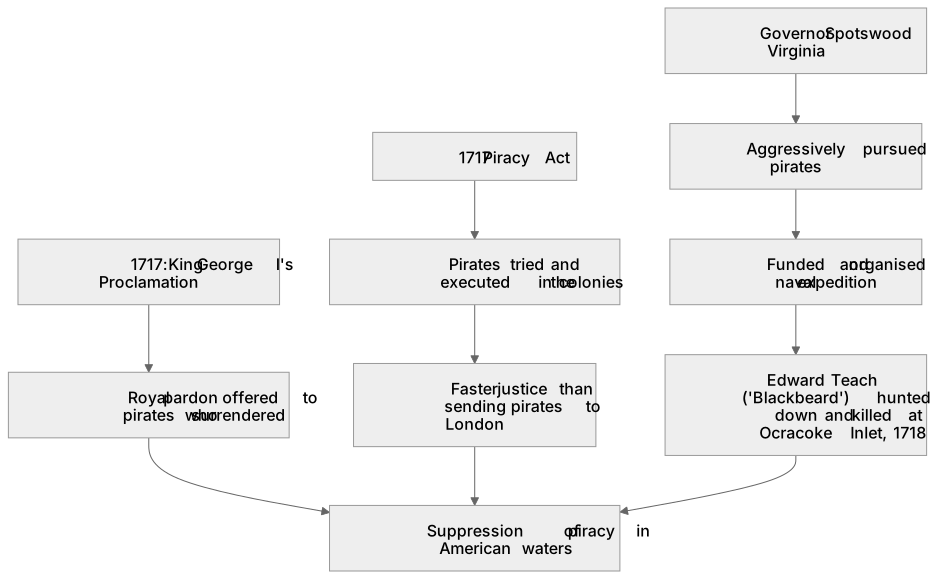
Label the diagram
Some boxes have lost their names. Pick the right name for each number.
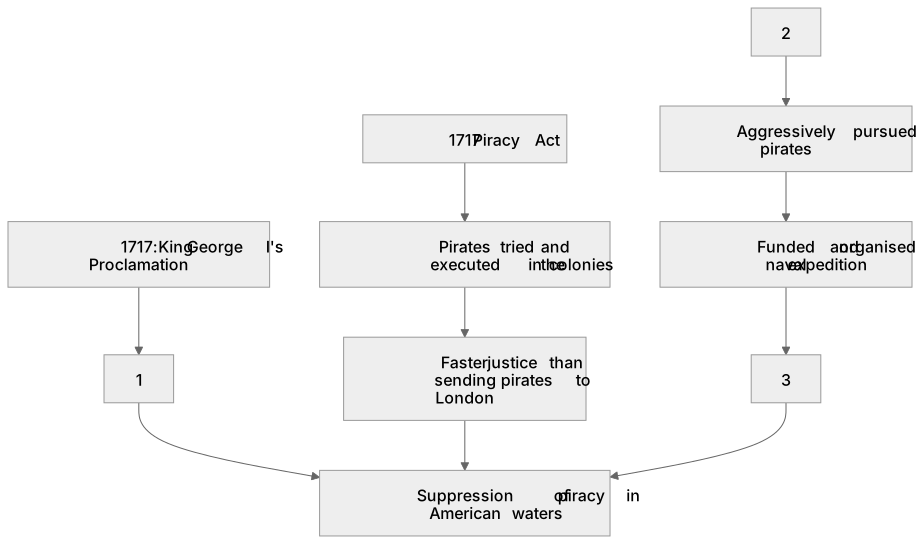
1Box 1
2Box 2
3Box 3
There is more to this lesson
The full lesson goes on to check your understanding and help you earn the marks. Create a free account to carry on, with your progress saved.
A week of Premium from your first lesson · Then the free plan continues · No card, no charge
Test your understanding of Option P2: Key topic 1: British settlement in North America, 1713–41 - 1 Developments in colonial society: The suppression of piracy in American waters: King George I’s Proclamation and the Piracy Act (1717), the work of Governor Spotswood.
Active recall beats re-reading. Take an instant quiz now to test what you’ve learned and lock it into long-term memory.
A week of Premium from your first lesson · Then the free plan continues · No card, no charge