Pearson Edexcel · GCSE · History
Course version: 1HI0 · Version from Sept 2016
Key topic 2: A disrupted society, 1742–64 - 1 The impact of cultural…
Full specification wording
Option P2: Key topic 2: A disrupted society, 1742–64 - 1 The impact of cultural developments: The Enlightenment: the emphasis on education; the growth of newspapers and public libraries.
The Enlightenment in the American colonies promoted reason, scientific inquiry, and intellectual exchange, significantly impacting cultural development.
Checked against the Pearson Edexcel 1HI0 specification (opens in a new tab) on .
- Point 2 of 3
Study notes
From the checked teaching notes for this specification point.
The idea
The Enlightenment in the American colonies promoted reason, scientific inquiry, and intellectual exchange, significantly impacting cultural development. A key feature was the growing emphasis on education, leading to the founding of new colleges and a push for broader literacy to ensure an informed citizenry. This intellectual awakening was fuelled by the rapid growth of newspapers, which disseminated political ideas, scientific discoveries, and local news across the colonies. Furthermore, the establishment of public libraries, such as the Library Company of Philadelphia, democratised access to books and knowledge, allowing colonists from various backgrounds to engage with Enlightenment ideals.
What earns the marks
- Explain the core principles of the Enlightenment, such as reason, science, and human progress.
- Describe how the emphasis on education led to the establishment of new educational institutions.
- Analyse the role of newspapers in spreading information and fostering a shared colonial discourse.
- Evaluate the significance of public libraries in making books and Enlightenment ideas accessible to a wider public.
Common mistakes and how to put them right
Viewing the Enlightenment as purely a European phenomenon.
Put it right: Emphasise that Enlightenment ideas were actively adopted and adapted within the American colonies.
Assuming public libraries were free and open to everyone in the modern sense.
Put it right: Clarify that early public libraries were often subscription-based, though they still significantly broadened access compared to private collections.
Underestimating the role of newspapers.
Put it right: Highlight that newspapers were crucial for connecting the colonies and spreading both practical information and philosophical ideas.
Exam tips
- Use the founding of institutions like the College of Philadelphia as an example of the Enlightenment's impact on education.
- Discuss how the growth of newspapers helped create a more unified colonial culture by sharing news across borders.
- Link the spread of Enlightenment ideas through libraries and newspapers to the growing political awareness of the colonists.
Try the lesson
The start of the Option P2: Key topic 2: A disrupted society, 1742–64 - 1 The impact of cultural developments: The Enlightenment: the emphasis on education; the growth of newspapers and public libraries. lesson, made from checked teaching notes for this specification point.
Have a go first
Which cultural movement in the eighteenth-century American colonies strongly emphasised reason, scientific inquiry, and the importance of education?
Listen
The Enlightenment in the American colonies promoted reason, scientific inquiry, and intellectual exchange, significantly impacting cultural development. A key feature was the growing emphasis on education, leading to the founding of new colleges and a push for broader literacy to ensure an informed citizenry. This intellectual awakening was fuelled by the rapid growth of newspapers, which disseminated political ideas, scientific discoveries, and local news across the colonies. Furthermore, the establishment of public libraries, such as the Library Company of Philadelphia, democratised access to books and knowledge, allowing colonists from various backgrounds to engage with Enlightenment ideals. A strong answer earns marks for these points. Explain the core principles of the Enlightenment, such as reason, science, and human progress. Describe how the emphasis on education led to the establishment of new educational institutions. Analyse the role of newspapers in spreading information and fostering a shared colonial discourse. Evaluate the significance of public libraries in making books and Enlightenment ideas accessible to a wider public. A common slip: Viewing the Enlightenment as purely a European phenomenon. Instead, Emphasise that Enlightenment ideas were actively adopted and adapted within the American colonies. Exam tip: Use the founding of institutions like the College of Philadelphia as an example of the Enlightenment's impact on education.
See it
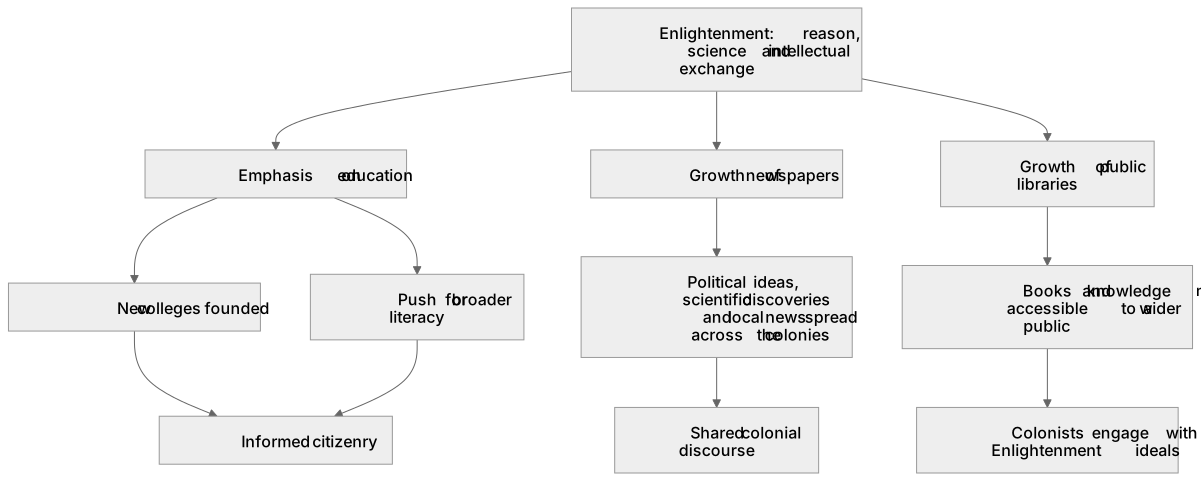
Label the diagram
Some boxes have lost their names. Pick the right name for each number.
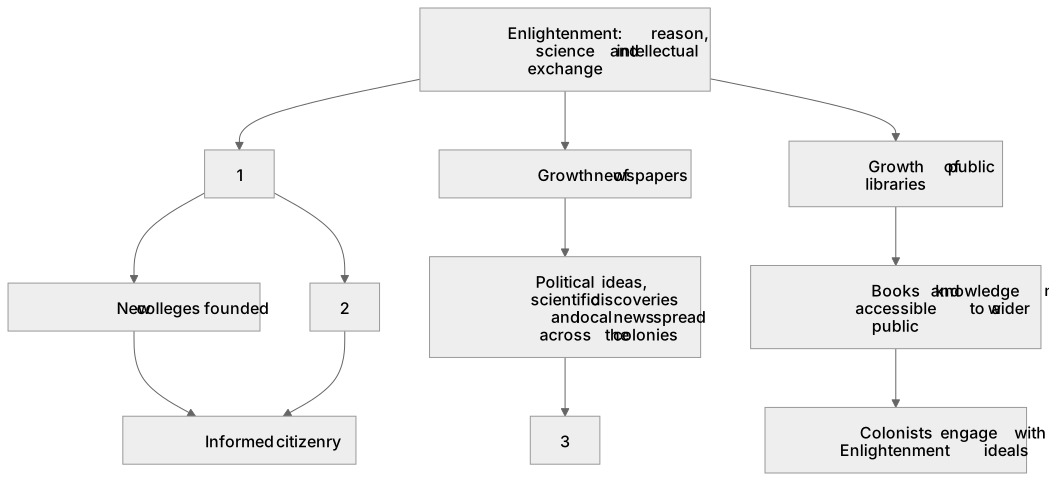
1Box 1
2Box 2
3Box 3
There is more to this lesson
The full lesson goes on to check your understanding and help you earn the marks. Create a free account to carry on, with your progress saved.
A week of Premium from your first lesson · Then the free plan continues · No card, no charge
Test your understanding of Option P2: Key topic 2: A disrupted society, 1742–64 - 1 The impact of cultural developments: The Enlightenment: the emphasis on education; the growth of newspapers and public libraries.
Active recall beats re-reading. Take an instant quiz now to test what you’ve learned and lock it into long-term memory.
A week of Premium from your first lesson · Then the free plan continues · No card, no charge