Pearson Edexcel · GCSE · History
Course version: 1HI0 · Version from Sept 2016
Key topic 2: A disrupted society, 1742–64 - 2 War in the colonies: The…
Full specification wording
Option P2: Key topic 2: A disrupted society, 1742–64 - 2 War in the colonies: The French and Indian War (1754–63) in North America and the role of Wolfe in Canada.
The French and Indian War (1754–63) was a decisive conflict over control of North America, beginning with clashes in the Ohio Valley.
Checked against the Pearson Edexcel 1HI0 specification (opens in a new tab) on .
- Point 2 of 3
- 4 key terms
Study notes
From the checked teaching notes for this specification point.
The idea
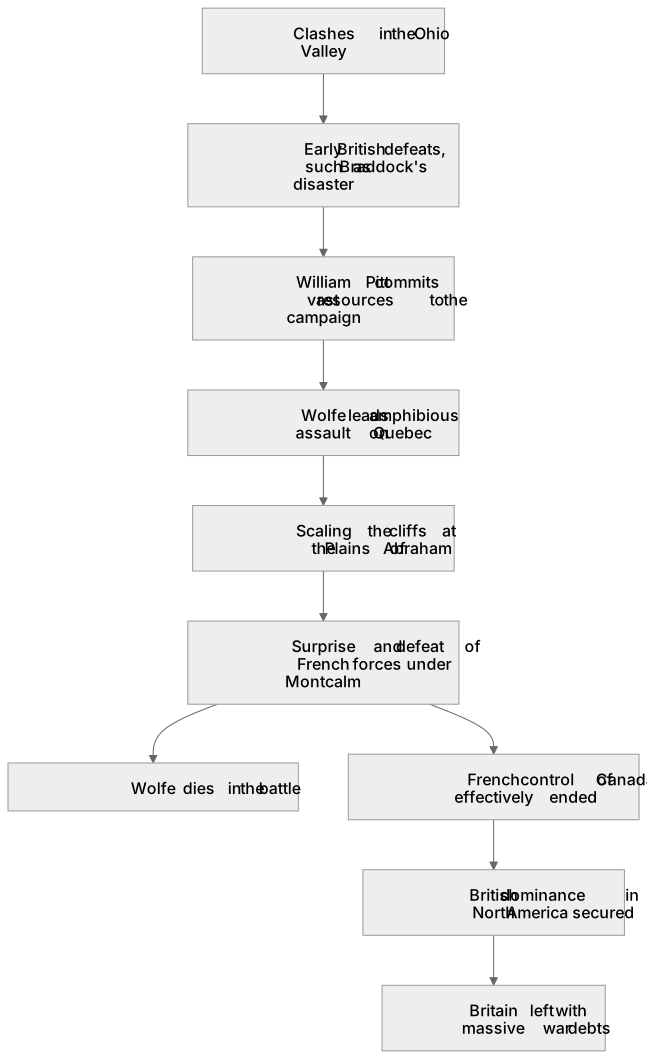
The French and Indian War (1754–63) was a decisive conflict over control of North America, beginning with clashes in the Ohio Valley. Early British defeats, such as Braddock's disaster, were reversed when William Pitt committed vast resources to the campaign. The role of Major General James Wolfe in Canada was pivotal to the British victory. In 1759, Wolfe led a daring amphibious assault on Quebec, scaling the cliffs at the Plains of Abraham to surprise and defeat the French forces under Montcalm. Although Wolfe died in the battle, his victory effectively ended French control of Canada. This campaign secured British dominance in North America but left Britain with massive war debts, fundamentally altering the political and economic landscape of the colonies.
What earns the marks
- Identify the Ohio River Valley as the initial flashpoint for the French and Indian War.
- Explain William Pitt's role in turning the tide of the war by investing heavily in the North American theatre.
- Describe Wolfe's strategic decision to scale the cliffs at the Plains of Abraham to attack Quebec in 1759.
- Evaluate the significance of the capture of Quebec in ending French imperial power in Canada.
Common mistakes and how to put them right
Believing the war was fought solely between the French and Indigenous peoples.
Put it right: Clarify that it was a war between Britain and France, both of whom had Indigenous allies.
Stating that Wolfe survived the Battle of Quebec.
Put it right: Note that Wolfe was mortally wounded during the battle but died knowing he had secured victory.
Confusing the start date of the North American conflict (1754) with the European Seven Years' War (1756).
Put it right: Specify that the colonial conflict began two years earlier.
Exam tips
- Highlight Wolfe's leadership at Quebec as a turning point in the war.
- Connect the massive cost of the British victory to the subsequent taxation of the American colonies.
- Use specific terms like 'Plains of Abraham' and 'amphibious assault' to strengthen descriptions of Wolfe's campaign.
Try the lesson
The start of the Option P2: Key topic 2: A disrupted society, 1742–64 - 2 War in the colonies: The French and Indian War (1754–63) in North America and the role of Wolfe in Canada. lesson, made from checked teaching notes for this specification point.
Have a go first
What was Major General James Wolfe's most significant military achievement during the French and Indian War?
Listen
The French and Indian War (1754–63) was a decisive conflict over control of North America, beginning with clashes in the Ohio Valley. Early British defeats, such as Braddock's disaster, were reversed when William Pitt committed vast resources to the campaign. The role of Major General James Wolfe in Canada was pivotal to the British victory. In 1759, Wolfe led a daring amphibious assault on Quebec, scaling the cliffs at the Plains of Abraham to surprise and defeat the French forces under Montcalm. Although Wolfe died in the battle, his victory effectively ended French control of Canada. This campaign secured British dominance in North America but left Britain with massive war debts, fundamentally altering the political and economic landscape of the colonies. A strong answer earns marks for these points. Identify the Ohio River Valley as the initial flashpoint for the French and Indian War. Explain William Pitt's role in turning the tide of the war by investing heavily in the North American theatre. Describe Wolfe's strategic decision to scale the cliffs at the Plains of Abraham to attack Quebec in 1759. Evaluate the significance of the capture of Quebec in ending French imperial power in Canada. A common slip: Believing the war was fought solely between the French and Indigenous peoples. Instead, clarify that it was a war between Britain and France, both of whom had Indigenous allies. Exam tip: Highlight Wolfe's leadership at Quebec as a turning point in the war.
See it
Key words
Say what each word means before you turn the card.
Military strategy
Try answering aloud or in your head before turning the card.
Imperial dominance
Try answering aloud or in your head before turning the card.
Leadership
Try answering aloud or in your head before turning the card.
Economic consequences of war
Try answering aloud or in your head before turning the card.
See every definition
- Military strategy
- Wolfe's strategic decision was to scale the cliffs at the Plains of Abraham to attack Quebec in 1759.
- Imperial dominance
- The campaign secured British dominance in North America and effectively ended French control of Canada.
- Leadership
- Wolfe's leadership at Quebec is highlighted as a turning point in the war.
- Economic consequences of war
- The British victory left Britain with massive war debts, fundamentally altering the political and economic landscape of the colonies.
Label the diagram
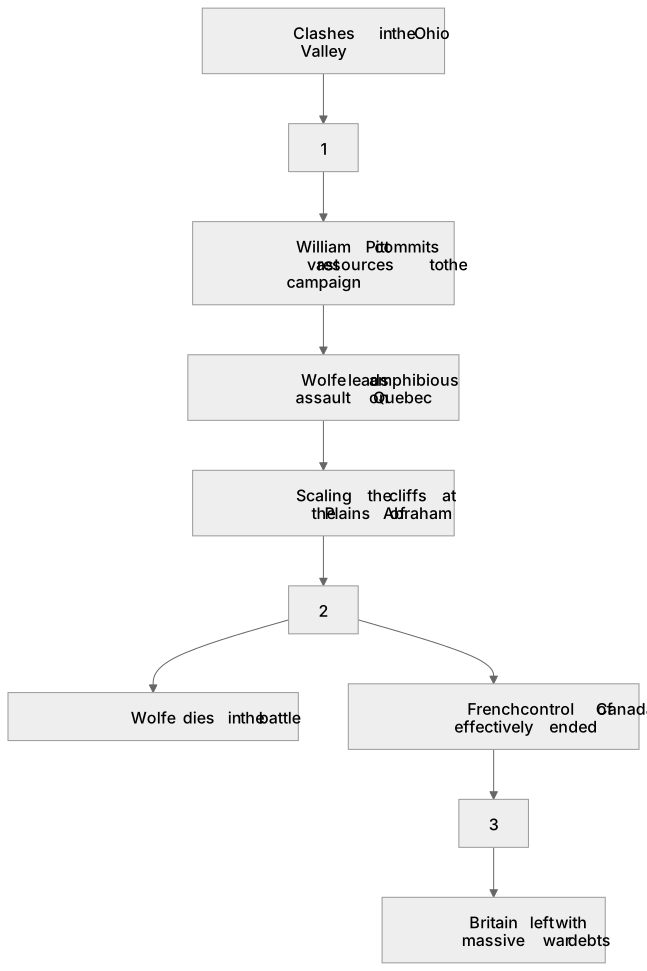
Some boxes have lost their names. Pick the right name for each number.
1Box 1
2Box 2
3Box 3
There is more to this lesson
The full lesson goes on to check your understanding and help you earn the marks. Create a free account to carry on, with your progress saved.
A week of Premium from your first lesson · Then the free plan continues · No card, no charge
Test your understanding of Option P2: Key topic 2: A disrupted society, 1742–64 - 2 War in the colonies: The French and Indian War (1754–63) in North America and the role of Wolfe in Canada.
Active recall beats re-reading. Take an instant quiz now to test what you’ve learned and lock it into long-term memory.
A week of Premium from your first lesson · Then the free plan continues · No card, no charge