Pearson Edexcel · GCSE · History
Course version: 1HI0 · Version from Sept 2016
Key topic 3: The loss of an empire, 1765–83 - 1 American colonist…
Full specification wording
Option P2: Key topic 3: The loss of an empire, 1765–83 - 1 American colonist relations with Britain: growing opposition, 1765-75: British and American relations: the Boston Tea Party (1773) and the Intolerable Acts (1774).
The Boston Tea Party (1773) was a direct protest against the Tea Act, which gave the British East India Company a monopoly on tea sales.
Checked against the Pearson Edexcel 1HI0 specification (opens in a new tab) on .
- Point 2 of 3
- 4 key terms
Study notes
From the checked teaching notes for this specification point.
The idea
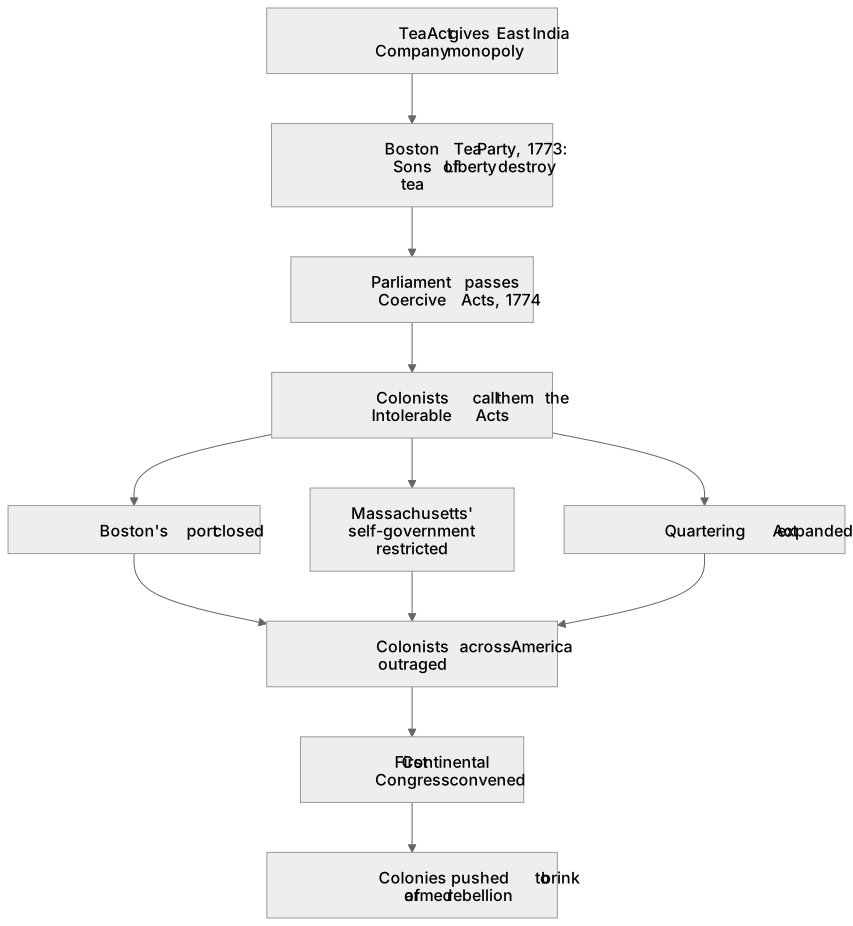
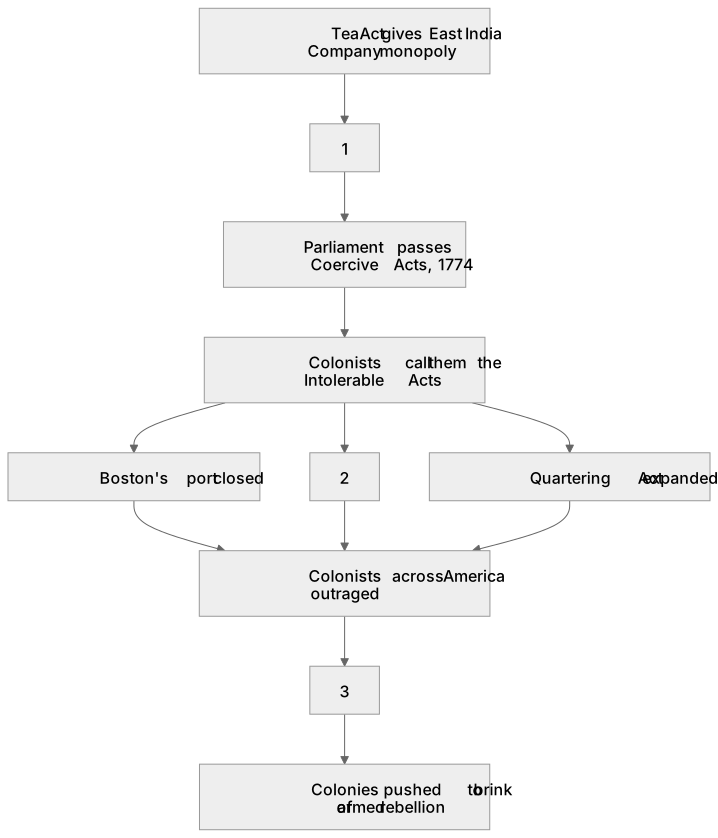
The Boston Tea Party (1773) was a direct protest against the Tea Act, which gave the British East India Company a monopoly on tea sales. Members of the Sons of Liberty, disguised as Mohawk Indians, boarded British ships and destroyed 342 chests of tea. In retaliation, Parliament passed the Coercive Acts in 1774, known by colonists as the Intolerable Acts. These punitive measures closed Boston's port, restricted Massachusetts' self-government, and expanded the Quartering Act. Rather than isolating Massachusetts as intended, the Intolerable Acts outraged colonists across America, prompting the convening of the First Continental Congress and pushing the colonies to the brink of armed rebellion against British rule.
What earns the marks
- Explain the causes of the Boston Tea Party, specifically colonial opposition to the Tea Act.
- Describe the events of the Boston Tea Party and the destruction of East India Company property.
- Identify the key components of the Intolerable Acts, such as the Boston Port Act and the Massachusetts Government Act.
- Analyse how the Intolerable Acts unified the colonies rather than isolating Massachusetts.
Common mistakes and how to put them right
Believing the Tea Act raised the price of tea.
Put it right: The Tea Act actually lowered the price of legally imported tea, but colonists opposed the monopoly and the hidden tax.
Confusing the Intolerable Acts with earlier taxation laws.
Put it right: The Intolerable Acts were punitive measures designed to punish Massachusetts, not primarily to raise revenue.
Stating that the Boston Tea Party immediately started the Revolutionary War.
Put it right: It led to the Intolerable Acts, which then led to the First Continental Congress; armed conflict began later in 1775.
Exam tips
- Clearly link the Boston Tea Party as the cause and the Intolerable Acts as the consequence.
- Explain why the British government felt compelled to respond so harshly to the destruction of the tea.
- Discuss how the Intolerable Acts backfired on the British by creating colonial unity and sympathy for Massachusetts.
Try the lesson
The start of the Option P2: Key topic 3: The loss of an empire, 1765–83 - 1 American colonist relations with Britain: growing opposition, 1765-75: British and American relations: the Boston Tea Party (1773) and the Intolerable Acts (1774). lesson, made from checked teaching notes for this specification point.
Have a go first
What action did colonists take during the Boston Tea Party in 1773?
Listen
The Boston Tea Party (1773) was a direct protest against the Tea Act, which gave the British East India Company a monopoly on tea sales. Members of the Sons of Liberty, disguised as Mohawk Indians, boarded British ships and destroyed 342 chests of tea. In retaliation, Parliament passed the Coercive Acts in 1774, known by colonists as the Intolerable Acts. These punitive measures closed Boston's port, restricted Massachusetts' self-government, and expanded the Quartering Act. Rather than isolating Massachusetts as intended, the Intolerable Acts outraged colonists across America, prompting the convening of the First Continental Congress and pushing the colonies to the brink of armed rebellion against British rule. A strong answer earns marks for these points. Explain the causes of the Boston Tea Party, specifically colonial opposition to the Tea Act. Describe the events of the Boston Tea Party and the destruction of East India Company property. Identify the key components of the Intolerable Acts, such as the Boston Port Act and the Massachusetts Government Act. Analyse how the Intolerable Acts unified the colonies rather than isolating Massachusetts. A common slip: Believing the Tea Act raised the price of tea. Instead, The Tea Act actually lowered the price of legally imported tea, but colonists opposed the monopoly and the hidden tax. Exam tip: Clearly link the Boston Tea Party as the cause and the Intolerable Acts as the consequence.
See it
Key words
Say what each word means before you turn the card.
Boston Tea Party
Try answering aloud or in your head before turning the card.
Intolerable Acts
Try answering aloud or in your head before turning the card.
Tea Act
Try answering aloud or in your head before turning the card.
First Continental Congress
Try answering aloud or in your head before turning the card.
See every definition
- Boston Tea Party
- A direct protest in 1773 against the Tea Act, in which members of the Sons of Liberty, disguised as Mohawk Indians, boarded British ships and destroyed 342 chests of tea.
- Intolerable Acts
- The name colonists gave to the Coercive Acts passed by Parliament in 1774 as punitive measures in retaliation for the Boston Tea Party.
- Tea Act
- The law that gave the British East India Company a monopoly on tea sales, against which the Boston Tea Party was a direct protest.
- First Continental Congress
- The body convened by colonists across America after the Intolerable Acts outraged them, pushing the colonies to the brink of armed rebellion against British rule.
Label the diagram
Some boxes have lost their names. Pick the right name for each number.
1Box 1
2Box 2
3Box 3
There is more to this lesson
The full lesson goes on to check your understanding and help you earn the marks. Create a free account to carry on, with your progress saved.
A week of Premium from your first lesson · Then the free plan continues · No card, no charge
Test your understanding of Option P2: Key topic 3: The loss of an empire, 1765–83 - 1 American colonist relations with Britain: growing opposition, 1765-75: British and American relations: the Boston Tea Party (1773) and the Intolerable Acts (1774).
Active recall beats re-reading. Take an instant quiz now to test what you’ve learned and lock it into long-term memory.
A week of Premium from your first lesson · Then the free plan continues · No card, no charge