Pearson Edexcel · GCSE · History
Course version: 1HI0 · Version from Sept 2016
Key topic 3: The loss of an empire, 1765–83 - 2 The War of Independence…
Full specification wording
Option P2: Key topic 3: The loss of an empire, 1765–83 - 2 The War of Independence 1775-83: The influence of Thomas Paine's 'Common Sense'. The significance of the Declaration of Independence. The role of Thomas Jefferson.
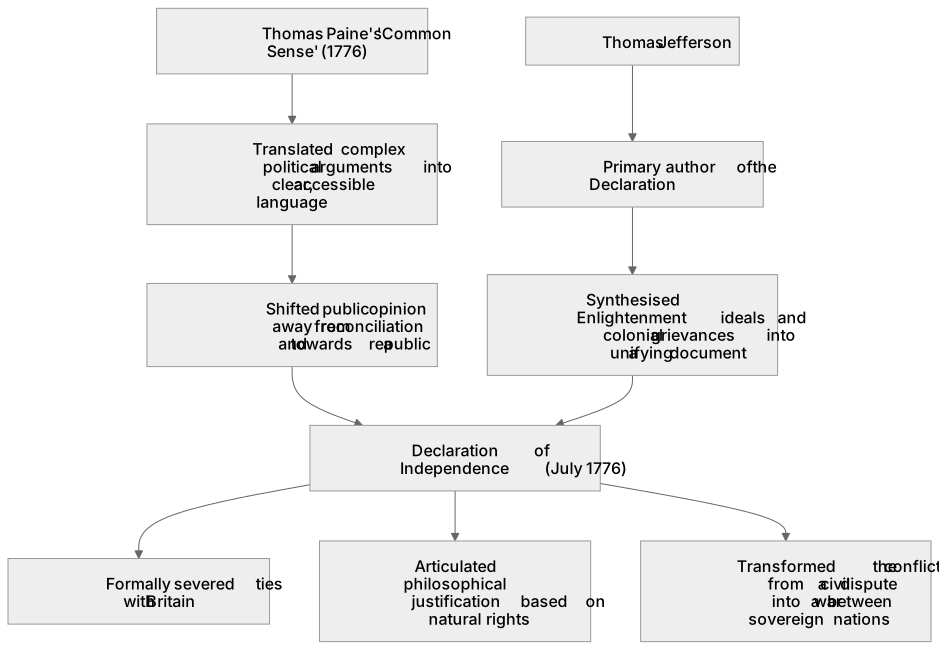
Thomas Paine’s pamphlet 'Common Sense' (1776) was highly influential because it translated complex political arguments for independence into clear, accessible language, shifting public opinion…
Checked against the Pearson Edexcel 1HI0 specification (opens in a new tab) on .
- Point 1 of 3
- 4 key terms
Study notes
From the checked teaching notes for this specification point.
The idea
Thomas Paine’s pamphlet 'Common Sense' (1776) was highly influential because it translated complex political arguments for independence into clear, accessible language, shifting public opinion away from reconciliation and towards a republic. The Declaration of Independence (July 1776) was significant as it formally severed ties with Britain, articulated the philosophical justification for rebellion based on natural rights, and transformed the conflict from a civil dispute into a war between sovereign nations. Thomas Jefferson played a crucial role as the primary author of the Declaration, skillfully synthesising Enlightenment ideals and colonial grievances into a powerful, unifying document that justified the American cause to the world.
What earns the marks
- Explain how 'Common Sense' popularised the argument for independence among ordinary colonists.
- Identify the Declaration of Independence as the formal break from British rule, changing the nature of the war.
- Describe Thomas Jefferson's role as the principal draftsman of the Declaration of Independence.
- Evaluate how the Declaration's assertion of natural rights provided a moral justification for the rebellion.
Common mistakes and how to put them right
Claiming Thomas Paine wrote the Declaration of Independence.
Put it right: Paine wrote 'Common Sense'; Thomas Jefferson was the primary author of the Declaration.
Assuming 'Common Sense' was only read by the elite.
Put it right: Paine deliberately wrote in plain language to appeal to the masses, making it widely read and highly influential.
Stating the Declaration immediately ended the war.
Put it right: The Declaration was issued in 1776, but the War of Independence continued until 1783.
Exam tips
- Link 'Common Sense' to the shift in public mood in early 1776, showing how it paved the way for the Declaration.
- When discussing Jefferson, focus on his ability to articulate colonial grievances and Enlightenment ideas clearly.
- Use the Declaration to explain why foreign powers like France might take the American cause more seriously.
Try the lesson
The start of the Option P2: Key topic 3: The loss of an empire, 1765–83 - 2 The War of Independence 1775-83: The influence of Thomas Paine's 'Common Sense'. The significance of the Declaration of Independence. The role of Thomas Jefferson. lesson, made from checked teaching notes for this specification point.
Have a go first
What was the main purpose of Thomas Paine's pamphlet 'Common Sense' published in 1776?
Listen
Thomas Paine’s pamphlet 'Common Sense' (1776) was highly influential because it translated complex political arguments for independence into clear, accessible language, shifting public opinion away from reconciliation and towards a republic. The Declaration of Independence (July 1776) was significant as it formally severed ties with Britain, articulated the philosophical justification for rebellion based on natural rights, and transformed the conflict from a civil dispute into a war between sovereign nations. Thomas Jefferson played a crucial role as the primary author of the Declaration, skillfully synthesising Enlightenment ideals and colonial grievances into a powerful, unifying document that justified the American cause to the world. A strong answer earns marks for these points. Explain how 'Common Sense' popularised the argument for independence among ordinary colonists. Identify the Declaration of Independence as the formal break from British rule, changing the nature of the war. Describe Thomas Jefferson's role as the principal draftsman of the Declaration of Independence. Evaluate how the Declaration's assertion of natural rights provided a moral justification for the rebellion. A common slip: Claiming Thomas Paine wrote the Declaration of Independence. Instead, Paine wrote 'Common Sense'; Thomas Jefferson was the primary author of the Declaration. Exam tip: Link 'Common Sense' to the shift in public mood in early 1776, showing how it paved the way for the Declaration.
See it
Key words
Say what each word means before you turn the card.
Common Sense
Try answering aloud or in your head before turning the card.
Declaration of Independence
Try answering aloud or in your head before turning the card.
Thomas Jefferson
Try answering aloud or in your head before turning the card.
Enlightenment ideas
Try answering aloud or in your head before turning the card.
See every definition
- Common Sense
- A pamphlet by Thomas Paine that translated complex political arguments for independence into clear, accessible language, shifting public opinion towards a republic.
- Declaration of Independence
- A document of July 1776 that formally severed ties with Britain and articulated the philosophical justification for rebellion based on natural rights.
- Thomas Jefferson
- The primary author of the Declaration, who synthesised Enlightenment ideals and colonial grievances into a unifying document.
- Enlightenment ideas
- Ideals that Thomas Jefferson synthesised with colonial grievances in the Declaration to justify the American cause.
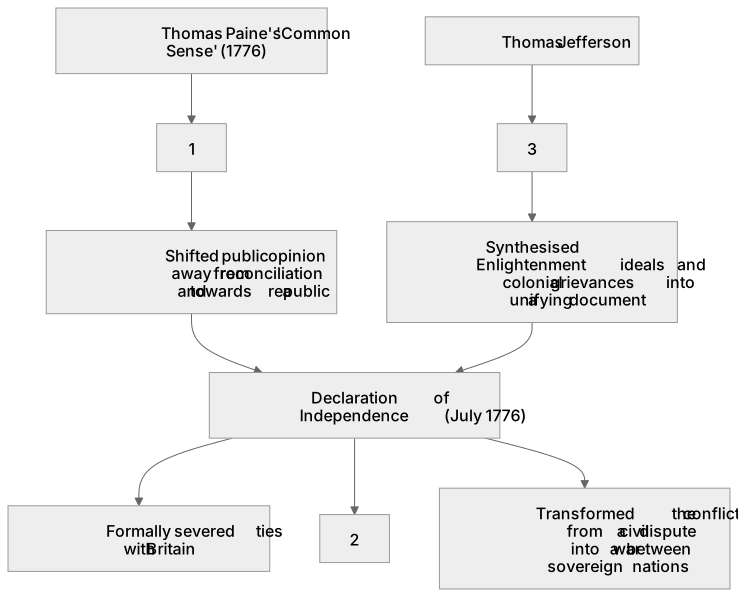
Label the diagram
Some boxes have lost their names. Pick the right name for each number.
1Box 1
2Box 2
3Box 3
There is more to this lesson
The full lesson goes on to check your understanding and help you earn the marks. Create a free account to carry on, with your progress saved.
A week of Premium from your first lesson · Then the free plan continues · No card, no charge
Test your understanding of Option P2: Key topic 3: The loss of an empire, 1765–83 - 2 The War of Independence 1775-83: The influence of Thomas Paine's 'Common Sense'. The significance of the Declaration of Independence. The role of Thomas Jefferson.
Active recall beats re-reading. Take an instant quiz now to test what you’ve learned and lock it into long-term memory.
A week of Premium from your first lesson · Then the free plan continues · No card, no charge