Pearson Edexcel · GCSE · History
Course version: 1HI0 · Version from Sept 2016
Key topic 3: The loss of an empire, 1765–83 - 2 The War of Independence…
Full specification wording
Option P2: Key topic 3: The loss of an empire, 1765–83 - 2 The War of Independence 1775-83: The Peace of Paris (1783), including the role of Franklin.
The Peace of Paris (1783) formally ended the American War of Independence, with Britain officially recognising the United States as a sovereign and independent nation.
Checked against the Pearson Edexcel 1HI0 specification (opens in a new tab) on .
- Point 3 of 3
Study notes
From the checked teaching notes for this specification point.
The idea
The Peace of Paris (1783) formally ended the American War of Independence, with Britain officially recognising the United States as a sovereign and independent nation. The treaty established generous boundaries for the new republic, extending west to the Mississippi River, north to Canada, and south to Florida. Benjamin Franklin played a pivotal role as a lead negotiator. He skillfully exploited the complex diplomatic dynamics between Britain, France, and Spain to secure highly favourable terms for the Americans. Franklin's pragmatic decision to negotiate separately with the British, despite the alliance with France, ensured that American territorial and political interests were prioritised and fully secured in the final treaty.
What earns the marks
- Identify the Peace of Paris (1783) as the treaty that formally recognised American independence.
- Describe the territorial gains secured by the United States, including lands up to the Mississippi River.
- Explain Benjamin Franklin's role as a key diplomat in Paris.
- Evaluate Franklin's strategy of negotiating directly with Britain to secure the best possible terms for America.
Common mistakes and how to put them right
Confusing the Peace of Paris (1783) with the Treaty of Paris (1763).
Put it right: The 1763 treaty ended the Seven Years' War; the 1783 Peace of Paris ended the War of Independence.
Believing France dictated the terms of the treaty.
Put it right: Franklin and the American negotiators secretly dealt directly with Britain to avoid French interference in American territorial claims.
Assuming the treaty only granted independence.
Put it right: The treaty also established crucial borders, granting the US vast western territories up to the Mississippi.
Exam tips
- Emphasise Franklin's diplomatic skill in playing the European powers against each other.
- Mention the specific geographical boundaries agreed upon to show detailed knowledge of the treaty's terms.
- Link the generous terms offered by Britain to their desire to break the Franco-American alliance and resume trade.
Try the lesson
The start of the Option P2: Key topic 3: The loss of an empire, 1765–83 - 2 The War of Independence 1775-83: The Peace of Paris (1783), including the role of Franklin. lesson, made from checked teaching notes for this specification point.
Have a go first
Which American diplomat played a crucial role in negotiating the Peace of Paris in 1783?
Listen
The Peace of Paris (1783) formally ended the American War of Independence, with Britain officially recognising the United States as a sovereign and independent nation. The treaty established generous boundaries for the new republic, extending west to the Mississippi River, north to Canada, and south to Florida. Benjamin Franklin played a pivotal role as a lead negotiator. He skillfully exploited the complex diplomatic dynamics between Britain, France, and Spain to secure highly favourable terms for the Americans. Franklin's pragmatic decision to negotiate separately with the British, despite the alliance with France, ensured that American territorial and political interests were prioritised and fully secured in the final treaty. A strong answer earns marks for these points. Identify the Peace of Paris (1783) as the treaty that formally recognised American independence. Describe the territorial gains secured by the United States, including lands up to the Mississippi River. Explain Benjamin Franklin's role as a key diplomat in Paris. Evaluate Franklin's strategy of negotiating directly with Britain to secure the best possible terms for America. A common slip: Confusing the Peace of Paris (1783) with the Treaty of Paris (1763). Instead, The 1763 treaty ended the Seven Years' War; the 1783 Peace of Paris ended the War of Independence. Exam tip: Emphasise Franklin's diplomatic skill in playing the European powers against each other.
See it
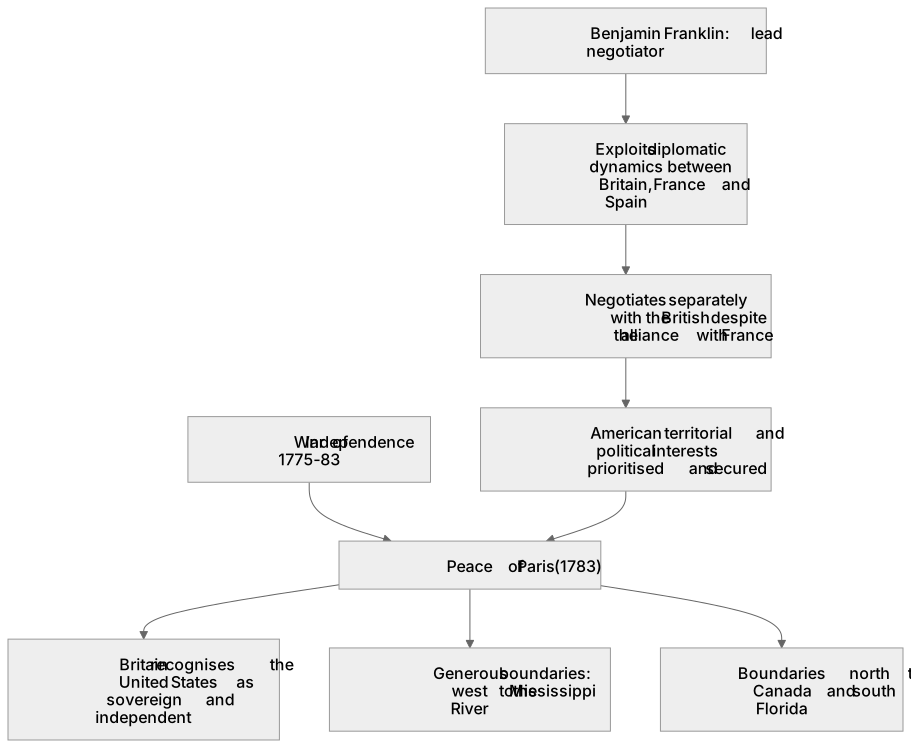
Label the diagram
Some boxes have lost their names. Pick the right name for each number.
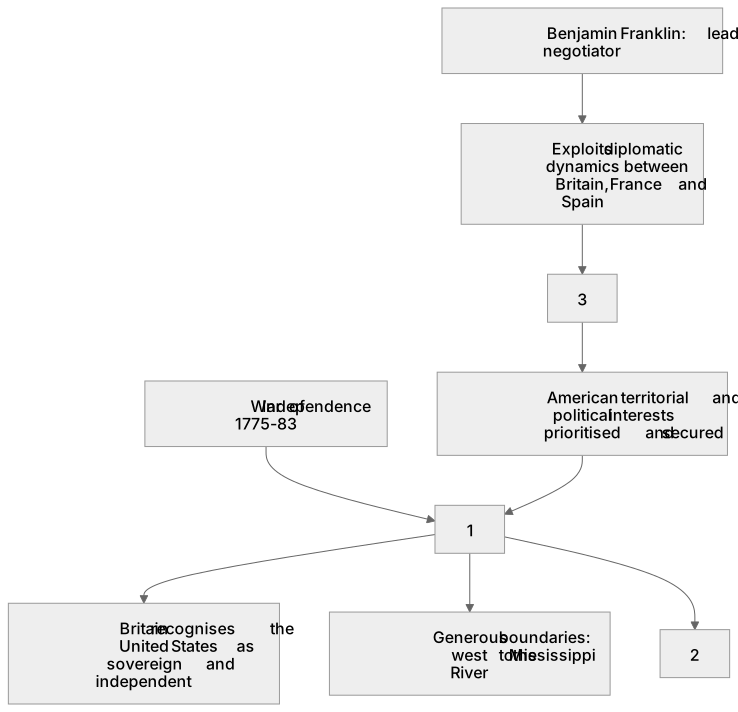
1Box 1
2Box 2
3Box 3
There is more to this lesson
The full lesson goes on to check your understanding and help you earn the marks. Create a free account to carry on, with your progress saved.
A week of Premium from your first lesson · Then the free plan continues · No card, no charge
Test your understanding of Option P2: Key topic 3: The loss of an empire, 1765–83 - 2 The War of Independence 1775-83: The Peace of Paris (1783), including the role of Franklin.
Active recall beats re-reading. Take an instant quiz now to test what you’ve learned and lock it into long-term memory.
A week of Premium from your first lesson · Then the free plan continues · No card, no charge