Pearson Edexcel · GCSE · History
Course version: 1HI0 · Version from Sept 2016
Key topic 3: The loss of an empire, 1765–83 - 3 Consequences of the war in…
Full specification wording
Option P2: Key topic 3: The loss of an empire, 1765–83 - 3 Consequences of the war in America: The significance of American independence for slavery.
American independence had a contradictory significance for slavery.
Checked against the Pearson Edexcel 1HI0 specification (opens in a new tab) on .
- Point 1 of 3
- 4 key terms
Study notes
From the checked teaching notes for this specification point.
The idea
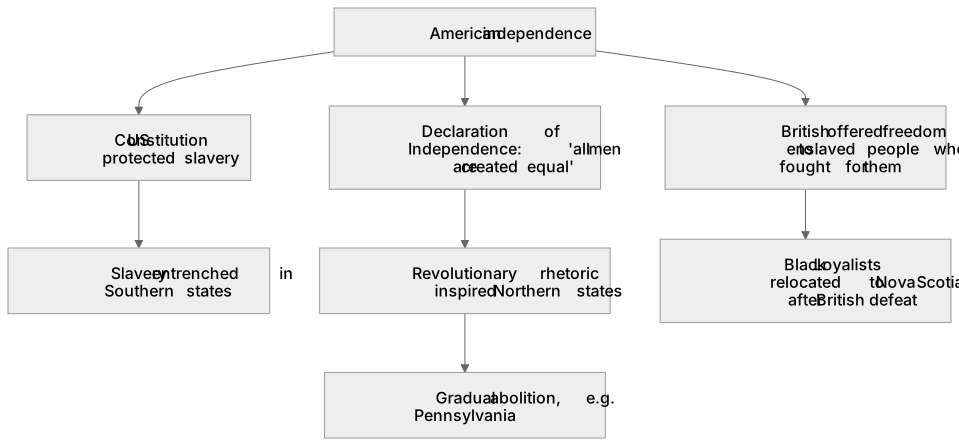
American independence had a contradictory significance for slavery. While the Declaration of Independence proclaimed 'all men are created equal', the new United States Constitution protected slavery, especially in Southern states where plantation economies relied on enslaved labour. However, revolutionary rhetoric inspired Northern states, like Pennsylvania, to begin gradual abolition. During the war, the British offered freedom to enslaved people who fought for them, leading to the relocation of thousands of 'Black Loyalists' to Nova Scotia after the British defeat. Therefore, independence entrenched slavery in the South, sparked early abolitionist movements in the North, and created a diaspora of freed people across the British Empire.
What earns the marks
- Identify the contradiction between the revolutionary ideals of liberty and the continuation of the institution of slavery.
- Explain the regional divide that emerged, with Northern states beginning gradual abolition while Southern states entrenched slavery.
- Describe the British military strategy of offering freedom to enslaved people who joined their forces, such as through Lord Dunmore's Proclamation.
- Detail the post-war migration and resettlement of Black Loyalists to British territories such as Nova Scotia.
Common mistakes and how to put them right
Claiming American independence immediately ended slavery.
Put it right: Specify that independence actually entrenched slavery in the Southern states, though some Northern states began gradual abolition.
Ignoring the role of the British in freeing enslaved people.
Put it right: Acknowledge that the British offered freedom to enslaved individuals who fought for them, creating the Black Loyalists.
Assuming the US Constitution banned the slave trade immediately.
Put it right: Note that the Constitution protected the institution and allowed the international slave trade to continue for another twenty years.
Exam tips
- Use the specific term 'Black Loyalists' when discussing enslaved people who gained their freedom by fighting for the British Crown.
- Contrast the economic needs of the Southern plantation colonies with the Northern colonies to explain the regional differences in abolition.
- Evaluate 'significance' by looking at both short-term impacts, such as Black Loyalists relocating, and long-term impacts, such as the entrenchment of Southern slavery.
Try the lesson
The start of the Option P2: Key topic 3: The loss of an empire, 1765–83 - 3 Consequences of the war in America: The significance of American independence for slavery. lesson, made from checked teaching notes for this specification point.
Have a go first
What was a direct consequence of the American War of Independence for enslaved people who had fought for the British?
Listen
American independence had a contradictory significance for slavery. While the Declaration of Independence proclaimed 'all men are created equal', the new United States Constitution protected slavery, especially in Southern states where plantation economies relied on enslaved labour. However, revolutionary rhetoric inspired Northern states, like Pennsylvania, to begin gradual abolition. During the war, the British offered freedom to enslaved people who fought for them, leading to the relocation of thousands of 'Black Loyalists' to Nova Scotia after the British defeat. Therefore, independence entrenched slavery in the South, sparked early abolitionist movements in the North, and created a diaspora of freed people across the British Empire. A strong answer earns marks for these points. Identify the contradiction between the revolutionary ideals of liberty and the continuation of the institution of slavery. Explain the regional divide that emerged, with Northern states beginning gradual abolition while Southern states entrenched slavery. Describe the British military strategy of offering freedom to enslaved people who joined their forces, such as through Lord Dunmore's Proclamation. Detail the post-war migration and resettlement of Black Loyalists to British territories such as Nova Scotia. A common slip: Claiming American independence immediately ended slavery. Instead, Specify that independence actually entrenched slavery in the Southern states, though some Northern states began gradual abolition. Exam tip: Use the specific term 'Black Loyalists' when discussing enslaved people who gained their freedom by fighting for the British Crown.
See it
Key words
Say what each word means before you turn the card.
Liberty and equality
Try answering aloud or in your head before turning the card.
Economic dependence on enslaved labour
Try answering aloud or in your head before turning the card.
Regional divisions
Try answering aloud or in your head before turning the card.
Migration and resettlement
Try answering aloud or in your head before turning the card.
See every definition
- Liberty and equality
- Revolutionary ideals proclaimed in the Declaration of Independence, which stated that 'all men are created equal', yet sat alongside the continuation of the institution of slavery.
- Economic dependence on enslaved labour
- The reliance of Southern plantation economies on enslaved labour, which meant the new United States Constitution protected slavery.
- Regional divisions
- The divide that emerged after independence, with Northern states beginning gradual abolition while Southern states entrenched slavery.
- Migration and resettlement
- The post-war relocation of thousands of 'Black Loyalists' to British territories such as Nova Scotia after the British defeat.
Label the diagram
Some boxes have lost their names. Pick the right name for each number.
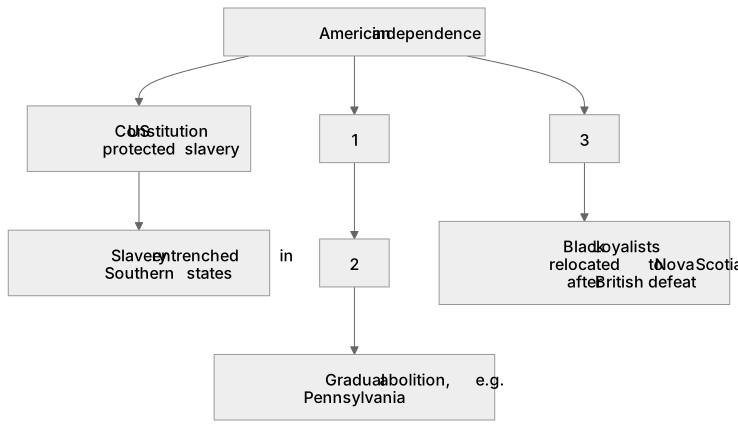
1Box 1
2Box 2
3Box 3
There is more to this lesson
The full lesson goes on to check your understanding and help you earn the marks. Create a free account to carry on, with your progress saved.
A week of Premium from your first lesson · Then the free plan continues · No card, no charge
Test your understanding of Option P2: Key topic 3: The loss of an empire, 1765–83 - 3 Consequences of the war in America: The significance of American independence for slavery.
Active recall beats re-reading. Take an instant quiz now to test what you’ve learned and lock it into long-term memory.
A week of Premium from your first lesson · Then the free plan continues · No card, no charge