Pearson Edexcel · GCSE · History
Course version: 1HI0 · Version from Sept 2016
Key topic 1: The early settlement of the West, c1835–c1862 - 3 Conflict…
Full specification wording
Option P3: Key topic 1: The early settlement of the West, c1835–c1862 - 3 Conflict and tension: Lawlessness in early towns and settlements, including attempts to tackle lawlessness.
Early towns and settlements in the West experienced severe lawlessness due to rapid population growth, transient populations, and a lack of established law enforcement.
Checked against the Pearson Edexcel 1HI0 specification (opens in a new tab) on .
- Point 2 of 2
Study notes
From the checked teaching notes for this specification point.
The idea
Early towns and settlements in the West experienced severe lawlessness due to rapid population growth, transient populations, and a lack of established law enforcement. Mining towns saw high rates of violence, gambling, and claim-jumping. Vast distances made it difficult for the federal government to impose order, leaving communities to devise their own solutions. Attempts to tackle lawlessness included the formation of vigilance committees who took the law into their own hands, often resulting in lynchings without fair trials. Additionally, towns appointed local sheriffs and US Marshals were assigned to territories, though they were often underpaid and corrupt. These attempts highlight the struggle to establish justice in a rapidly expanding frontier.
What earns the marks
- Identify the causes of lawlessness, such as rapid population influx, isolation, and the transient nature of mining towns.
- Describe specific crimes prevalent in early settlements, including claim-jumping, robbery, and murder.
- Explain the role and methods of vigilance committees in attempting to restore order outside the formal legal system.
- Evaluate the effectiveness and limitations of formal law enforcement, such as sheriffs and US Marshals, in the early West.
Common mistakes and how to put them right
Assuming that formal law enforcement was completely absent in the West.
Put it right: Note that sheriffs and US Marshals did exist, but they were often ineffective due to vast territories and lack of resources.
Viewing vigilantes purely as heroic figures who solved crime.
Put it right: Explain that vigilantes often bypassed the right to a fair trial and could be as corrupt or violent as the criminals they pursued.
Confusing the lawlessness of early mining towns with later cattle towns.
Put it right: Focus on the specific context of early settlements (c1835–1862), such as the California Gold Rush camps, rather than later cowboy-related violence.
Exam tips
- Use specific examples of crimes, like claim-jumping in gold rush towns, to illustrate the nature of lawlessness.
- When discussing attempts to tackle lawlessness, contrast the formal methods (sheriffs) with informal methods (vigilantes).
- Consider the geographical factors, such as vast distances and poor communication, that hindered effective law enforcement.
Try the lesson
The start of the Option P3: Key topic 1: The early settlement of the West, c1835–c1862 - 3 Conflict and tension: Lawlessness in early towns and settlements, including attempts to tackle lawlessness. lesson, made from checked teaching notes for this specification point.
Have a go first
Which of the following was a common method used by early mining towns to tackle lawlessness before official law enforcement was established?
Listen
Early towns and settlements in the West experienced severe lawlessness due to rapid population growth, transient populations, and a lack of established law enforcement. Mining towns saw high rates of violence, gambling, and claim-jumping. Vast distances made it difficult for the federal government to impose order, leaving communities to devise their own solutions. Attempts to tackle lawlessness included the formation of vigilance committees who took the law into their own hands, often resulting in lynchings without fair trials. Additionally, towns appointed local sheriffs and US Marshals were assigned to territories, though they were often underpaid and corrupt. These attempts highlight the struggle to establish justice in a rapidly expanding frontier. A strong answer earns marks for these points. Identify the causes of lawlessness, such as rapid population influx, isolation, and the transient nature of mining towns. Describe specific crimes prevalent in early settlements, including claim-jumping, robbery, and murder. Explain the role and methods of vigilance committees in attempting to restore order outside the formal legal system. Evaluate the effectiveness and limitations of formal law enforcement, such as sheriffs and US Marshals, in the early West. A common slip: Assuming that formal law enforcement was completely absent in the West. Instead, Note that sheriffs and US Marshals did exist, but they were often ineffective due to vast territories and lack of resources. Exam tip: Use specific examples of crimes, like claim-jumping in gold rush towns, to illustrate the nature of lawlessness.
See it
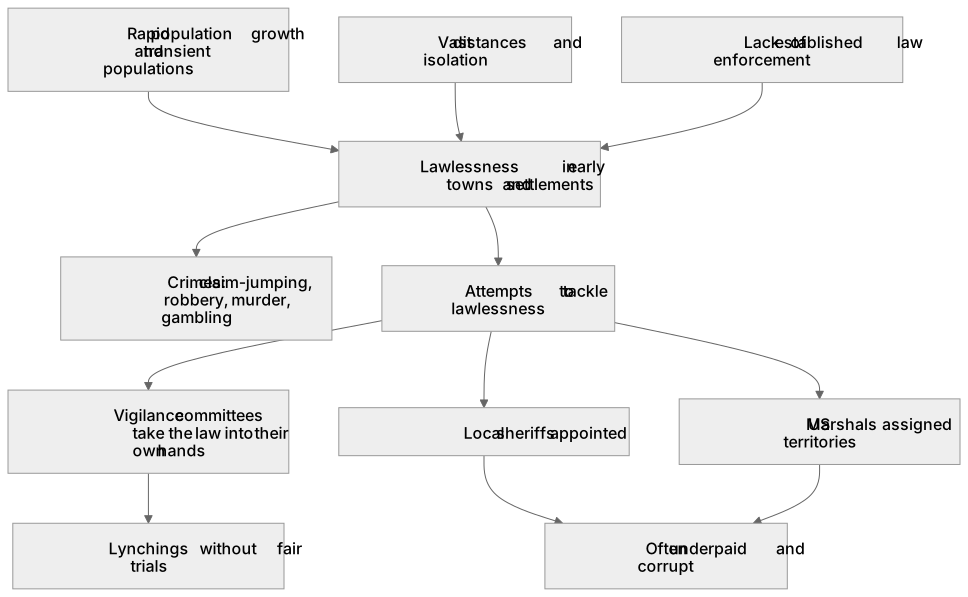
Label the diagram
Some boxes have lost their names. Pick the right name for each number.
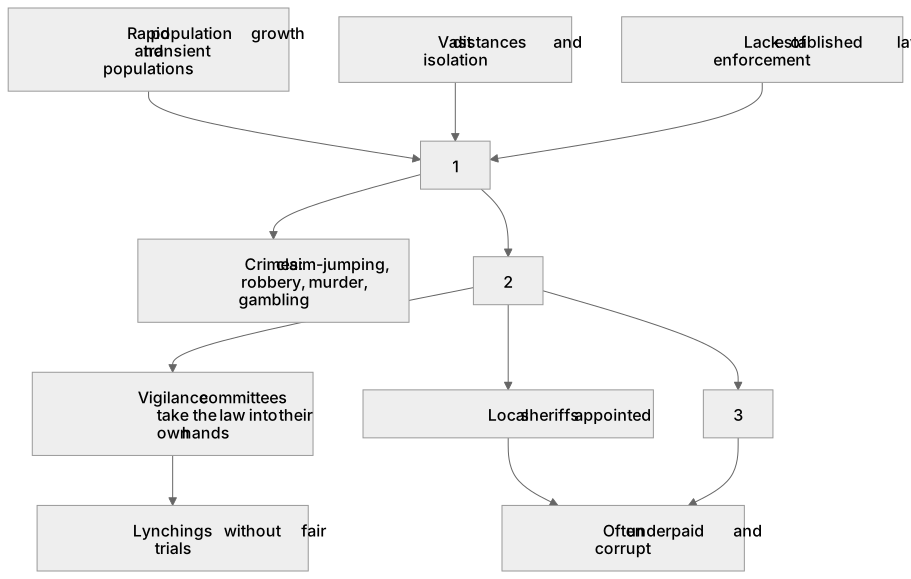
1Box 1
2Box 2
3Box 3
There is more to this lesson
The full lesson goes on to check your understanding and help you earn the marks. Create a free account to carry on, with your progress saved.
A week of Premium from your first lesson · Then the free plan continues · No card, no charge
Test your understanding of Option P3: Key topic 1: The early settlement of the West, c1835–c1862 - 3 Conflict and tension: Lawlessness in early towns and settlements, including attempts to tackle lawlessness.
Active recall beats re-reading. Take an instant quiz now to test what you’ve learned and lock it into long-term memory.
A week of Premium from your first lesson · Then the free plan continues · No card, no charge