Pearson Edexcel · GCSE · History
Course version: 1HI0 · Version from Sept 2016
Key topic 2: Development of the Plains, c1862–c1876 - 2 Ranching and the…
Full specification wording
Option P3: Key topic 2: Development of the Plains, c1862–c1876 - 2 Ranching and the cattle industry: The changing role of the cowboy, including changes in ranching. Relations between ranchers and homesteaders.
The role of the cowboy transformed significantly as the cattle industry evolved between 1862 and 1876.
Checked against the Pearson Edexcel 1HI0 specification (opens in a new tab) on .
- Point 2 of 2
- 4 key terms
Study notes
From the checked teaching notes for this specification point.
The idea
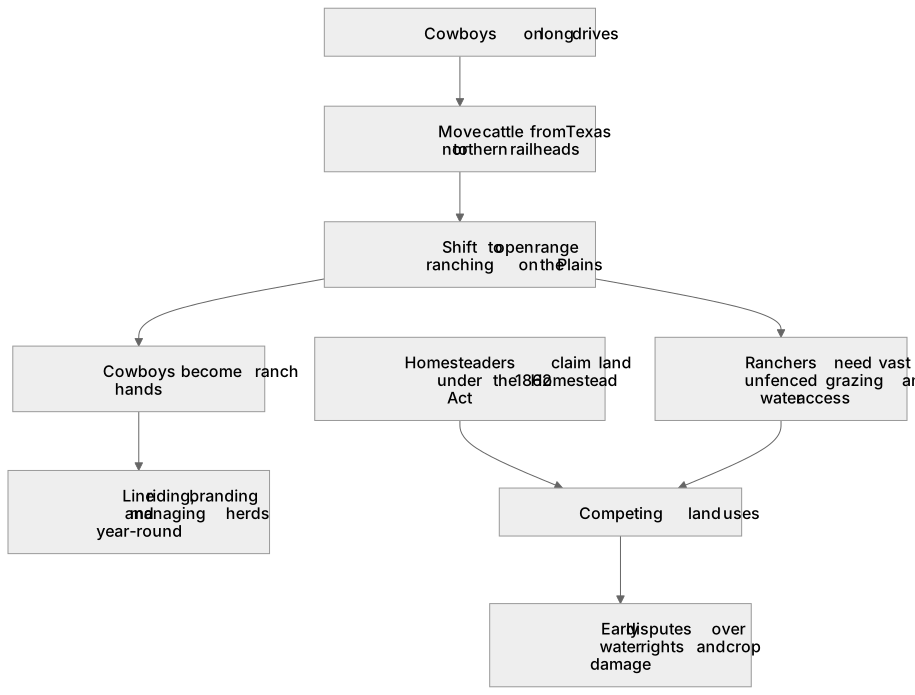
The role of the cowboy transformed significantly as the cattle industry evolved between 1862 and 1876. Initially, cowboys undertook arduous, months-long 'long drives' to move cattle from Texas to northern railheads like Abilene, facing harsh weather and stampedes. However, as ranching shifted to the open range on the Plains, cowboys became ranch hands, focusing on line riding, branding, and managing herds year-round. This expansion of open range ranching led to early conflicts with homesteaders. Ranchers needed vast, unfenced areas for grazing and access to water, while homesteaders began claiming land under the 1862 Homestead Act. These competing land uses sparked early disputes over water rights and crop damage, laying the groundwork for the severe range wars of later decades, highlighting the tension between different settlement models.
What earns the marks
- Contrast the early role of cowboys on the long drives with their later duties on open range ranches.
- Explain the shift in ranching practices from driving Texan cattle to breeding and raising herds directly on the Plains.
- Identify the core causes of conflict between ranchers and homesteaders, specifically focusing on land use, crop damage, and water access.
- Describe how the competing needs of open grazing and homestead farming created early tensions during the 1862-1876 period.
Common mistakes and how to put them right
Assuming cowboys only ever drove cattle on long trails.
Put it right: Explain that their role changed to static ranch work as open range ranching developed.
Using the Johnson County War (1892) as an example for this period.
Put it right: Focus on the early tensions over water and land access between 1862 and 1876, as major range wars occurred later.
Believing homesteaders were always the aggressors.
Put it right: Recognise that wealthy cattle barons often used intimidation and illegal tactics to control public lands and water sources.
Exam tips
- Use the transition from the 'long drive' to the 'open range' as a framework to structure answers about the changing role of cowboys.
- When discussing relations between ranchers and homesteaders, explicitly mention competition for water sources as a primary flashpoint in this early period.
Try the lesson
The start of the Option P3: Key topic 2: Development of the Plains, c1862–c1876 - 2 Ranching and the cattle industry: The changing role of the cowboy, including changes in ranching. Relations between ranchers and homesteaders. lesson, made from checked teaching notes for this specification point.
Have a go first
How did the role of the cowboy change as open-range ranching began to decline?
Listen
The role of the cowboy transformed significantly as the cattle industry evolved between 1862 and 1876. Initially, cowboys undertook arduous, months-long 'long drives' to move cattle from Texas to northern railheads like Abilene, facing harsh weather and stampedes. However, as ranching shifted to the open range on the Plains, cowboys became ranch hands, focusing on line riding, branding, and managing herds year-round. This expansion of open range ranching led to early conflicts with homesteaders. Ranchers needed vast, unfenced areas for grazing and access to water, while homesteaders began claiming land under the 1862 Homestead Act. These competing land uses sparked early disputes over water rights and crop damage, laying the groundwork for the severe range wars of later decades, highlighting the tension between different settlement models. A strong answer earns marks for these points. Contrast the early role of cowboys on the long drives with their later duties on open range ranches. Explain the shift in ranching practices from driving Texan cattle to breeding and raising herds directly on the Plains. Identify the core causes of conflict between ranchers and homesteaders, specifically focusing on land use, crop damage, and water access. Describe how the competing needs of open grazing and homestead farming created early tensions during the 1862-1876 period. A common slip: Assuming cowboys only ever drove cattle on long trails. Instead, explain that their role changed to static ranch work as open range ranching developed. Exam tip: Use the transition from the 'long drive' to the 'open range' as a framework to structure answers about the changing role of cowboys.
See it
Key words
Say what each word means before you turn the card.
Long drives
Try answering aloud or in your head before turning the card.
Open range ranching
Try answering aloud or in your head before turning the card.
Homesteaders
Try answering aloud or in your head before turning the card.
Water rights
Try answering aloud or in your head before turning the card.
See every definition
- Long drives
- Arduous, months-long journeys in which cowboys moved cattle from Texas to northern railheads like Abilene, facing harsh weather and stampedes.
- Open range ranching
- Ranching on the open range of the Plains, where cowboys became ranch hands focusing on line riding, branding and managing herds year-round.
- Homesteaders
- Settlers who began claiming land under the 1862 Homestead Act, competing with ranchers who needed vast, unfenced areas for grazing and access to water.
- Water rights
- A source of early disputes between ranchers and homesteaders, alongside crop damage, as competing land uses sparked early tensions.
Label the diagram
Some boxes have lost their names. Pick the right name for each number.
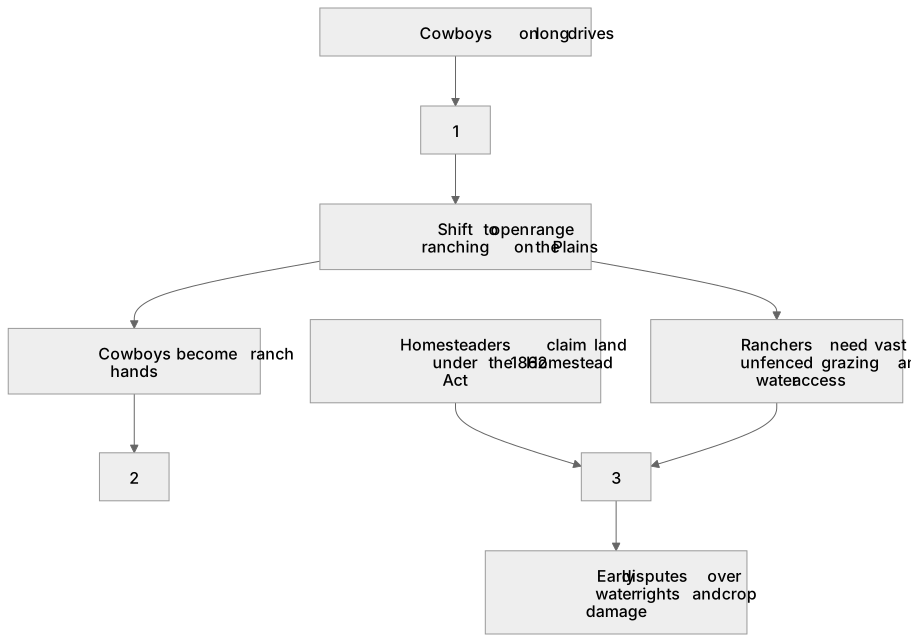
1Box 1
2Box 2
3Box 3
There is more to this lesson
The full lesson goes on to check your understanding and help you earn the marks. Create a free account to carry on, with your progress saved.
A week of Premium from your first lesson · Then the free plan continues · No card, no charge
Test your understanding of Option P3: Key topic 2: Development of the Plains, c1862–c1876 - 2 Ranching and the cattle industry: The changing role of the cowboy, including changes in ranching. Relations between ranchers and homesteaders.
Active recall beats re-reading. Take an instant quiz now to test what you’ve learned and lock it into long-term memory.
A week of Premium from your first lesson · Then the free plan continues · No card, no charge