Pearson Edexcel · GCSE · History
Course version: 1HI0 · Version from Sept 2016
Key topic 2: Development of the Plains, c1862–c1876 - 3 Changes in the…
Full specification wording
Option P3: Key topic 2: Development of the Plains, c1862–c1876 - 3 Changes in the ways of life of Indigenous peoples of the Plains: Conflict on the Plains: Little Crow’s War (1862) and the Sand Creek Massacre (1864), the significance of Red Cloud’s War (1866–68).
Conflict escalated on the Plains as white settlement encroached on Indigenous lands.
Checked against the Pearson Edexcel 1HI0 specification (opens in a new tab) on .
- Point 3 of 3
- 4 key terms
Study notes
From the checked teaching notes for this specification point.
The idea
Conflict escalated on the Plains as white settlement encroached on Indigenous lands. Little Crow’s War (1862) erupted when starving Dakota Sioux in Minnesota, denied promised government annuities, attacked settlers, resulting in mass executions and their expulsion. The Sand Creek Massacre (1864) saw Colonel Chivington’s militia brutally murder over 150 peaceful Cheyenne and Arapaho, mostly women and children, under Black Kettle, sparking widespread retaliation. Red Cloud’s War (1866–68) was highly significant because the Sioux successfully used guerrilla tactics, including the Fetterman Trap, to blockade the Bozeman Trail. This forced the US government to concede defeat and sign the 1868 Fort Laramie Treaty, a unique Indigenous victory.
What earns the marks
- Identify the causes of Little Crow's War, focusing on delayed annuities, starvation, and poor reservation conditions.
- Describe the events of the Sand Creek Massacre, highlighting the unprovoked attack on Black Kettle's peaceful camp by Colonel Chivington.
- Explain the causes of Red Cloud's War, specifically the establishment of the Bozeman Trail through Sioux hunting grounds.
- Assess the significance of Red Cloud's War, noting it as a rare instance where Indigenous forces successfully defeated the US military and dictated treaty terms.
Common mistakes and how to put them right
Stating that the Sand Creek Massacre was a battle between armed warriors.
Put it right: It was an unprovoked massacre of a mostly unarmed, peaceful camp flying a white flag.
Confusing the leaders of the different conflicts.
Put it right: Little Crow led the Dakota Sioux in 1862, Black Kettle was the victim at Sand Creek in 1864, and Red Cloud led the Oglala Lakota from 1866.
Underestimating the success of Red Cloud's War; students often fail to recognise that the US government surrendered and abandoned its forts along the Bozeman Trail.
Exam tips
- Use Little Crow's War to demonstrate the failures of the early reservation system and the consequences of broken government promises.
- When discussing the Sand Creek Massacre, emphasise its role in destroying trust and escalating further conflicts across the Plains.
- Focus on the strategic brilliance of Red Cloud, such as the Fetterman Trap, to explain why the US government was forced to negotiate the 1868 Fort Laramie Treaty.
Try the lesson
The start of the Option P3: Key topic 2: Development of the Plains, c1862–c1876 - 3 Changes in the ways of life of Indigenous peoples of the Plains: Conflict on the Plains: Little Crow’s War (1862) and the Sand Creek Massacre (1864), the significance of Red Cloud’s War (1866–68). lesson, made from checked teaching notes for this specification point.
Have a go first
Which event in 1864 involved an unprovoked attack by Colonel John Chivington's militia on a peaceful camp of Cheyenne and Arapaho people?
Listen
Conflict escalated on the Plains as white settlement encroached on Indigenous lands. Little Crow’s War (1862) erupted when starving Dakota Sioux in Minnesota, denied promised government annuities, attacked settlers, resulting in mass executions and their expulsion. The Sand Creek Massacre (1864) saw Colonel Chivington’s militia brutally murder over 150 peaceful Cheyenne and Arapaho, mostly women and children, under Black Kettle, sparking widespread retaliation. Red Cloud’s War (1866–68) was highly significant because the Sioux successfully used guerrilla tactics, including the Fetterman Trap, to blockade the Bozeman Trail. This forced the US government to concede defeat and sign the 1868 Fort Laramie Treaty, a unique Indigenous victory. A strong answer earns marks for these points. Identify the causes of Little Crow's War, focusing on delayed annuities, starvation, and poor reservation conditions. Describe the events of the Sand Creek Massacre, highlighting the unprovoked attack on Black Kettle's peaceful camp by Colonel Chivington. Explain the causes of Red Cloud's War, specifically the establishment of the Bozeman Trail through Sioux hunting grounds. Assess the significance of Red Cloud's War, noting it as a rare instance where Indigenous forces successfully defeated the US military and dictated treaty terms. Exam tip: Use Little Crow's War to demonstrate the failures of the early reservation system and the consequences of broken government promises.
See it
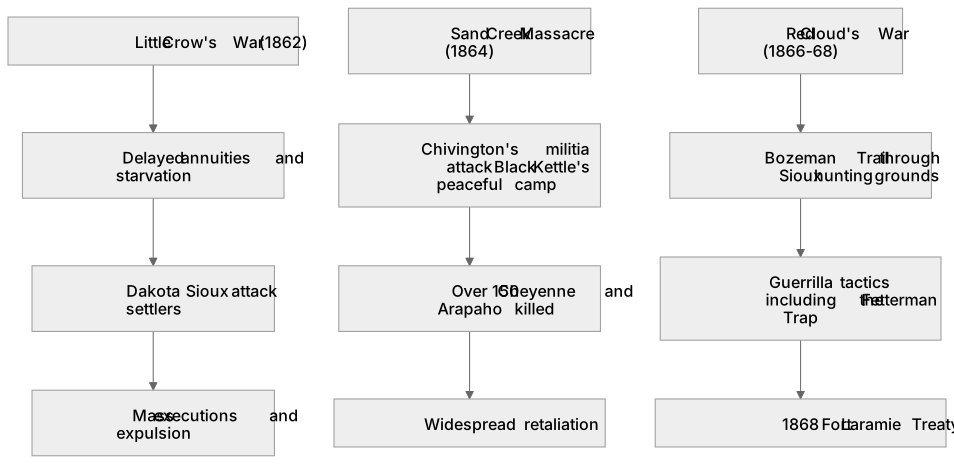
Put the events in order
Put these events in the order they happened, earliest first.
- 1. Little Crow’s War erupted when Dakota Sioux attacked settlers
- 2. Red Cloud’s War began with Sioux guerrilla tactics against the Bozeman Trail
- 3. Sand Creek Massacre saw Chivington’s militia murder peaceful Cheyenne and Arapaho
Key words
Say what each word means before you turn the card.
Conflict
Try answering aloud or in your head before turning the card.
Broken Promises
Try answering aloud or in your head before turning the card.
Military Strategy
Try answering aloud or in your head before turning the card.
Indigenous Resistance
Try answering aloud or in your head before turning the card.
See every definition
- Conflict
- Escalated on the Plains as white settlement encroached on Indigenous lands, with Little Crow's War, the Sand Creek Massacre and Red Cloud's War as examples.
- Broken Promises
- The Dakota Sioux were denied promised government annuities, which, with starvation, caused Little Crow's War.
- Military Strategy
- The Sioux used guerrilla tactics, including the Fetterman Trap, to blockade the Bozeman Trail during Red Cloud's War.
- Indigenous Resistance
- Red Cloud's War was a unique Indigenous victory, forcing the US government to concede defeat and sign the 1868 Fort Laramie Treaty.
Label the diagram
Some boxes have lost their names. Pick the right name for each number.
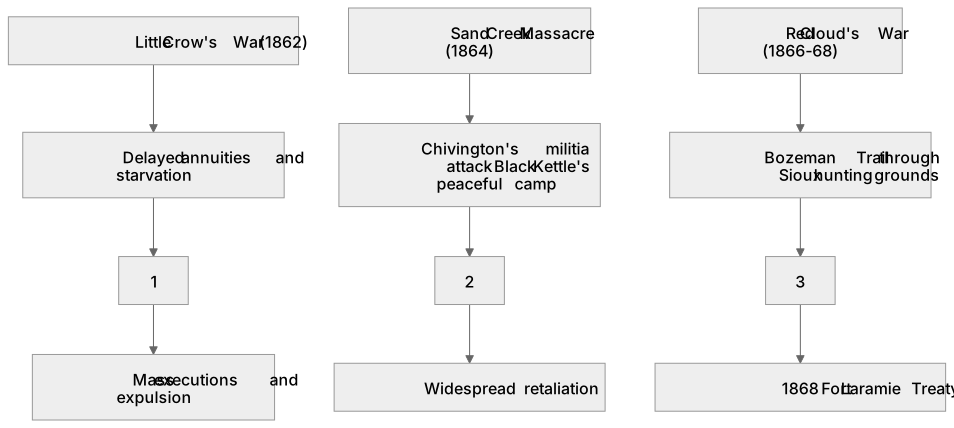
1Box 1
2Box 2
3Box 3
There is more to this lesson
The full lesson goes on to check your understanding and help you earn the marks. Create a free account to carry on, with your progress saved.
A week of Premium from your first lesson · Then the free plan continues · No card, no charge
Test your understanding of Option P3: Key topic 2: Development of the Plains, c1862–c1876 - 3 Changes in the ways of life of Indigenous peoples of the Plains: Conflict on the Plains: Little Crow’s War (1862) and the Sand Creek Massacre (1864), the significance of Red Cloud’s War (1866–68).
Active recall beats re-reading. Take an instant quiz now to test what you’ve learned and lock it into long-term memory.
A week of Premium from your first lesson · Then the free plan continues · No card, no charge