Pearson Edexcel · GCSE · History
Course version: 1HI0 · Version from Sept 2016
Key topic 2: Development of the Plains, c1862–c1876 - 3 Changes in the…
Full specification wording
Option P3: Key topic 2: Development of the Plains, c1862–c1876 - 3 Changes in the ways of life of Indigenous peoples of the Plains: The impact of railroads, the cattle industry and gold prospecting on Indigenous peoples.
The expansion of railroads, the cattle industry, and gold prospecting severely disrupted the traditional ways of life of Indigenous peoples on the Plains.
Checked against the Pearson Edexcel 1HI0 specification (opens in a new tab) on .
- Point 1 of 3
- 4 key terms
Study notes
From the checked teaching notes for this specification point.
The idea
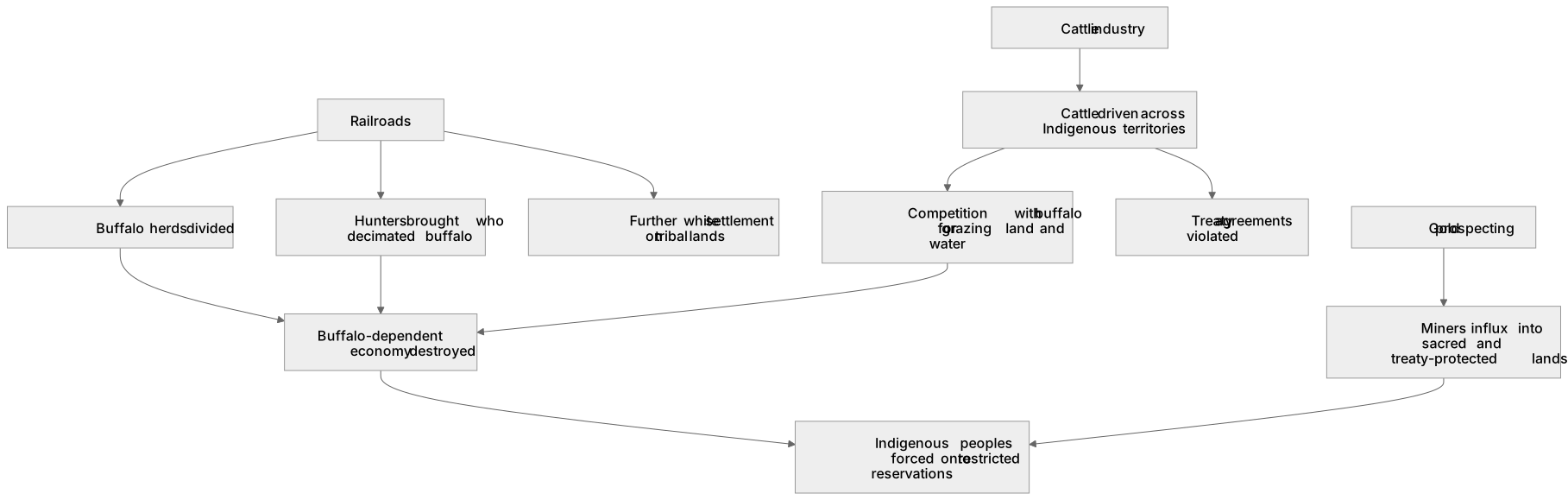
The expansion of railroads, the cattle industry, and gold prospecting severely disrupted the traditional ways of life of Indigenous peoples on the Plains. Railroad construction divided buffalo herds, brought hunters who decimated the buffalo population, and encouraged further white settlement on tribal lands. The booming cattle industry led to ranchers driving cattle across Indigenous territories, competing with buffalo for grazing land and water, and often violating treaty agreements. Furthermore, gold prospecting, particularly in areas like the Black Hills of Dakota, triggered massive influxes of miners into sacred and treaty-protected lands. This relentless encroachment destroyed the buffalo-dependent economy of the Plains tribes and provoked defensive conflicts, ultimately forcing Indigenous peoples onto increasingly restricted reservations.
What earns the marks
- Explain how railroad construction physically divided the Plains, disrupting buffalo migration routes and facilitating mass hunting.
- Describe the impact of the cattle industry, including competition for grazing land and the trespassing of cattle drives on Indigenous territory.
- Analyse the consequences of gold prospecting, such as the Black Hills gold rush, which led to the violation of the Fort Laramie Treaty.
- Evaluate how these three factors combined to destroy the buffalo-based economy and force Indigenous peoples onto reservations.
Common mistakes and how to put them right
Treating the three factors as isolated events.
Put it right: Explain how railroads, cattle, and gold prospecting simultaneously and cumulatively pressured Indigenous lands.
Focusing only on the physical conflict.
Put it right: Ensure you discuss the ecological and economic impact, particularly the destruction of the buffalo herds.
Stating that Indigenous peoples willingly gave up their lands.
Put it right: Emphasise that lands were often taken in violation of existing treaties due to economic pressures like gold rushes.
Exam tips
- Link the destruction of the buffalo directly to the railroads, as trains brought the hunters who slaughtered them for hides.
- Use the Black Hills gold rush as a specific example of how economic interests (gold) overrode legal agreements (treaties) with Indigenous peoples.
- When assessing impact, consider both the immediate loss of land and the long-term destruction of the nomadic, buffalo-hunting way of life.
Try the lesson
The start of the Option P3: Key topic 2: Development of the Plains, c1862–c1876 - 3 Changes in the ways of life of Indigenous peoples of the Plains: The impact of railroads, the cattle industry and gold prospecting on Indigenous peoples. lesson, made from checked teaching notes for this specification point.
Have a go first
How did the construction of railroads across the Plains negatively impact Indigenous peoples?
Listen
The expansion of railroads, the cattle industry, and gold prospecting severely disrupted the traditional ways of life of Indigenous peoples on the Plains. Railroad construction divided buffalo herds, brought hunters who decimated the buffalo population, and encouraged further white settlement on tribal lands. The booming cattle industry led to ranchers driving cattle across Indigenous territories, competing with buffalo for grazing land and water, and often violating treaty agreements. Furthermore, gold prospecting, particularly in areas like the Black Hills of Dakota, triggered massive influxes of miners into sacred and treaty-protected lands. This relentless encroachment destroyed the buffalo-dependent economy of the Plains tribes and provoked defensive conflicts, ultimately forcing Indigenous peoples onto increasingly restricted reservations. A strong answer earns marks for these points. Explain how railroad construction physically divided the Plains, disrupting buffalo migration routes and facilitating mass hunting. Describe the impact of the cattle industry, including competition for grazing land and the trespassing of cattle drives on Indigenous territory. Analyse the consequences of gold prospecting, such as the Black Hills gold rush, which led to the violation of the Fort Laramie Treaty. Evaluate how these three factors combined to destroy the buffalo-based economy and force Indigenous peoples onto reservations. A common slip: Treating the three factors as isolated events. Instead, explain how railroads, cattle, and gold prospecting simultaneously and cumulatively pressured Indigenous lands. Exam tip: Link the destruction of the buffalo directly to the railroads, as trains brought the hunters who slaughtered them for hides.
See it
Key words
Say what each word means before you turn the card.
Impact on Indigenous peoples
Try answering aloud or in your head before turning the card.
Economic expansion vs traditional life
Try answering aloud or in your head before turning the card.
Broken treaties
Try answering aloud or in your head before turning the card.
Environmental change
Try answering aloud or in your head before turning the card.
See every definition
- Impact on Indigenous peoples
- Railroads, the cattle industry and gold prospecting severely disrupted the traditional ways of life of Indigenous peoples on the Plains.
- Economic expansion vs traditional life
- The relentless encroachment of these industries destroyed the buffalo-dependent economy of the Plains tribes.
- Broken treaties
- Cattle ranchers often violated treaty agreements, and gold prospecting led to the violation of the Fort Laramie Treaty.
- Environmental change
- Railroad construction divided buffalo herds and brought hunters who decimated the buffalo population, while cattle competed with buffalo for grazing land and water.
Label the diagram
Some boxes have lost their names. Pick the right name for each number.
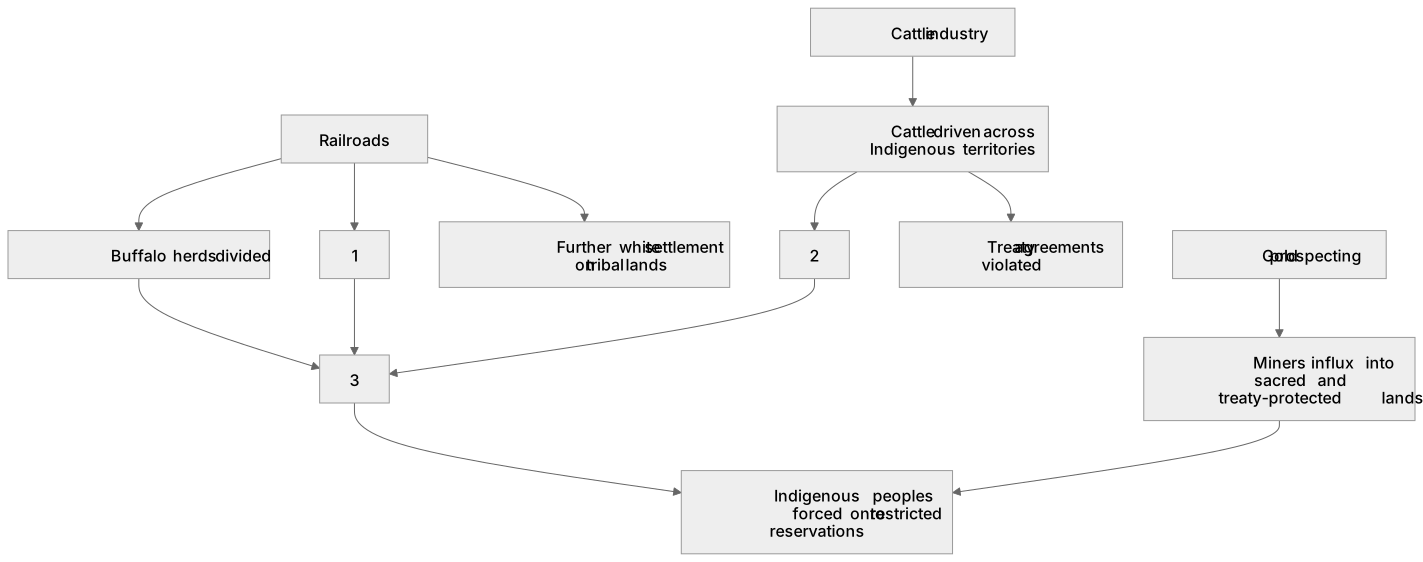
1Box 1
2Box 2
3Box 3
There is more to this lesson
The full lesson goes on to check your understanding and help you earn the marks. Create a free account to carry on, with your progress saved.
A week of Premium from your first lesson · Then the free plan continues · No card, no charge
Test your understanding of Option P3: Key topic 2: Development of the Plains, c1862–c1876 - 3 Changes in the ways of life of Indigenous peoples of the Plains: The impact of railroads, the cattle industry and gold prospecting on Indigenous peoples.
Active recall beats re-reading. Take an instant quiz now to test what you’ve learned and lock it into long-term memory.
A week of Premium from your first lesson · Then the free plan continues · No card, no charge